
Good morning.
I would like to thank the organizers of this wonderful conference,
and for hosting in your lovely city.
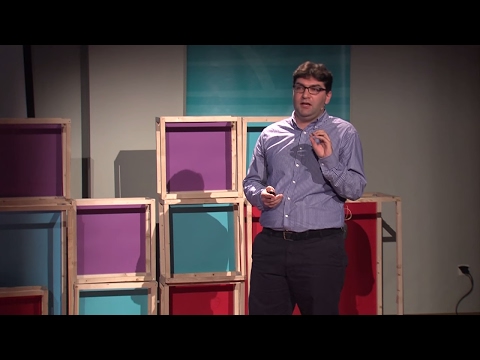
My name is George Laskaris
and I am a member of the MIT Adult Physics Group.
I am a postdoctoral researcher in this group,
and today I will talk to you about nuclear physics,
which is the science I have spent almost all of my adult life.
Speaking with my friends, before I go to the conference,
I was told that
– is out of physics –
and they told me that
“Look, nuclear physics does what it does
is to deal with bombs and energy production. “
I could not, therefore, begin my speech
with an idyllic image of an explosion of a thermonuclear weapon,
but also an even more idyllic picture of a nuclear plant,
which produces nuclear energy based on nuclear fission.
But my speech will not have anything to do with it,
at first we will talk purely about physics.
What are the research fields of physics,
or rather, what is physical?
Physics is the field of science, which is studying,
ie trying to understand matter,
either in very large or in very small dimensions.
The research fields of physics start from astrophysics,
which deals with the stars and with the Universe.
The typical dimensions of the stars or the Universe
is about 10 at 9 meters,
of the stars.
The next branch of physics is the natural condensed matter.
Natural condensed matter deals with molecules,
and how molecules determine the properties of the bodies.
They have a standard dimension of 10 in the minus 9 meters,
and here I am showing you superconductivity,
which is a classical application, now, of natural condensed matter.
Proceeding below we have individual physics,
and when we say atomic physics,
we mean the physics that has to do with the individual,
and we mean the nucleus, but also the electrons
which surround the core.
One person has typical dimensions of about 10 in the minus 12 meters.
Finally, it is nuclear physics, which obviously deals with the core.
The core, measuring 10 in the minus 15 meters,
that is, it is much smaller than all other dimensions
which we said earlier.
Depending on the field of physics we have,
each field of physics examines a distinct fundamental force of physics.
Starting from the most basic fundamental force of physics,
the gravity – and I characterize it more basic,
because gravity is the power that everybody understands.
Gravity, then, is examined by astrophysics.
Electromagnetism, which is also a fundamental force,
is being considered by the field
natural condensed matter and atomic physics.
The weak nuclear power, but also the strong nuclear power,
is obviously being studied by the field of nuclear physics.
Because in life everything is relative, so in physics it is relative,
and physicists have determined
that the power of the nuclear power is equal to the unit.
If the power of the nuclear power is equal to the unit,
then the weak nuclear power is a million times weaker
by strong nuclear power,
electromagnetism is 1000 times weaker
by strong nuclear power,
and gravity is 10 to minus 37 times
weaker than strong nuclear power.
You understand, then,
that nuclear physics examines power that is the strongest force
which exists in the Universe.
But what is nuclear physics?
Nuclear physics is a field that has begun
in 1910 by Rutherford, who did what he did
was to scatter alpha particles, which are particles of helium,
on gold leaves.
Most of the alpha particles passed through the gold leaves,
some of the particles receded.
What has been observed led to the conclusion
– because alpha particles were positively charged –
that there was something positively charged in the people,
which was local, that looked like the core.
So they discovered the core,
and after about 20 years
Chadwick, who was awarded the Nobel Prize,
discovered that, in addition to the kernel,
which is a proton in this case,
there is also the neutron, which is neutral charged,
ie it has no load,
and which has about the same mass as the proton.
These two discoveries together led to discovery
of nuclear physics as a field of research.
So what does nuclear physics do?
What is the purpose of her research?
The aim of nuclear physics research,
is to examine the kernel.
The core, which in dimensions relative to the individual,
is very, very, very small, to a huge person.
The first objective of nuclear physics,
classics, is the understanding of nuclear power,
which is like glue,
that sticks the protons and neutrons together,
and the second objective of nuclear physics
is to understand the structure of protons and neutrons.
Now, we are talking about nuclear physics and we must have some tools,
to find out how the kernel works.
And one of the tools is scattering experiments.
Scattering experiment –
scattering is a word, perhaps, difficult, scattering means conflict –
so we have the conflict experiments.
Most people when they try to break something,
what they are trying to do is find a recess,
if they are lucky and have a key, open it with a key.
In fact,
when they can not do anything of this,
decide to break the object, and see what it has inside.
This basic thinking of mankind,
is being applied to nuclear physics.
Physicists, then, have a goal, try to break a person,
or a core, or a target.
Heavier people, that is.
To do so use a hammer,
which is the accelerator.
The accelerator, in this case,
is the LHC accelerator at CERN in Geneva, Switzerland.
So they hit the target with the hammer,
and the target breaks and pulls out some particles that we detect.
In the case of people,
the detector is their eyes or their other senses,
and find that something broke.
In this case it is a huge machine
which usually makes billions of euros or dollars,
and detects the broken particles.
The whole picture of the core we have since the last century is
that they are some balls, nucleons,
protons and neutrons,
inside a basket, the basket of the core.
But this is the sense of the nuclear physicists,
those who study the subject.
The feeling I had formed in elementary, high school, and high school
was that the core is static.
There are protons and neutrons, they do not interact with each other,
they sit there, and they do not move.
This impression is completely wrong, as you understand.
And I think this impression
most people have it,
with whom I have spoken, apart from physics.
The discoveries, in recent years, of technology
have led to corresponding discoveries in the scientific fields.
It would not be an exaggeration to say that all the discoveries
of the 20th and 21st centuries
equals all the discoveries of mankind
which have occurred since the beginning of mankind to this day.
The same in nuclear physics.
Discoveries that have occurred in recent years,
due to the corresponding discoveries of the technology,
have led to discoveries that equate to all the discoveries
which occurred at the beginning of the last century.
Recent discoveries of nuclear physics
refer to the relationship of nucleons.
Nuclear physics has discovered that nucleons,
instead of moving quickly into the core,
besides that, they also have some kind of relationship.
How did he do that?
This is a core in its classical form,
that is, neutrons and protons, they do not move in my image,
but you imagine they are moving.
To take a photo of the kernel we need to do a scatter experiment,
that is, a conflict.
We have an accelerated particle, which is scattered over the core,
on a proton, the proton leaves the core
and we can detect the scattered particle,
but also the proton.
The apocalyptic is that we have discovered that along with the proton that is scattered,
at the same time a neutron is emitted.
Which means that the proton and the neutron,
in the kernel had an initial relationship, ie they made a smaller core.
This discovery is very important,
because it is not a 1% phenomenon,
but it is a phenomenon that is about 20% of the nucleons,
they are in some kind of relationship to one another.
This discovery led to several publications
from the MIT Adrenal Physics Group,
which refer to either particle physics,
either in nuclear physics or in quantum, astrophysics,
neutrinos, and atomic physics.
That is, the team of astronaut physics has made various discoveries
which refer to various fields of physics.
Our discoveries were published in various magazines,
such as Science and Nature,
and the CERN Courier, the official CERN magazine.
I could say more here
for research applications of nuclear physics,
but I would like to say about the applications you all know.
Applications of nuclear physics are X-rays,
which we use either for medical purposes,
either for product control.
Another famous application is radioisotope drugs,
which we use in the fight against cancer.
Another application is –
here you see a nuclear reactor,
and the fuel rods that we produce nuclear energy.
And of course, I’m sure the last application is used
more widely in Thessaloniki by archaeologists.
It is radio timing,
where archaeologists can date their findings,
the finds on the earth.
I could, therefore,
here to stop my speech and not to say anything else.
But I would like to add something else.
When the organizers of the conference called me,
and they said to me, “Come on, give a speech”
what I thought – I was negative –
and I said “OK, what a scientist wants,
which usually goes all day in a workshop,
in a TEDx speech? “.
It’s “too fancy”.
When I asked one in my lab
tells me “it’s too fancy, you can not go there”.
Afterwards, I rethought and changed my mind,
and I said that with excitement I will come.
And I thought about it again, because when I was young
my first contact with nuclear physics
was when I opened the book of the fifth grade
and we did a lesson that said the kernel is like a pine nut.
The pine nut opens in the summer and takes off its seeds.
In the same way the kernel at some point, on its own,
opens and emits particles and transforms the core itself.
From the moment I saw
that a body on Earth can be transformed by itself,
without causing him to transform something else,
I was in love with the field of nuclear physics.
And I think the beauty of nuclear physics
is not hiding in her power,
but it hides what he can tell us about the world.
Thank you very much for your attention.
(Clap)
”
Be First to Comment