
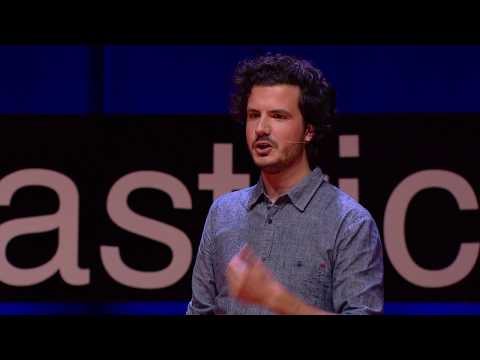
Who ever thought about the past year: I work too hard?
Put your hand up.
Wow, look around you.
That’s a lot of hands.
And statistically, that was to be expected.
Just look at these numbers.
This is the percentage of the workforce in each country
that almost feels overworked.
And added up, these figures come to millions of people worldwide
who are against a burn-out.
So you could say
that we live in a burn-out society.
In the past, a car was a status symbol.
Look at how proud this guy is.
Today, in the burn-out society,
is ‘being busy’.
Every time someone asks how it goes with us,
we react almost instinctively with:
“Oh, so busy.”
Imagine you would answer:
“Well, I feel pretty relaxed actually.”
You would seem so unimportant.
(Laughter)
Yet?
And precisely because we are always so busy with making the best CV,
or working on the best body, or getting the most likes,
or go on the most original holiday,
we destroy ourselves from early in the morning until late at night.
And every day we plopped exhausted on the couch
to start the next day from the beginning
with a bulging inbox.
It happened to me too.
I was totally dragged into the rat race of endless self-improvement.
You could say that I was addicted to it.
That was because I had a problem ten years ago …
Every time I wanted to have a toast at a family dinner,
during Christmas, for example,
the wine sloshed from my glass,
because I was terrified to speak in public.
Every time I had to speak to a group of people,
my hands began to vibrate tremendously.
This was a bit uncomfortable for my family,
but it really became a problem when I got my first job.
I was 20 years old and had to keep talking for my work.
At one of those presentations my boss was in the back of the room,
a bit smaller than this, and he said nothing.
But a few days later he walked past my desk
and he put something down.
It was a book.
I picked it up:
a self-help book about speaking in public.
Very subtle.
(Laughter)
So I read the book – he was my boss –
I read it twice
and I practiced and practiced,
and slowly but surely my hands began to shake less.
And then I thought:
What else can I improve on myself?
I started reading self-help books about organizing, negotiating,
work more efficiently, earn money, spend money, save money, play sports,
make lists, do nothing, sleep, etc., etc.
And I started to improve myself, simply because it was possible.
Around me, I saw people suffering from the same problem.
They could, just like me, answer emails at lightning speed,
but with a grim face and tense shoulders.
I thought about my work permanently, continually taking aspirin.
But as I said, I saw my colleagues and friends suffer the same.
Every time I went to a party,
I heard about someone with a burnout.
As I said, a true epidemic.
I wanted to know what the cause was,
again came out with self-help
and went into the world of positive psychology.
And I roughly learned two things.
The first is that we are in a burn-out society
consider life as a competition.
All goals that are said to be worth it –
from money to popularity –
are always measured in relation to other people.
We must therefore always have more than others.
The second thing I learned:
it is a pretty bad idea to see life as a competition.
Because it is a competition that you can not win anyway.
No matter how successful we are,
there is always someone who seems to be doing better.
Take a professional football player, for example.
He lives the life that millions of children dream of.
But he is probably jealous because Lionel Messi is still there
and that is the best football player in the world.
What about Messi?
He’s probably jealous too,
because Cristiano Ronaldo, his biggest rival,
wins all prizes.
What about Ronaldo?
I think he is also pretty dissatisfied,
because, yes, they always say that Messi has more talent.
So it does not matter how successful you are:
even if you are at the top,
someone else always seems to be doing better.
And if we know that, and we count them together –
the exhaustion of working too hard, as most of you do,
and the empty promise of success –
then you have the recipe for burn-outs.
So now we know this.
What is the solution?
It is stupid:
we already know what the answer is.
All the research I did about happiness seemed to confirm the obvious.
We know what makes us happy.
These are things like helping other people,
or spending time with people we care about,
or in a ‘flow’ –
that is when you are completely swallowed by what you do and forget the time –
or have fun learning a new skill,
instead of focusing
on what other people think of your performance.
And one last: gratitude.
Countless studies have shown
that people who appreciate what they currently have,
more often happier people.
So when I read about this in all self-help books
I began to nod enthusiastically and I said to myself: “Yes!
I am going to change my approach. I will do everything differently.
There’s a list, and I’m going to do everything. “
And then, two weeks later, I had forgotten it smoothly again.
Instead of building LEGO castles with my son,
I still worried and worked through in the evenings.
And instead of spending time with my wife,
I still checked my e-mail every two minutes.
And instead of enjoying my work,
I was still busy with what others would think of my work.
So I knew exactly how to be happy,
but I could not keep to the rules.
And I think this is because everyone,
the media, ads, the race to get likes,
tells us to pursue other goals.
Goals like money,
or popularity
or power.
And these are precisely the things that do not make us happy.
So despite that we know what makes us happy,
we keep forgetting it.
And then, one day, after a bunch of self-help books,
I thought I knew it.
I think we need daily rituals
to remind us what really makes us happy.
Just as we brush our teeth, or shower for our physical hygiene,
we also need rituals for our mental hygiene,
so that these insights about happiness are just as natural as brushing teeth.
This ritual works for me.
Every day I write three things that I am grateful for and why.
And it has become my daily memory
what really matters in life.
This is, for example, what I wrote last week:
“I am grateful that I could read my son,
because I liked to focus entirely on him. “
And that is what almost always concerns me,
about the times that I am completely there for the people I care about.
And this ritual helped me to see that.
I encourage you –
Of course I also have lesser days,
but it made me happier.
So I encourage you to find your own daily ritual.
That can be showing gratitude,
like I do,
but it can also be something else,
like meditation.
And then, if you do that, we will go one step further.
Because even if you and I succeed
to escape the burnout society,
there are still millions of people suffering
under the constant pressure to perform.
Imagine that you and I are colleagues and we have our workload under control,
then we still have colleagues
who suffer from the threat of being overworked.
And that’s because a personal burn-out
also has social reasons.
It is not just someone’s own fault.
For example, it may also be due to an unhealthy working environment.
We can only effectively tackle this together.
So the question is:
we want to live in a society that works towards a place
where most people feel overworked and exhausted,
where there is no place for creativity
and in which we no longer have the time and energy
to have good conversations with friends?
Do we want that?
No! Of course not!
So let’s fight back together, let’s say:
“We are not available in the evenings.”
Because that’s when we spend time with family and friends.
Let’s turn off our notifications during dinner,
so that we can fully focus on the people we are with.
And when we’re out there for ourselves,
let us then help our friends, family and colleagues do the same.
Let’s beat the burn-out society together.
Thank you.
(Applause)
”
Be First to Comment