
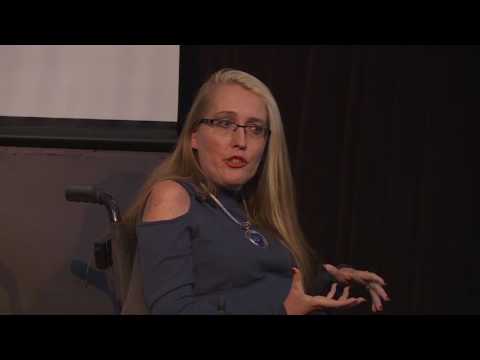
So, hello everybody. Officially.
My name is Lesa Bradshaw, thank you for the introduction.
So my talk today aligns beautifully to the topic of ‘It’s About Time’,
but I’d like to add a little bit more of an exasperated spin to that and go:
It is about time we got this show on the road
in term of disability integration in the workplace.
So right now, if you have a disability in the workplace, you are hot property.
Finally, after many centuries, we’re having our moment to shine.
And the reason is because we’ve got companies that actively going out to seek
people with a disability to employ, right?
In South Africa, if part of you have been down our road to democracy,
you’ll know that we’ve spent a lot of time and money and effort trying to understand
how we got to a place where we’re judging peoples abilities based on them belonging
to a particular group and how we assign people’s abilities
according to our stereotypes of what they can and can’t do.
We spent a fortune as companies promoting diversity and saying,
“Well, you know, it’s just differences, it’s just diversity celebrated”.
We spent a lot of money looking at each other and going:
“Wow, you know, gender and race and all the rest of it, it adds to our value.
We can’t judge people based on our stereotype understandings”.
So I’ll ask the question: Why is it that people still approach me
with that sing-song pity voice and give me the cognitive credibility of a 5 year old?
And they come and say: “Hello!”,
(Laughter)
“And what’s your name?”
I mean the other day flying up to Joburg, it was this week in fact,
I get lifted up of the little skinny chair and I get put onto the seat,
and they take the wheelchair away and this lady leans over and she goes:
“Shame, lovey, are you okay?” So I said: “Yes, I’m fine, thank you”.
She goes: “(Tuts) Ah, shame… Are you going to Johannesburg on holiday?”
And I said: “No, no, I’m going up on business just for the day”.
“Wait, you work?”
(Laughter)
And I said: “I do”, and she goes:
“You know, it just shows you, you people are so brave”.
And I look and I think: Really? I’m not a firefighter. I’m just going to work.
You get credibility for doing absolutely nothing.
I’m buying a pumpkin the other day at Fruit & Veg City and someone told me
I was courageous. And I said, well, what’s wrong with the pumpkin?
(Laughter)
And you’ve kind of got to ask yourself:
Why is it that I’m getting credibility for not doing much?
You give it a bit of thought and you realize it’s because
people have set very low benchmarks of expectations
for people with disabilities.
So if you do something normal, people go: “Wow, you champion!”
And you go: “Not so much, really.” OK?
And why is this? It’s because we don’t understand disability.
Because we see the disability and we judge people’s abilities based on that.
OK. Now, the problem in the workplace is if you have low benchmarks,
then you don’t see the value that the person can actually add
to your organization.
So what happens is you panic a bit.
So the Labor Department goes: “(Tuts) You must reach your two per cent”.
And you go: “Alright, alright”, and you dash down and you go:
“Uh, eh, I don’t know about this, you know?
Because we’re a very busy department, can’t really have disabled people here,
it’s too dynamic, it’s too busy”.
Because you’re judging it on your understanding of someone
sitting in a wheelchair with a crochet blanket perhaps budging a bolt on a nut.
(Laughter)
That’s not disability.
And the other problem with that is we tend to assign which jobs
we feel are suitable for people with a disability.
So the starting strategy of a company doing a disability inclusion process
is, we go: “Well, now, which positions are suitable for the disabled?”
And usually it’s like: switchboard, call center.
OK, and my question is: Do you also say,
“Well, which positions in our company are suitable for black people?”.
When you say that people go: “Aah, ay, that’s not right, that’s discriminatory”.
And I go: “Well, why?”
“Well because in the category of black people, so to speak,
there is such a vast arrangement of different potentials, and skills,
and knowledge, and personalities, and motivation.
You can’t say: “Which positions are suitable for black people?”
So why is it OK to decide which positions are suitable
for disability, and people with a disability?
It’s because you are thinking: blind, deaf, and in a wheelchair.
So you’re thinking from functionality perspective.
Well, the reality is, disability includes a huge, wide range of impairments
which may or may not disable you,
depending on what context you’re operating in, right?
So, here is the thing.
We’re 22 years down the line towards democracy,
and we’re still no closer to integrating people with a disability.
In fact, in some provinces, the representation in the workplace
has actually dropped.
So not only are we not getting it right, we’re doing it wrong. OK?
So, what do we do?
And here is my thing: It’s that you have got to stop deciding
what people with a disability can and can’t do, right?
The problem that we’re doing is we’re trying find people with disabilities
that fit into our existing structures.
So if you can find someone that’s missing a pinky: Woo-hoo!
We can check the equity box (Clicks) and there we go.
Or somebody with a minor hearing impairment in the left ear.
But when it’s, “We’ve got a candidate with schizophrenia”, they’re like:
“Ah, ah, ah, no, no: We can’t have people coming to work
with axes and chopping people up, you know, that won’t do at all”.
Because that how you understand it, right?
So, we need to get companies to understand,
or employers to understand, that disability integration
is not about finding disabilities that suit your structure;
It’s also about changing your structure to suit people with a disability.
So let me give you one example. The Matric minimum qualification.
90% of our company, whoever they employ, your minimum requirement is a Matric.
Whether you’re sweeping the floor, packing a box, making a cup of tea, or the CEO.
And I say: “Why?”.
And the company will say: “Because we do succession planning”.
So I go: “Well, listen, here is the problem:
If you look at our special needs schooling system in South Africa,
– if you think our main stream schooling system is bad, it is horrific –
because we don’t have the resources, so we don’t have the right skills,
we don’t have money to resource from an assistive device perspective.
I had a candidate that came in for an interview and I assumed
he was visually impaired because he went to a school for blind children,
or visually impaired children.
He came and he was in a wheelchair, and I was like, “OK, what’s up with that?
You know? What’s happening there?”
He said: “There was no other disabled school in my area,
so I had to go to the school for the blind”.
And I’m like, “Really?”
OK. So do you see the problem of categorizing the disabled as a group?
Ok, so, here’s what we need to do. We need to be flexible.
We need to think: what is the purpose of the Matric certificate
as a requirement?
It’s to train and develop. So, start your training and developing one step back.
Do a bridging program with that person, to help them get their Matric.
And then move on to the next step.
It’s flexibility, but people panic when you don’t have a one-size-fits-all policy.
Now, you don’t have to go and change your company policies to say:
Well, now any person with a disability doesn’t have to have a Matric.
It’s specific to individual cases. So you use a little bit of judgement.
Does this person have equal access to schooling? No
Did this person manage to get a Matric?
No, but they managed to get a grade 10 or 11.
Do they have learning potential to learn in this job? Yes they do.
Do they have the right attitude? Yes they do
It’s a no brainer, if you ask me.
OK. So. Let me take this back
and contextualize it in our topic of ‘It’s About Time,’ right?
It’s about time that we stopped associating disability with charity only.
Right.
There are a lot of people with a disability that will and need to
benefit fit from a charity.
The same as there’s a lot of people without a disability
that need to benefit from charity.
But it’s not a synonymous term. Right?
So if we’re approaching disability inclusion in the workplace
from a social responsibility perspective, it’s not going to work.
If you’re doing it as a value-add transaction:
this person is going to bring value to my organization
and I’m going to bring value to that person, then it’s sustainable.
I read a very interesting statistic the other day, it had me giggling.
It says that it’s estimated that of your working age population of people
with a disability that are around today, 70% of those people actually
acquired their disability at some point; they were not born with it.
So I’m just saying, from a risk management perspective.
The older you get, eh!
It’s really going to work to your benefit to start getting it right now,
put things in place, right?
The other thing is disability is just diversity.
It will be normalized, the same as gender and race was, once we just get used to it.
And you know, you think disability is abnormal but it’s actually not.
They estimate between eight and 12% of the population have a disability.
That’s a lot of people.
And I just have to relate it to my post-divorce dating game:
you’re drawing from single men over 40, there’s your pool, right?
Now, they’ve got to have a strong back because there’s no point
in me dating someone who can’t pick me up.
(Laughs)
And, zooom, your pool goes to that.
I mean, there’s a lot of pedestrians out there that are on a slippery slope,
you’re not that far away from disability yourselves.
So, it’s really not as uncommon as you think. Alright.
The other thing is, we have to, it is about time we stopped thinking about
disability as something medically wrong with that person.
Disability is not about what’s broken in you, it’s a dynamic between you,
your impairment, your personality, your upbringing,
your opportunities, and your environment.
So I want to give you an example: What about somebody of short stature?
So somebody, lets just say, you might know
somebody as having dwarfism, is the common term.
That person is functioning absolutely perfectly
There is nothing, actually,
that is impairing that person, right?
Until you put that person
in an environment that is built for average height people.
So, your cars are all built for average height people, your modes of transport,
your production lines, your manufacturing equipment, your machinery,
your hospitality areas, these ridiculously high desks at reception,
and your banks where all they see is my hand flapping around the counter
and that’s how they know someone’s here.
OK, so, you don’t actually have the disability
until you’re placed in a context that disables you.
If you can get this right in the workplace, stop worrying about
all the lists of disabilities so you can look on your checklist and go:
“Hang on, you’re not on the list, you don’t have a disability, sorry”.
Look at the person, look at the function and the job that they’re going to be in.
Decide: what is disabling them?
And see if you can remove or minimize that barrier.
That is reasonable accommodation.
OK? So, I did my MBA thesis on disability integration strategies
and one of the things I really enjoyed
was to tell companies these little snippets of information.
I know that the principal driver of disability inclusion
is because we want to comply with the labor legislation,
because we know it’s part of diversity, because we have to do it to be
an equal opportunity environment, or cultural country.
But there’s also a little bit of a competitive edge
you’re forgetting about right here, OK?
And here it is:
They reckon that about 20% of the consumer population
is directly influenced by disability in some way in the decision making.
So although eight to 12% of the population have a disability,
they all have friends and family, and spouses and children,
and so that factors into their choice of consumer behavior.
So if I want to go to a restaurant for dinner, for supper,
I will choose the accessible restaurant over the non-accessible restaurant,
and maybe that restaurant is accessible because
they employed somebody with a mobility impairment.
So, I go to that restaurant.
And so do the 15 people that I was going out to supper with that night.
So can you see the consumer impact? 20%
The other thing is, from a branding perspective,
it gives you the same positive, touchy feely image
as it does when you say you’re environmentally, you know, friendly
and you’re going green; we get the same green status.
OK, so, there’s this restaurant in Cape Town
I heard heard about, I think it’s fabulous.
It’s called Brownies and Downies.
And what this restaurant is, is they employ people
with intellectual impairments or learning impairments,
or people with Down Syndrome.
And it’s a training organization so they train on all hospitality related skills.
But they also sell their product as a restaurant and people come there.
And it is very, very popular. Do you know why?
People like to see people being empowered, It makes them feel good.
So their prices are high, their food is good, and they are very busy.
You’re spotting the competitive edge here. It just makes good business sense.
So I wanted to wrap up by saying this: When it comes to disability, don’t panic,
it’s just diversity. We’ll get used to it, don’t worry.
OK, the second thing is, no more meetings about it,
no more bits of written legislation, we’ve got all of that in paper
and it’s time we put it in practice. Get going. Consult with the experts.
Get help, do it right from the beginning. OK? But get moving on it.
It’s about time we got this show on the road.
”
Be First to Comment