
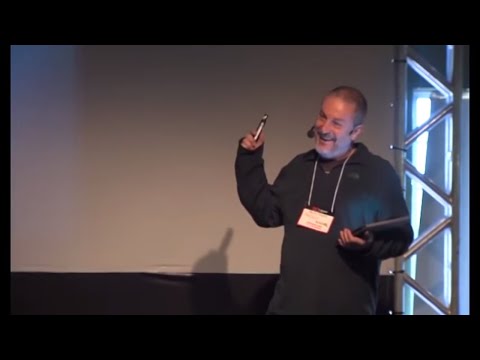
[That all children can have a dream]
and are able to follow it,
creating a fair and self-sustainable society.
(Video) Fernando Pressler: I’ve changed a lot.
I could be smoking marijuana right now, or crack, or something,
just like my friends.
Or I could be dead, right?
Or in jail.
I’ve changed a lot.
Marcelo Ruschel: The friends to which Fernando refers to
when this video was made,
two of them have been arrested and one has been killed.
I’m here to talk about social initiative and social transformation.
Thirteen years ago, I founded a project called “WimBelemDon,”
which is a social project that teaches tennis
and supplementary schooling
to children and adolescents in Belém Novo –
a neighborhood in the south of Porto Alegre.
The name “WimBelemDon” is a combination of “Belem Novo” and “Wimbledon” –
a tribute to the most traditional tennis tournament in the world.
We started off as almost any other social initiative:
with a lot of love and goodwill, and with a pinch of creativity.
Every time I’d go from my home in Belém Novo
to my downtown office,
I’d pass in front of an abandoned court,
and I’d wonder how many great things could be done in this place.
One day a “For Rent” sign appeared,
and the first thing I did was quickly sign a long-term contract.
As a photographer,
I had no idea where to start and what I could do,
I only had this cool name and goodwill.
(Chuckles)
This was in October of 2000.
The project started in March 2003 with 40 children,
then doubled to 80,
and today we offer daily tennis lessons to over 100 children and adolescents,
and also mandatory weekly workshops in math, Portuguese, English, psychology,
and a film and video workshop.
Right from the start,
we always ask this same question
to all the children who enter the project:
“What’s your dream?”
You don’t need to be a mathematician to come to the grave conclusion
that they had no idea what they wanted to be,
of what they wanted for their future.
The less privileged of our society
lose their ability to dream.
Except that, very different from how it was long ago,
today almost all houses have television.
So they can’t help but see those wonderful, fantastic commercials
where having a big car or a certain brand of sneakers
is a synonym of happiness.
People get that very strong yearning,
that false need to obtain that product, that happiness.
There are children who kill for a pair of sneakers.
It’s exactly here
where one of the fundamental aspects of sport comes in,
which is knowing how to lose, to tolerate frustrations.
And you must be wondering, “OK, but why tennis?”
I’ll borrow a phrase from the American Arthur Ashe,
who was the first black tennis player to win a Grand Slam tournament.
He fought against racism and poverty in the world.
“The practice of tennis helps children:
develop work ethics and discipline;
deal with errors and solve problems;
take responsibility for their actions;
control their emotions when facing difficulties;
deal with stress, pressure, and tension;
make decisions through planning the best strokes and strategies;
develop effective performance rituals;
develop sportsmanship and social skills;
win with dignity and lose with honor;
and develop team spirit and communication.”
In these more than ten years of activity, we have proved in practice
that all these phrases from Arthur Ashe do work
and are absorbed internally by our children.
Any individual sport, and especially tennis,
helps children discover
that they can overcome obstacles by themselves,
and win the game.
They develop skills and attitudes
that allow them to subsequently become integrated into society.
So, going back to our vision, there at the beginning:
“That all children can have a dream and are able to follow it,
creating a fair and self-sustainable society.”
And our mission says:
“Through the teaching of tennis,
together with reading and supplementary schooling,
to help develop skills and attitudes in children at social risk,
enabling them to participate actively in Brazilian society.”
We did not invent anything at all.
We only use this combination of sport and leisure
with learning and supplementary schooling.
And, as I mentioned before, with a pinch of creativity.
So, four years ago, we invented the Summer Olympics,
which are activities and team games, to score points,
as an optional activity.
Both morning and afternoon students get together every morning
when it’s less hot, when the temperature is lower.
The teams involve children from 6 to 18 years,
enforcing integration, communication, patience, and tolerance.
The success of this event officialized the Summer and Winter Olympics.
The top ten participate in something which we call “The Perfect Day.”
They spend a day in a club,
complete with lunch, swimming pool, football
and, naturally, a lot of tennis – it couldn’t be otherwise.
This always happens during the school holidays.
It was a little controversial, but it was very positive
when we introduced the competition,
the trip to the tournaments.
It’s amazing that even after losing the first rounds,
during the first tournaments,
the kids would return with a contagious happiness.
They’d return much more motivated to our training sessions and workshops.
It was as if they suddenly understood and discovered
that from that time onward
everything would depend on them,
that they could dedicate themselves more, focus more,
and that they could win the game.
And this game, ladies and gentlemen,
of course, doesn’t have to be a tennis match, right?
This change in attitude is impressive.
From that point on we were invited to go, with zero cost,
to several tennis tournaments.
Another cool thing is our evaluation system.
They are evaluated monthly, in all workshops,
for behavior, attendance, and commitment.
These aren’t tests.
This evaluation, together with their school performance,
is decisive in choosing who is going on the outings
and who is going to the tournaments.
Well, it seems like everything is perfect, everything is wonderful,
but of course, we’ve encountered a lot of difficulties along the way,
and we still do today.
For example, due to some opportunistic minorities
who pass through the third sector,
there’s a very big distrust in relation to NGOs.
We’ve faced this difficulty
adopting all the principles of good management and transparency,
including having an entire chapter about our case
in a book called “ONG – Transparência como Fator Crítico de Sucesso,”
which talks about the pilot project that the Inter-American Development Bank
developed together with the NGO “Parceiros Voluntários,”
training 76 NGOs in Rio Grande do Sul.
Another problem was with prejudice.
“Ah! They don’t need money, they’re a rich NGO!”
“They’re always in the media, Meligeni always helps them!”
“They’re involved with tennis, a bourgeois sport!”
It’s with remarks like these that we have to face our challenges.
Einstein said that it’s easier to disintegrate an atom than a prejudice.
Social inclusion with an elite sport.
Deconstructing paradigms?
We’re stubborn, we’re pushing hard and overcoming this every day.
Our neighborhood is far from the center of Porto Alegre.
People complain that it’s very far.
This makes it difficult to invite people, entrepreneurs,
to see our work.
We felt the need to create an event
that combined social initiative, gastronomy, fun, and lots of tennis.
That’s where “Rolando Arroz” came about.
It’s an allusion to the charming French tournament of Roland Garros,
and it’s an eight trio tournament,
where a student from the project,
a professional tennis player, and an entrepreneur
play a really fun tournament.
Students are defined by our internal ranking.
Those not playing are ball boys/girls
and all the others participate in the “Arrozlimpíadas,”
which is a tidier version of the Winter and Summer Olympics.
The highlight of the Olympics is the mimicking,
where players who are not on court have to participate in one of the teams
and represent with gestures some word to score points.
Throughout the four editions, we invited several professional tennis players
who participated voluntarily in the “Rolando Arroz.”
Last year, Gustavo Kuerten gave us the honor of his presence,
attracting over 1,000 people to our event,
where we served over 600 servings of risottos,
tens of kilos of rice cakes – which were wonderful –
and all made by 11 chefs, all voluntary work.
We believe that our best means to assess the positive impact
and the results obtained along our journey
is the verification and monitoring of our students and ex-students.
(Video) Leonardo Baltazar: Now I also have the opportunity
to better my future by learning tennis, English, reading.
It’s a great chance for us to have a better future.
MR: Leo was 13 years old in this video.
Tell us a little more, Leo.
(Video) LB: I think I was a person who’d give up too easily on things.
Here, in the project, I learned to be persistent, very persistent.
Especially during the match, it was difficult to give up a point,
and that helped me a lot in my personal life.
If I hadn’t entered the project, I don’t even know what I’d be today.
I’ve met players who have gone through the same things that we have.
They came from favelas, and today they are great players.
I think the story that struck me the most
was when Feijão came here and told us his story.
I was very surprised,
and listening to him made me want to continue in the project even more,
carry on and believe that we’ll have many chances ahead.
MR: Leonardo Baltazar, now 21,
is completing his last assignment in Mathematics
at the Federal University of Rio Grande do Sul.
He also passed the entrance exam this year in Actuarial Science.
And not only that,
he even knocked on our door to be a volunteer in the math workshop.
(Video)
Jaleska Mendes: The project changed my life.
I wasn’t doing anything at home.
And now every day I have a reason to get up and come to the project,
knowing that I’ll feel happy inside.
MR: This is Jaleska Mendes,
she entered the project at the age of nine.
Today she’s 18, her last year in the project.
In 2011, she took part in three tournaments,
was champion in one of them.
In 2012, she played in four, won three titles,
and this year she has already won three tournaments.
Our goal is not to create great tennis players, but great citizens.
We all knew deep down that she was only in these tournaments
because she was doing well in all our workshops,
and, of course, in high school.
In March, Jaleska participated in an international tennis tournament,
where she lost in the last qualifying round.
This game lasted almost three hours
and, from the third and last set, she began to feel cramp pains.
She fought hard, lost, except she lost with her head held high.
And she was rewarded.
She won a sponsorship from a great brand of rackets,
and she also won a full scholarship in 2015
to study in an American university.
And best of all: doing what she likes most which is playing tennis.
She knows she has the biggest challenge of her life.
She has to keep going well at school with good grades,
she has to continue doing well in the workshops,
she has to also continue training and playing well
to be able to represent a university.
But, anyway, we know it won’t be easy,
especially because next year, at the end of 2014,
she has to pass two exams as if they were entrance exams:
TOEFL and SAT, both in English.
Anyway, it’s a great challenge.
We’re rooting for her, but to us, she’s already a great champion.
Folks, what I’ve just shown here is called social transformation.
It seems that we believe as an absolute truth
that either we do good for ourselves and for our family,
or we do good to the world, to others.
That we have to choose one way or the other –
which is great nonsense.
In fact, this must have been invented by someone very lazy –
not one of you here.
(Chuckles)
Social transformation does good,
it generates well-being, and not only in other people.
To witness social transformation, co-participate in social transformation,
or even promote social transformation –
this makes you feel good.
But you don’t have to be special or a hero
to start creating well-being.
Do you believe in Santa Claus, in Batman, in Wonder Woman?
Would you wait, for example,
for Superman to solve all our life problems,
to save our planet?
Of course, there were many special people
who transformed, who made great changes:
Jesus Christ, Buddha, Mahatma Gandhi, and many others.
But I need to stress that anybody can start a social initiative.
It’s easy. Everybody can.
Just take one step at a time.
You’ll get there.
Begin, for example, by switching “no” for “why not?”
Use this mantra several times in your day
to take the first step; it’s easy.
The Tibetan monk Gampopa said, back in the 10th century:
“The more we expand our focus
to include the interests of others as well as ours,
the stronger we build the foundations of our own happiness.”
Folks, it’s never too late to be happy, it’s never too late to start doing good.
You only have to start with “Why not?”
Thanks a lot.
(Applause)
”
Be First to Comment