
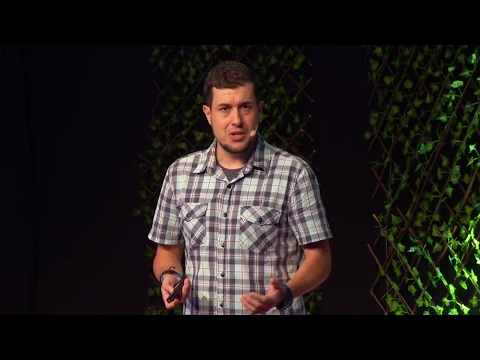
We need to make the invisible visible.
As a professor of biology,
my daily life has always had invisibility:
when I was looking for a bacterium through the microscope,
or when I found only the footprint of an ounce
on my way through the woods.
But it was through an invitation from some students
that this concept has been expanded.
They had invited me to participate in a photography project
within a program of scientific initiation
which would last two years at school.
That moment,
both I and they had the same level of knowledge about photography,
practically zero,
and we made a decision:
we were going to learn together how to transform that will to photograph
in something concrete, with purpose.
We had practically a year
to make the most of information about photography,
And that’s what we did.
We photograph, we know, we study, we create,
we made a lot of mistakes and often thought about giving up.
But our main problem at that time
was precisely to find the purpose of photography,
What story did we want to tell you?
and to help us with that, we’ve created small weekly photography challenges,
where we developed technique, composition,
we broadened our eyes, we knew new references
and mostly we understood who that group was.
During this process, it was becoming clear what kind of photography we wanted.
People were present in most of our photos.
The end of the year, the first phase,
and we had to deliver the project objective.
We think a lot, we discuss about society, people, citizenship,
and it became clear to us that photography, our photography,
could be a voice for some people
who might not have had another chance to do so.
Thus, questions arose:
who would these people be?
What stories would they have to tell?
Where would they be?
And during one of our outings, we met his Dorico,
a very simple person,
owner of a trade in a very hidden place, of precarious access,
on the coast of São Paulo,
and, understanding his challenge to remain visible in that society,
came the fundamental question for us:
how to make invisible people visible?
At that moment, we had found our purpose.
Thus was born the project “Invisibles”.
The following year was a year of great search,
mainly by understanding and finding who these people would be
and in what context of social invisibility they would be inserted.
We did not want
follow only the stereotyped and classic context of invisibility,
like street dwellers, or garbage collectors.
We understood that the people we did not see
were precisely those of which we had no reference
economic, social, cultural or aesthetic concept.
And, thinking about it,
we believe that in school we would not find these people.
We decided, then, to cover 1,600 kilometers, seven cities,
and to find, in that second year, more than 50 people.
But we had a simple rule:
never, during this phase,
the people who would be photographed would be photographed without realizing it,
what we call the “stolen portrait” photograph.
The first thing would be the meeting.
We would find these people, wherever they were,
and during that meeting we would promote a listening,
empathically, without judgments, we would understand that story
and only after the encounter and the empathic listening,
we would ask for the photo.
So the photo had an ingredient beyond the picture.
In this way,
we think, find, listen and photograph many people
and we know many stories,
such as his Antonio Herrera, a man who, for many years,
worked in a psychiatric hospital in São Paulo,
taking care of many invisible ones.
And after he retired, he was walking the streets of the Liberdade neighborhood
and talked to everyone there, fighting his own invisibility.
We met people like Estevam, a street artist,
who had much to transform images into poetry,
the beauty in motion,
and often within a crowd he presented himself,
without anyone realizing it.
And people like Mrs. Marilda,
a very friendly lady that we found walking down Avenida Paulista.
She spent the afternoons talking to everyone,
and she said it was the way she had found it
to leave home and show who she was.
Just as these people went through our lives,
many others, a number of them,
and, when image and history came together,
we begin to see these people.
It was a moment of connection,
and we thought that perhaps it was time to present these stories
and share these experiences with others,
and our starting point was where we got the job:
at our school.
We created an exhibition so everyone could understand
what we had done during those two years.
And, thinking of those people who were not in school,
we went beyond and created a book.
This book told a little of each of these people
and the stories they carried.
When we thought the project was over,
which had already reached its peak,
we were invited by an educational seminar,
now in 2016,
to travel through nine cities across Brazil showing this history
and the many other stories that have emerged, for educators,
and also inspiring these educators
to use photography as a form of language within the classroom.
Except that, just as we had gone through these places,
these capitals for Brazil, this year,
the youth of our school began to want to participate in the project,
to express themselves through photography.
And we, I, Leticia, Renato,
we started thinking about how we could do it.
Then, we created a photography academy
with young people from high school who also wanted to tell their story.
In this academy, through a process of mentoring,
we would help these young men find out what stories they could tell.
And during that year, we had many surprises.
Many have brought us an extension of the concept of invisibility.
Some girls thought of a project, which is still in its initial stages,
of telling stories, of women close to them,
of overcoming various types of violence.
A group of boys surfers
who are so bothered by the negative stereotype they put on them,
with regard to surfing,
that they want to show, through photography,
that, besides the board, there is a person who is there and who has a history,
besides practice,
and, often, this stereotype placed on these adolescents
away and created a field of invisibility in the school itself.
Another group tries to establish an ancient relationship
between humans and dogs, but in a street situation,
and they have a question,
who will try to respond through photography, fantastic:
will it be that street dwellers who own dogs
survive on the street?
And will it be that dogs that have owners living in the streets
also survive more?
And, finally, one of the projects that has a theme that most promotes
and causes invisibility in school:
a student wants to work and give voice to those people
whereas, for reasons of protection,
they end up being invisible because they suffer from bullying.
Are derivations of the concept of invisibility
which were happening during that year.
And then, we started to ask ourselves: “What was the learning for this group?
What did we learn from this journey? “
The first thing was to see us.
Each of us discovered, during this process,
skills we did not even know or were asleep:
empathy, communication, creativity, resilience, patience.
The photograph for us was the bridge that each one built
to see people.
And we know that there are other bridges that can be built,
but for us, the image is the way to reach them.
We also understand that the concept of invisibility is very broad,
and that we just want to connect with people to understand the stories.
And more than that: often the invisible is on our side,
much closer than you think.
This is Mrs. Marina. She is my grandmother.
For years, she has been battling Alzheimer’s disease,
an unfair struggle between the clarity of their memories
and the darkness of oblivion that disease causes.
I had to rotate more than 1,600 kilometers
to understand that a person was getting invisible inside my house.
I learned much more than I taught.
These young people taught me the real meaning of the word “education.”
Education is nothing more than building bridges
along with those who want to cross them,
and being a teacher is also an act of turning invisible into visible.
Thank you.
(Applause) (Live)
”
Be First to Comment