
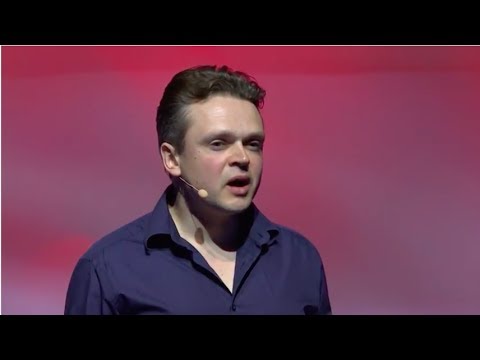
For the next ten minutes, I will be speaking about listening.
I am going to give you a demonstration of the world’s oldest technology.
Many millions of years older than human existence.
This is going to be something quite unusual,
I would like to ask everyone to, please, close your eyes.
Close your eyes.
And do not open them for the next 10 minutes.
(Laughter)
I mean it.
[This is an unusual, experimental TEDx video.]
[Please close your eyes, as the audience did,]
[and let the words, the voice and the sounds guide your experience.]
[Listen with headphones, because sound quality matters.]
[The screen will stay dark until the end of the talk.]
We usually listen to sounds coming from the world outside us.
At this moment you can hear the sound of my voice.
You can hear subtle noises present in the space,
blowing of an air conditioning,
people shuffling on their chairs.
You can hear the sound of your own breath.
You can hear a high hissing sound which doesn’t seem to come from anywhere.
This is your nervous system at work.
And if you listen even more carefully,
you can hear a low rumbling sound.
This is the blood pumping through your veins.
Do not open your eyes.
We usually think that we listen by just using our ears,
but it involves the body as a whole.
Sound, as it moves through space and fills that space,
touches every single cell in your body.
And we listen with our skin.
Sound is striking it like a breeze of wind.
We listen with our internal organs, mostly consisting of water.
Ripples of sound are flowing through it.
We listen with our bone structure,
sound resonates through all the pockets and cavities of the skeleton.
We are not just passively receiving these sounds,
but we invariably respond to them.
Listening activates the entire nervous system,
evoking slight twitches of the muscles as we tune ourselves to what we hear.
We become aware that our bodies and the space around us
function as a single organism.
Now let us go back some 100 million years
and visit our early ancestors.
Amoebas floating in the oceans.
We have no ears to hear with, we have no eyes to see,
we have no mind to think.
We are surrounded by water and have no sense of orientation.
Yet we are listening and responding to the environment.
(Pulsating noise)
We are organisms touched by and bringing about vibrations
rippling out through the water.
And this is how we detect proximity and distance
of prey, predators, of partners, as they are floating around us.
(Pulsating noise)
We, humans, are the inheritors
of the ability to interact with our environment through vibration,
linking us to the earliest forms of life on earth.
No need to open your eyes, just keep them closed.
The sounds we make ourselves, the expressions of our voices,
are the result of listening and tuning to the environment.
Let me guide you into the ancient caves,
first explored by men about 35 thousand years ago.
We are entering unknown space in the pitch dark,
only accompanied by the light of a torch flame.
(Echoing sound of a voice)
(Echoing sound of a voice)
(Echoing sound of a voice)
As my voice echoes through the openings and pockets of the cave,
it tells us where the space is narrow and closed, or open and hollow.
(Echoing sounds of a voice start)
(Echoing sounds of a voice end)
We notice that our voices sound full and strong in certain places
and weaker in others.
The space invites us to explore what we can do with our voices.
And this is how we discover early forms of speech
and singing together.
(Singing starts)
(Singing ends)
And those places, where we found the cave to resonate the strongest,
this is where we made our first drawings on the walls
as symbolic expressions of the sounds we discovered there.
The very beginnings of a system giving meaning to meaningless sounds,
which we now call: language.
Do not open your eyes.
We usually think that we listen to sounds coming from the world outside us,
but everything we hear is happening inside us.
We are not separate from the space that we experience,
but actively shaping it from moment to moment.
Let me take you on a tour through our modern cities,
the soundscape of the postindustrial age.
(Urban noises)
We are surrounded by noises coming from machines, motorized vehicles,
and many human beings,
continuously moving around, above and beneath us.
The way we move ourselves through space changes what we hear.
(Urban noises)
(Urban noises continue)
Sounds are muffled and defused when we are distant,
and they become loud, full and pronounced when we are close.
(Urban noises increasing in volume)
(Urban noises decreasing in volume)
The rhytm and pitches of sounds are speeding up and slowing down
as we move ourselves faster or slower through space.
(Doppler effect sounds)
So when we listen to space, we are listening to ourselves.
To our state within and through space.
What we distinguish as other and self,
there and here,
then and now,
it is a movement, like ripples flowing through water.
To listen to space, then, is to experience continuity.
The unfolding of experience itself, from moment to moment.
Do not open your eyes.
The space we listen to contains our bodies.
It does not stop there.
You might usually think of your body as being ‘you’,
but listening doesn’t distinguish what is inside or outside of you.
Your entire body, up to its finest tissue and smallest cavities,
is a part of the continuity of space we experience.
So if it is not your body that’s ‘you’,
what is this ‘you’
that is listening to all of this?
And where is ‘you’?
Let me transport you to the future, into the postdigital age.
We have merged with our technologies to communicate.
Receiving messages, images and sounds from each other
as appeareances in our own minds.
(Ultrasonic sounds)
The high density of signals transmitted through the atmosphere
is interfering with our nervous systems.
Electrical currents are passing through the skin,
our internal organs are flooded by a stream of ultrasonic frequencies.
What do we hear?
Will we once more evolve our ability to listen?
And perceive as yet inaudible vibrations?
Or will we simply stop listening, as we are deafened by the noise
suffocating the environment.
(High frequency sounds)
Do not open your eyes just yet.
Technologies are moving us rapidly forward.
But we are not aware of what we leave behind.
We already have a technology
that allows for an experience of such infinite depth and detail
we will never be able to reproduce,
and it’s available to us at any given moment, in any given place.
Our ability to listen is already ready, yet it’s not a passive state.
Listening is a conscious effort in the here and now
to increase our awareness of the environment.
It is also not a given state.
Our listening evolves, and it keeps on evolving,
the more careful attention we give to it.
From day to day, from moment to moment.
Let’s consider that we have a choice.
The way we evolve our listening collectively
will be the way we evolve our environment.
The way our environment evolves will be the way we evolve as a species.
This is the ecology of listening.
You may now open your eyes.
Thank you for listening.
(Applause)
”
Be First to Comment