
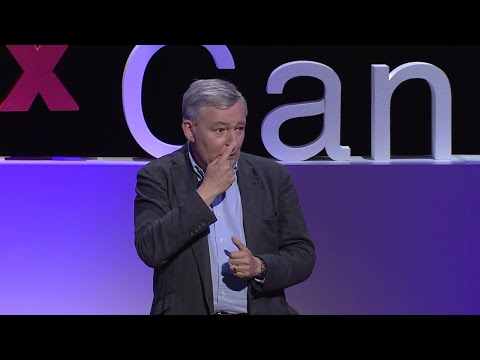
[The subtitle is a compromise between voice and sign language]
Good day all.
My name is Henri, Henri Corderoy.
I was born deaf.
I can speak, but not so well that you can understand me
and that is why I have called in an interpreter
that translates what I say in sign language.
Saint-Exupéry could have been pretty deaf,
because there was a lot of noise in the aircraft at that time.
And radio was not there.
There is another pilot, called Lindbergh,
which has flown across the Atlantic from New York to Paris
33 hours long and without radio.
And that was in 1927.
10% of the French population has hearing problems.
Maybe you wonder: how is that if you do not belong?
Can you really fly?
For example, you would have stepped in at Saint-Exupéry
if he had been deaf?
I am 58 years old the day after tomorrow.
I have flown two thirds of my life.
People have often told me:
“You can not, you can not fly!”
Yet I was the best student
at the national civil aviation school of Toulouse in 1982.
And then I found out that in America
quite a few deaf pilots were.
In France it was very complicated to get a certificate.
So I went to America
where I got my certificate in 5 weeks.
I became a pilot.
That was in 1990.
Subsequently, in 2004, I once again swallowed it in England.
I also experienced a wonderful adventure by flying in Australia.
It is indeed very difficult to get a medical exemption
if you want to become a private pilot.
Once you have a hearing problem
the doctors usually refuse to grant such a request.
Perhaps you think: “How is that possible now?
Are not you wise to fly while you are deaf? “
Many people think: “No, a deaf pilot, that is impossible
because he can not use the radio “.
But the radio is not mandatory.
Of course it is mandatory if you want to become an airline pilot,
transport pilot, pilot in the army, etc.
But in France about two thirds of the airports
not equipped with a control tower.
That means that there is no radio.
One of the most important rules in aviation is that you are seen.
A pilot has to see and look out.
For the safety of all pilots you have to be seen and watched.
For example, being seen and looking at landing, when taking off
and to avoid a collision.
And for that purpose a deaf person is perfectly capable.
There are resources that are used,
for example the GPS, the transponders,
that enable communication without a radio.
But there are also means of visual communication
and through flashes as you can see behind me now.
They send those flashes via the control tower
to the aircraft in the flight space.
This is often used, for example, for exercises in radio interference.
Last Wednesday I made a flight near Paris
and then I used that system without a problem.
The world of aviation, which reminds me of the 1950s,
to the deaf who wanted to drive.
At that time people said:
“No, someone who is deaf can not drive,
that is forbidden, that is impossible! “
And now look at: deaf driving car,
that is a very common fact.
So I count on the same development for aircraft.
But it is indeed very difficult
because of the medical advice
which unfortunately only issues small permits
to deaf people so that they can fly.
That restraint of the medical council does not exist in the US
In the US there are more than 250 deaf people who have a permit to fly.
They have that PPL certification for private aircraft.
And more and more will come.
There are Americans, there is an Australian, a Hungarian,
a Frenchman I know and there are also in other countries,
for example in Australia where there are about ten deaf pilots;
in England there are about fifteen,
soon a few will arrive in Brazil
and of course I hope that more will come in France.
There are also innovative solutions.
I also participate in such a new project
that Fans For All is called, as you can see.
That project offers solutions for radio communication.
New equipment for aircraft can be developed through this project
that makes communication possible in two directions
between the control tower and the aircraft.
The system works with the aid of textual signals
and luminous indicators.
It is a system based on existing standards
already developed and in use since the 80s
for a system called CPDLC
and that is actually used on airliners.
It is developed and adapted for smaller aircraft.
Of course deaf people will benefit from this,
but in fact all pilots will benefit from it,
to land, take off, to check more accurately.
Obviously, that development must be accelerated.
As I told you, the deaf will benefit,
but also hearing.
It is a new communication tool that is safer and more reliable
for all aircraft, and for the entire airspace
that unfortunately is getting fuller.
It is really an interesting solution, also for pilots
who have speech problems.
Then there is the ULM that really offers freedom
because there are much less mandatory rules.
That is why there are about 40 deaf people
using the ULM.
My fighting spirit and my perseverance
finally made my license in France possible in 2007.
I now have more than 2300 flight hours with aircraft and ULM.
Flying is something incredible, a feeling of freedom
that removes all worries from everyday life,
of social problems or personal work.
I love it, it’s my passion,
and that’s why I talk to people who encourage me,
who support me, I discuss a lot with them,
we really share ideas with each other.
Speaking of parts: I am also an instructor at the ULM
for deaf and hard of hearing students at Coulommiers airport
near Paris.
France is a beautiful country
and I think France can help realize our dreams.
Frustration is an unpleasant feeling
and yet deaf and hearing-impaired people experience that.
But it is also a force; therefore we can push back boundaries
that the legislation sets us,
those rules that should not be there.
Then you have to fight against those difficulties.
I am a real Gascogner
and I often say: “One for all and all for one”.
Another lesson in life: Help yourself, you help God.
I have a message for you,
for all of you today,
who comes from a friend who is also a pilot,
Gérald Feldzer, present here
and that reads: “If you can do it, then do it!”
Thank you for your attention.
(Applause)
”
Be First to Comment