
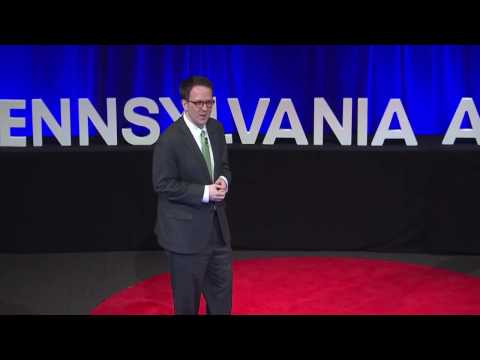
So last year I ran for Mayor of my hometown, Tulsa, Oklahoma.
And I was the underdog, running against a two-term incumbent.
My opponent ran the classic partisan playbook.
He publicized his endorsement of Donald Trump.
He publicized a letter he sent to President Obama,
protesting Syrian refugees, even though none of them were coming to Tulsa.
(Laughter)
He ran ads on TV that my kids thought made me look like Voldemort.
(Laughter)
and sent out little gems in the mail like this.
Never mind that America’s most liberal labor union, as defined by this ad,
was actually The Tulsa Firefighters’ Union hardly a famed bastion of liberalism.
(Laughter)
Never mind that while she was running for President,
and he was serving in his final year in that office,
Hillary, Barack, and I could never find the time to get together and yuk it up
about the Tulsa Mayor’s race.
(Laughter)
Never mind, that I, like my opponent, am a Republican!
(Laughter)
When something like this hits you in a campaign,
you have to decide how you’re going to respond.
And we had a novel idea.
What if instead of responding with partisanship, we responded
with a focus on results?
What if we ran a campaign that was not about running against someone,
but was about bringing people together behind a common vision?
So, we decided to respond not with a negative ad,
but with something people find even sexier: data points.
(Laughter)
And so we emphasized things like:
increasing per capita income in our city, increasing our city’s population.
And we stuck to those relentlessly, throughout the campaign,
always bringing it back to those things by which our voters could measure
in a very transparent way, how we were doing,
and hold me accountable if I got elected.
And a funny thing happened when we did that.
Tulsa’s home to one of the most vibrant young professional populations
in the country, and they took notice of this approach.
We have – in our culture, in our city – an ethos where our business leaders
don’t just run companies; they run philanthropic institutions and nonprofits.
And those folks took notice.
We have parents who are willing to sacrifice today so that their kids
can have a better future, and those people took notice, too.
And so on election day, I, G.T. Bynum,
a guy whose name reminds people of a circus promoter;
(Laughter)
a guy with the raw animal magnetism of a young Orville Redenbacher;
(Laughter)
I won the election by 17 points!
(Applause)
And we did it with the support of Republicans and Democrats.
Now why is that story and that approach so novel?
Why do we always allow ourselves to fall back on philosophical disagreements
that ultimately lead to division?
I believe it is because politicians find it easier to throw the red meat
out to the base than to innovate.
The conventional wisdom is that to win an election, you have to dumb it down
and play to your constituency’s basest divisive instincts.
And when somebody wins an election like that, they win, that’s true –
but the rest of us lose.
And so what we need to do is think about how can we change that dynamic?
How can we move in a direction where partisanship is replaced with policy?
Fortunately, there’s a growing bipartisan movement across this country
that is doing just that.
One of its heroes is a guy named Mitch Daniels.
Mitch Daniels served as George W. Bush’s budget director.
During that time, he created what was called the PART Tool.
The PART Tool allowed people to evaluate a broad range of federal programs
and apply numerical scoring for them on things like program management
and project results.
And using this, they evaluated over 1,000 federal programs.
Over 150 programs had their funding reduced
because they could not demonstrate success.
But unfortunately there wasn’t ever a well publicized increase in funding
for those programs that did demonstrate success.
And because of this, the program was never really popular with Congress
and was eventually shuttered.
But the spirit of that program lived on.
Mitch Daniels went home to Indiana, ran for governor, got elected,
and applied the same premise to state programs,
reducing funding for those programs that could not demonstrate success.
But this time, he very publicly increased funding for those programs
that could demonstrate success, things like:
increasing the number of state troopers that they needed to have,
reducing wait times at the DMV.
And today, Mitch Daniels is the president of Purdue University,
applying yet again the same principles, this time at the higher ed level.
And he’s done that to keep tuition levels for students there flat for half a decade.
Now while Mitch Daniels applied this at the federal level,
the state level, and in higher ed, the guy that really cracked the code for cities
is a Democrat, Martin O’Malley, during his time as Mayor of Baltimore.
Now when Mayor O’Malley took office, he was a big fan of what
they’d been able to do in New York City when it came to fighting crime.
When Rudy Giuliani first became Mayor of New York,
crime statistics were collected on a monthly, even an annual basis,
and then police resources would be allocated based on those statistics.
Giuliani shrunk that time frame, so that crime statistics would be collected
on a daily, even hourly, basis.
And then police resources would be allocated to those areas quickly
where crimes were occurring today,
rather than where they were occurring last quarter.
Well O’Malley loved that approach, and he applied it in Baltimore.
And he applied it to two areas that were most problematic for Baltimore
from a crime-fighting standpoint: We call these the “kidneys of death.”
So there they are, the kidneys.
Watch what happens when you apply data in real time and deploy resources quickly.
In a decade, they reduced violent crime in Baltimore by almost 50%
using this approach.
But the genius of what O’Malley did
was not that he just did what some other city was doing
– lots of us Mayors do that –
he realized that the same approach could be used to all of the problems
that his city faced.
And so they applied it to issue after issue in Baltimore,
and today, it’s being used by mayors across the country
to deal with some of our greatest challenges.
And the overall approach is a very simple one:
Identify the goal that you want to achieve;
Identify a measurement by which you can track progress toward that goal;
Identify a way of testing that measurement cheaply and quickly;
Deploy whatever strategies you think would work;
Test them;
Reduce funding for the strategies that don’t work; and
Put your money into those strategies that do.
Today, Atlanta is using this to address housing issues
for their homeless population.
Philadelphia has used this to reduce their crime rates
to levels not enjoyed since the 1960s.
Louisville has used this not just for their city
but in a community-wide effort, bringing resources together to address
vacant and abandoned properties.
And I am using this approach in Tulsa.
I want Tulsa to be a world-class city.
And we cannot do that if we aren’t clear in what our goals are
and we don’t use evidence and evaluation to accomplish them.
Now what’s interesting and we’ve found in implementing this, a lot of people
when you talk about data, people think of that as a contrast to creativity.
What we’ve found is actually quite the opposite.
We’ve found it to be an engine for creative problem solving.
Because when you’re focused on a goal
and you can test different strategies quickly, the sky’s the limit
on the different things you can test out.
You can come up with any strategy and utilize it and try and test it
until you find something that works and then you double down on that.
The other area that we’ve found that lends itself to creativity
is that it breaks down those old silos of ownership
we run into so often in government.
It allows you to draw all the stakeholders
in your community that care about homelessness or crime fighting,
or education or vacant, abandoned properties,
and bring those people to the table so you can work together to address
your common goal.
In Tulsa, we’re applying this to things that are common city initiatives.
Things like public safety, that’s an obvious one,
improving our employee morale at the city
– we don’t think you can do good things unless you’ve got happy employees –
improving the overall street quality throughout our community.
But we’re also applying it to things that are not so traditional
when you think about what cities are responsible for.
Things like increasing per capita income;
increasing our population;
improving our high school graduation rates;
and perhaps the greatest challenge that we face as a city.
At the dawn of the 1920s, Tulsa was home to the most vibrant
African American community in the country.
the Greenwood section of our city was known as “Black Wall Street.”
In 1921, in one night, Tulsa experienced the worst race riot in American history.
Black Wall Street was burned to the ground.
Today, a child born in the most predominantly African American part
of our city is expected to live 11 years less
than a kid that’s born elsewhere in Tulsa.
Now for us, this is a unifying issue.
Four years from now, we will recognize
the 100th commemoration of that awful event.
And in Tulsa, we are bringing every tool that we can
to address that life expectancy disparity.
We’re not checking party registration cards
at the door to the meetings.
We don’t care who you voted for for President,
if you want to help restore the decade of life
that is being stolen from these kids right now.
And so we’ve got white folks and black folks,
Hispanic folks and Native American folks.
We’ve got member of Congress, members of the city council,
business leaders, religious leaders,
Trump people and Hillary people,
all joined by one common belief that a kid should have an equal shot at a good ife
in our city regardless of what part of town they happen to be born in.
Now, how do we go forward with that?
Is that easy to accomplish?
Of course not!
If it were easy to accomplish, somebody would have already done it before us.
But what I love about city government is that the citizens can create
whatever kind of city they’re willing to build.
And in Tulsa, we have decided to build a city where Republicans and Democrats
use evidence, data, and evaluation
to solve our greatest challenges together.
If we can do this, if we can set partisanship aside
in the only state in the whole country
where Barack Obama never carried a single county,
then you can do it in your town, too.
(Laughter)
Your cities can be saved or squandered in one generation,
so let’s agree to set aside our philosophical disagreements
and focus on those aspirations that unite us.
Let’s grasp the opportunity that is presented by innovation
to build better communities for our neighbors.
Let’s replace a focus on partisan division with a focus on results.
That is the path to a better future for us all.
Thank you for your time.
(Applause)
”
Be First to Comment