
Everyone knows someone that either is or was in the military –
grandparents, parents, brothers, sisters, friends –
and I’m sure you can visualize them as I speak.
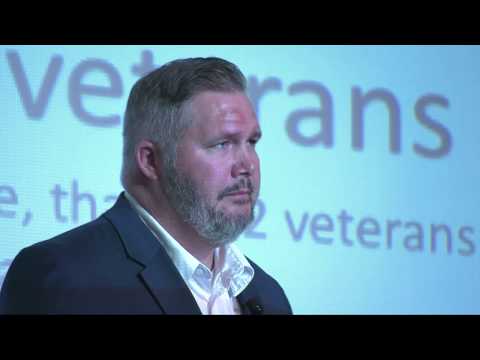
The soldier behind me on the screen is just that: me.
I’m what’s known as a veteran,
and America has millions of veterans who proudly served their country.
What you may not know is 20% of these veterans have PTSD,
post-traumatic stress disorder.
I personally think that number is higher
simply because many veterans never talk about PTSD
or whether or not they suffer from it.
I was one of these veterans;
I was fine.
I didn’t talk about it;
I buried it deep down inside,
and only I knew what I did,
what mistakes I made,
what I saw, heard or smelled.
I told myself I couldn’t have PTSD because I volunteered for the Army.
Actually, a judge encouraged me to enlist,
but that’s a story for when we have more time.
(Laughter)
The military did a fantastic job
training me to be an emotionless, paranoid killer
capable of doing great and terrible things:
jumping out of airplanes,
blowing stuff up.
The only thing I had to worry about was the enemy,
and the enemy could be anyone or anything,
anywhere, at any time.
I had to be careful where I walked or stepped,
keeping an eye on doors, windows, roofs, vehicles
because the enemy is out there waiting to kill me.
So how did I deal with this?
Hypervigilance.
It’s where all your senses are operating at full speed,
collecting data and visuals,
and to a degree, you even learn to use your intuition.
There is no training to turn this off,
so back home, I was just as alert as I ever was over there.
In restaurants, I’d sit facing the entrance,
having already scanned the room to get a baseline of threats.
I’ve identified all the improvised weapons near me,
and how I would react to the various ambush scenarios in my mind.
Now, let’s have dinner.
(Laughter)
Notice I didn’t say, “Let’s enjoy dinner.”
There’s not a lot of joy in a veteran’s life with PTSD.
However, hypervigilance was just part of my PTSD.
Nightmares kept me up most of the night,
which kept me exhausted.
I would relive the events throughout the day, in my mind,
raising my heart rate, anxiety and blood pressure.
This would often then leave me very agitated, angry or distant,
not very fun to be around for long periods of time,
which is why I chose to be alone a lot.
It was easier that way.
In large groups such as this,
I feel like a target
because I cannot control the situation.
My anxiety level is high because I’m alone.
Even up here in front of all of you or sitting next to family and friends,
I feel alone.
You see, back in the day, I had my brothers with me,
and they were just as alert and well-armed as I was,
and we were in it together –
brothers ’til you fall.
And fall, some of them did.
“But no one gets left behind,” we’d say,
as if that’s supposed to help.
There was strength in numbers,
and now I’m by myself waiting on a fight that never comes.
As a veteran, I’m haunted 24 hours a day, 7 days a week by my PTSD:
loud noises,
car accidents,
or any number of triggers causes me to relive those days again.
Exhausted, the experience seems so vivid,
only confusing things further.
Being trained to expect the unexpected with no way to turn off the obsession
left me emotionally numb.
Exhaustion – well, that’s standard government issue in the military
along with fatigues and a rifle.
Typically, though, I’m just as exhausted back home as I ever was over there.
Being so tired makes thinking and good decisions very hard to do,
leaving you looking for any type of relief.
Sadly, the easiest thing to obtain is alcohol,
and I found myself drinking alcohol before bed
in the hopes of getting a few hours of sleep.
A doctor once did a cortisol test on me,
and was shocked to find that my highest levels of stress
were in the hours before bed.
This did not shock me, however,
because if you think about it,
I was trained to believe that someone was always trying to kill me.
So feeling alone and closing my eyes is not an easy thing to do.
And when this goes on long enough, my body started to break down
due to my stress, exhaustion and bad habits.
Stress-related illnesses like chronic fatigue,
fibromyalgia, irritable bowel
brought me physical pain to go along with my emotional pain
that I pretended did not exist.
I’ve had shingles 17 times.
Some of you know that intense pain,
and you’ll know most people get it once or twice,
but not me.
In August of 2011, my body started to break down in a really bad way.
The VA did a massive work-up on me to try to figure out what was going on.
It hurt to walk, move, sleep or think.
I had lost interest in living, if I was going to live like this.
And I was okay with dying.
I truly was considering my mortality
because I wanted the pain to end one way or another.
The shocking part to this:
it was easy to have these thoughts.
In fact, America has an ongoing veteran suicide crisis
where 22 soldiers, 22 veterans, will commit suicide today.
22 veterans will commit suicide tomorrow
and each day;
over 8,000 veterans a year.
I have known some of the …
And while I don’t know
what that final thing was that put them over the edge,
I can imagine it’s not very different from my story.
This cycle has to end,
and it seems society is concerned about veteran’s suicide awareness
but with no solutions.
Think about it this way:
If 22 soldiers were killed today, it would be all over the news,
and the public would be calling for airstrikes in retaliation.
It’s easy to see how a veteran can feel alone and forgotten
when he goes to the VA with PTSD,
and all he gets is pills to numb the pain.
However, I was lucky enough to see any type of doctor I could afford:
Western, Eastern, Indian, alternative medicine,
and I will tell you what I found that helped me the most;
it’s simple, really.
In February of 2015,
I went to a holistic medical retreat to see if I could reset my body and health
using an ancient Indian way of medicine called Ayurveda.
Part of this seminar was regular yoga and meditation sessions,
and being me,
I was extremely apprehensive about doing such activities.
But I was looking for any type of relief,
so I bought the biggest yoga mat I could find and tried as hard as I could.
(Laughter)
The results are just that funny.
(Laughter)
Most people were stretching and enjoying the workout,
and I’m in the corner having visions of Braveheart sweating and moaning.
Inside, I felt meditation might be another failure,
but during my first guided meditation,
something dramatic happened.
I felt my body actually relax,
and I was in a place between thoughts,
my mind quieted,
and it felt really good.
I was able to see and process my memories for being just that – memories.
As the session ended, I sobbed
because I had no idea what was happening to my body,
but I knew that I wanted that feeling back.
And so I meditated again before bed,
fell asleep during the session,
slept hard – no nightmares even –
and woke up actually feeling refreshed.
Back home, I continued my meditation, and things continued to improve.
Others noticed a difference in my attitude and demeanor at work
and asked what changed.
My answer: “Meditation.”
Intrigued by my progress,
I decided to do some research on PTSD and meditation
and found several recent medical studies confirming what my heart already knew.
Meditation lowers stress and anxiety levels,
improves immune function,
and lowers heart rate and blood pressure.
Upon conclusion of one these studies,
veterans confirmed that they were continuing to practice daily meditation
and reported feeling calmer, less stressed and deeply rested,
and finally, more engaged in their daily lives and family.
Encouraged by these reports,
I saw a huge opportunity to help veterans with PTSD.
So, in keeping with the soldier’s mantra
“No one gets left behind,”
eight months ago, I started a nonprofit
to raise money and send veterans with PTSD
to learn and practice meditation like I have.
And this is where I need your help.
Will you help me find these brave men and women
and encourage them to contact us?
Because one month ago, in early October,
we had five veterans come together from across the country,
and go through an all-expenses-paid, four-day meditation seminar,
and the results were truly life changing.
Words will not do justice to what happened.
They were relaxed;
they were smiling;
they were joking
and sleeping without medication
and starting to enjoy their life again.
Now the best part about this
is we’ve raised enough money to send ten more veterans very soon,
but our work has just begun.
With your help, we will continue to raise awareness
so that any veteran with PTSD can find peace
from the haunting scars of war.
Thank you.
(Applause)
”
Be First to Comment