
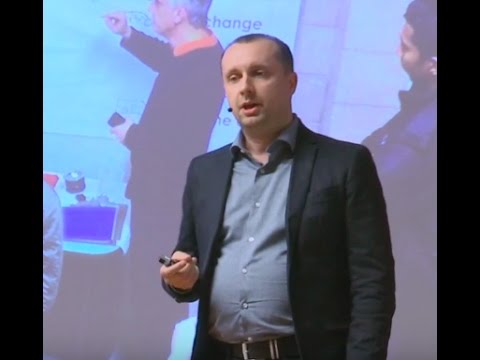
My name is Paolo Sammicheli,
and my next car will travel at 40 Km per liter.
I am here to tell you the story of Wikispeed
and of a modern hero, with a heroic name: Joe Justice.
In 2008, Progressive Insurance
offered a ten million dollars prize
for an XPrize competition,
challenging the attendees to build a car that could travel 100 miles per gallon:
for us Europeans,
this means 100 Km with 2,8 liters of petrol.
In 2008 there already were some 100Mpg cars.
But they were more like this bobsled: they could just host the driver,
and sure they didn’t meet legal road safety requirements.
One of the things the XPrize commission asked
us to do was to meet these road safety requirements
to drive in United States.
Joe Justice decided to join, and at first he was basically alone,
but thanks to social media, he started sharing via web
his experiences, his mistakes, and the lessons he was learning.
And pretty soon,
a community of 44 people, from four different countries,
virtually knocked on his door to help.
And so Wikispeed was born.
Wikispeed, in just three months,
with no corporate or university support,
built the first prototype and joined the competition,
achieving a whopping tenth place,
beating more than 100 other cars from all around the world
sponsored by universities and companies,
in what the New York Times called “incredible”.
How did they do that?
Joe Justice, just like me, is a software developer,
and he took the best practices of software engineering
to enable him to create products and innovate quickly.
Flexible methods with weird names like Scrum, Kanban, eXtreme Programming.
With the $10.000 consolation prize,
the team could afford their car’s road legalization tests.
In 2011, Wikispeed received an invitation
to show the car in the world’s largest auto show.
In Detroit, Michigan, in a sense “the belly of the monster”.
The world’s most important car brands would also attend.
Great excitement in the team, but also panic!
The Wikispeed team wanted something nicer, for a car show,
than the prototype they used for the challenge.
But creating a custom shell, would take three months and $36,000.
So Joe came back to school, and took training in composite materials.
Once back with the team,
they started making models of the new Wikispeed body.
Small at the beginning, and a full size model later on.
And in only three days, at a cost of just $800,
they built a carbon fiber body for the exhibition.
It was so beautiful.
Thankfully, because they were placed on the main floor,
between Ford and Chevrolet.
Everybody talked about them that day:
The New York Times Online; The National Geographic; Wired Magazine;
even Rai 3 with “Report”, in Italy.
Today Wikispeed has 1000 members from 40 countries, and they build cars.
If you go on the Wikispeed website
it’s just like any open source software project:
you can download the plans for free and build it yourself;
or you can order the parts, and mount it yourself;
or you can ask them to build one for you.
And they are doing other interesting projects
like micro-houses that cost less than 100 Usd
with a bed, a bathroom, and a lockable front door
to help involuntary homelessness with recycled material.
But the most stunning thing
that Joe Justice and the Wikispeed team did
is showing that you can apply some specific software methodologies
to build tangible products,
debunking a common belief that this wasn’t possible.
They organized the team with a method called Scrum,
that in software creates cohesive and very productive teams.
All members work in pairs, taking the idea from eXtreme Programming,
so that knowledge is passed from a team member to another,
thus also increasing quality and safety.
And the car is designed
with what we call in software “object-oriented programming”,
destructuring the car in pre-defined modules,
with stable connecting interfaces
so you can change or improve single parts of the car
without redesigning the entire project.
Still today, the Wikispeed chassis
is the lightest chassis on sale in the United States
with a five-star rate equivalency in a crash test.
They achieved it because security tests
are designed and created even before the components to test.
We took this idea from software also:
it’s called “Test-driven development”.
But above all, they proved that even in building physical products
a team’s mood is a productivity multiplier.
Every industry can benefit from these ideas.
And today, Joe works as an advisor, helping companies all around the world
to find new ways to create better products.
And here’s where I met him last summer,
Colorado, north of Denver, at the Scrum for Hardware Gathering,
which was the first international meeting
of these crazy software guys
driven by the idea of contaminating the industry
with ideas coming from software.
We’ve been discussing for two days
about those software practices that are best portable to hardware,
and the less portable ones.
Eventually we wrote a document, a manifesto,
with principles and values coming from our own experience.
Saturday morning we went to a garage, at Hubert Smith’s home,
the guy with the glasses behind me.
We had a Wikispeed build party –
namely, we built a Wikispeed car from scratch.
Upon my arrival to the United States,
I said to myself,
“I’ll probably be the only Italian, maybe even the only European.”
I was wrong.
Upon my arrival, seven out of 30 participants,
plus me, were Italians, all working on a company based in Ivrea,
founded decades ago by former Olivetti employees.
During the day,
we had a lot of fun building the car.
It was also quite tiring.
At the end of the day Joe was super happy.
We mounted the four suspensions on the chassis;
attached the wheels, the brakes, the steering mechanism;
fixed the body, which got damaged during the shipping;
and integrated all the parts
to ensure a perfect coupling.
According to Joe,
and could we have stayed four more days in the US, he told us,
we could have turned our Wikispeed car on!
At the end of the day, exhausted as we were, we all drank a beer together.
I went close to our host and I said,
“Hubert, your next car is going to be built
by a bunch of nerd programmers, and most of them come from Italy.
I suggest you buy an all-inclusive insurance!”
(Laughter)
That day, a community of people was born,
with the idea to contaminate industries of all kind
with ideas coming from software.
They wrote a document, a manifesto
with principles and values around this idea.
In English, firstly, then translated into Italian.
A website was then made
with experiences from companies around the world
who started using these ideas.
In English, firstly translated into Italian.
I felt something similar
during my first travel to the US, years ago.
I went to California, to Silicon Valley, to attend a conference at Google HQ.
On Saturday, with other colleagues, we went to visit some museums.
And in San Jose,
the administrative capital of Silicon Valley,
at the Museum of Science and Technology,
we found an exhibition
about Leonardo da Vinci, a 16th century engineering.
Once in, just around the corner,
I found the history of Siena’s engineers and our old aqueduct.
On my way out,
our district’s flags hovered around the ticket office.
I basically flew across the ocean,
going to the world’s most technological place,
to find out that the world’s most technological place
was my own town, but 500 years ago.
Now it looks like a new Industrial Revolution is coming,
they call it the Fourth Industrial Revolution.
They say that it will no longer be the bigger fish eating the smaller,
but the faster fish eating the slower.
That’s exactly what happened in the software industry
in the last 15 years.
In a few years, a bunch of young guys in a garage
beat the giants of the stock market.
So if all the things
that gave glory to software in the last 15 years –
the sharing, the open source, the team work and the audacity –
if all these things
are about to seep into all kind of industries,
well, I’m sure it’s going to be awesome!
Thank you!
(Applause)
”
Be First to Comment