
My passion for sports started when I was a kid.
I used to play soccer in the backyard of my house every afternoon
and, as I became confident, I asked my dad to put me in a soccer tournament.
I remember the day I was among the players who had scored more goals,
and they called me to join the soccer team.
That was awesome for a boy of that age.
Moving forward to the time I was attending a preparatory course to college,
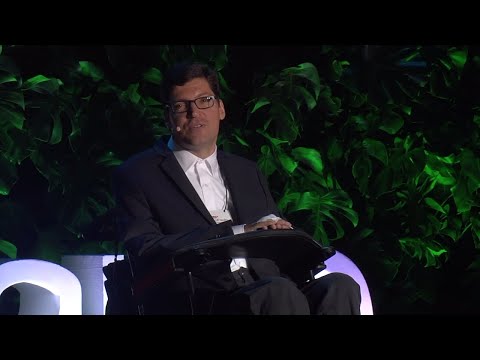
I was robbed, and got shot,
which caused the paralysis below my shoulders called tetraplegia.
I was forced to drop out of school,
and devote all my time to several types of physical therapy.
But I had unconditional support from my family and friends.
At no time did I lack support.
As I got to know the world of rehabilitation clinics,
I realized that I was an exception.
Most people who get involved in accidents
or who are born with disabilities
also face poverty.
I remember the suffering of a family that could not afford the treatment
of a child who had been born with cerebral palsy.
That started to bother me a lot.
Unfortunately, a lot of people still go through this.
How big is this audience in the world nowadays?
According to the World Health Organization,
15% of the world population has some kind of disability.
We are talking about one billion people in the world
and 30 million in Brazil.
When we look at studies about inequality,
we realize this segment
still faces the most serious levels of inequality and discrimination.
What can we do to change this situation?
One day, I was talking to a friend, and we said
that discussing about inadequate education sharing in the world
would be more important than discussing about poor income sharing.
In other words, we won’t get any further
unless everyone has the opportunity to study,
and access to knowledge, to the work market, and to dignity.
It is also true for people with some kind of disability.
That is the purpose in my life.
I have founded an institute whose mission
is helping every kid and youngster with disability
to achieve their best as human beings,
and be independent through education.
For that reason,
I returned to the world of sport.
A few years ago, UNICEF came to me so we could create a project together.
They wanted to take advantage
of the World Cup and the Olympics in Brazil
to motivate schools
to look into physical education in a different way,
guided by inclusion instead of competition.
Then we created a course
which has been attended by teachers from all over Brazil.
Each participant is committed to create classes
that make possible every student’s participation and amusement.
At the end,
we visit each city to get to know the stories closely.
There are already hundreds of transformations worth telling.
On a trip to the Brazilian city of Natal, for example,
I met Maria Luiza, a 12-year-old student.
She was in the fifth year of a public school.
Maria had a critical disorder: she had never spoken.
She barely interacted with people and did not even take school lunches.
From this project,
teachers asked Maria and her classmates
to think of an inclusive activity.
So she spoke for the first time, surprising everyone.
She gave her opinion, and helped the group to create a new version of badminton,
a mixture of volleyball and tennis.
What did they do so different?
One: the referee started to use visual signalling
so that deaf students could understand what was happening.
Two: they changed the duration of the game
so that students with autism stayed focused.
And three: the court was resized
so that wheelchair users could move easily.
Because of this project,
her school, once standardized and guided by homogenization,
is now an environment of diversity, which considers singularities.
And best of all, Maria ended the distressing silence of many years.
This project is a real example
of a positive legacy left by the megaevents in our country.
Due to it, I ended up getting quite involved with the Olympics in Rio.
I had the joy of conducting the torch.
Last year I went to Japan, invited by the World Economic Forum,
to attend a seminar.
It was aimed to discuss
how the upcoming Olympics can broaden their social impact.
At the end of the debate, the moderator asked me,
“Rodrigo, what do you think Tokyo
can change about that in 2020?”
Summarizing my answer,
I think the complete separation
between Olympic and Paralympic Games
goes against the idea of an inclusive society.
What kind of message…
(Applause)
(Cheers)
(Applause)
What kind of message do we send to the world
segregating some athletes based on the existence of a disability?
Besides, the act of putting out the fire of the Olympic cauldron,
and then, weeks later, lighting the Paralympic cauldron,
only reinforces this negative message.
There is a UN convention, signed by more than 100 countries,
which condemns the separation of people due to their differences.
Considering that the Olympic Games are the biggest event in the world,
and that their ceremonies are seen by billions of people,
I would like to make a proposal for Tokyo.
Changes in history demand symbols.
[This image is a courtesy of Shutterstock]
(Music)
So I propose that in Tokyo we use the same torch, the same cauldron,
and most importantly,
that we keep the flame lighted between both games.
That’s how the Olympic flame will improve its magnificent role:
to represent the equality among human beings.
Thank you.
(Applause)
(Cheers)
(Music)
(Applause)
(Cheers)
(Applause)
”
Be First to Comment