
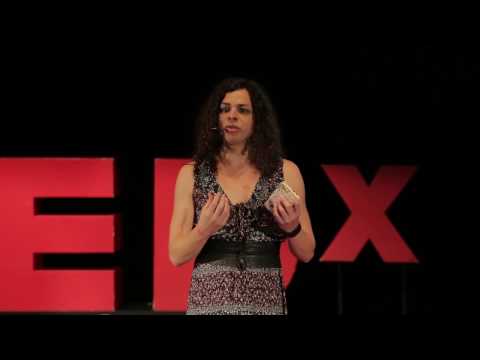
My name is Amara Moira.
I came here to talk a little about this world that exists for trans people.
I get very … thinking, sometimes.
It’s been two and a half years since I asked the first person to call me Amara,
for two and a half years I’ve started a transition,
that I begin to build my feminine identity,
that I start thinking differently
than the way my genital had predicted for me.
And the world I found from then on is quite different.
[It is worth] to think, for example, that ten years ago,
when I was in the second year of my undergraduate degree,
no prior professional experience qualifying me,
and I went to look for a job and I ended up hired –
still existed for society as a man at that moment –
I just got engaged as a literature teacher.
an important college in my city.
No professional experience that would qualify me,
second year of graduation of Letters, that is,
no great intimacy with literature,
but I already had this job at my disposal.
Today, ten years later,
finishing a doctorate in one of the most important universities in the country,
in Unicamp,
studying one of the most difficult authors in Western literature, James Joyce,
no college would hire me as a teacher,
no college would have the courage to hire me as a teacher,
because even “courage” is not a word that usually accompanies,
is not a word that is very present when one thinks of school.
School is always closely associated with the reproduction of paradigms,
reproduction of stereotypes, places of violence.
Everyone who is not in the most absurd standard possible,
all these people will be raped in school,
and transvestites more than anyone else.
And they can not see me in this place as a teacher.
Today they can not,
as much as I am a much better teacher than I was ten years ago,
as much as I was much better able than I was ten years ago.
And then, all this leads me to think: “Why?
Why would it be so incompatible that I could exist in this place,
since I’m in university, since I’m graduating,
since I’m in the process of learning? “
Meritocracy then comes in check,
because she will tell you: “It strives that you get wherever you want.”
Then, suddenly, I realize that, ten years ago, when I did not try anything,
I was already there and today, when I start a transition,
I can not get anywhere, you know,
being much more prepared to occupy this post, this position, this job.
So what comes to mind?
is precisely the way society understands transvestites and transsexuals,
this unique narrative that engulfs us, immobilizes us,
which causes us to be reduced to nothing,
which means that we can only occupy the banks,
occupy these places that we do not even consider places.
But narratives that engulf and immobilize
they are not peculiarity, our peculiarity.
Many other groups,
all other groups that are somehow being excluded, oppressed,
they are also victims, they are hostages of these narratives.
So we can think, for example, women –
half the population, more than half the population –
how much machismo does not suit our eyes
to go get the woman beauty instead of intelligence.
So the first thing we will see, that will focus there:
“Wow, is the woman beautiful, ugly? Did she do her makeup well?
Is she in pretty clothes? Is she fit?
Is she a standard woman?
Does it conform to the beauty standards of prevailing femininity? “
We’ll see this first.
Then, if you have time, if you have interest, goodwill,
we’re going to open a little listening to see if this is a smart woman,
if this is a woman who says something beyond the obvious
and, if she says, she’ll be questioned, she’ll be challenged all the time.
She has to prove herself much more important,
much more powerful, shrewd and intelligent than any man
to be able to occupy the same spaces as the men.
Because? Men will not be so questioned.
Men will not be, first: “Let’s check if he’s handsome,
if it is within the standard,
and then let’s see if he’s saying anything he’s doing. “
No; one can only pay attention to what he is talking about,
it will start from the assumption that he is saying something that lends.
Then, one can think, for example,
inasmuch as racism teaches our eyes to recognize danger in the black person.
So, lots of friends of the black movement bring this very delicate account,
what it’s like to exist in a society where you walk on the street
and people will see you as a threat, as a danger,
go retracting the body, go hiding purse, knows,
the whole time, no matter who the person is.
He saw a black person, his body shakes.
Your body has learned to react that way.
This is racism.
This is racism by training our bodies, our feelings.
This is a form of very heavy violence.
This is also true for transvestites, right?
When they look at us, the first thing they think is not:
“Wow, what a smart person”, “What a brilliant person”,
or that person whatever.
You can only see one thing:
they can only see this future that is destined for us
at the moment when we denied what the genital decreed for our body.
Because it seems that there is a genital that nobody sees,
nobody has access to this genital,
unless you go and have sex with the person,
but we think you see, right?
And this genital has the power to decree a future for this body
and that future has to be obeyed and, if not obeyed, there of that person.
I remember, within the university, two and a half years ago,
when I start my transition, one of the first sentences I’ve heard
of a person who did not follow the whole “prehistory” of that first day,
of that day when I arrive and ask, kind of apologizing:
“Could you please call me Amara?”
Today I do not ask. Today I put it: “My name is Amara”.
Today I am someone else.
At that moment, I was still taking my first steps, crawling,
and I remember that this person, who did not follow all this trajectory,
comes to me and sees me one day when I was wearing a pink sneaker,
a pair of jeans and a SpongeBob sweater …
very bad taste, I assure you … I was this person in the beginning …
and this person looked at me and said, “Wow!”,
surprised to see me like that,
but it was not a surprise of the bad taste of my clothes.
It was: “Wow, what happened? Are you going to become a prostitute?”
She looked at my SpongeBob shirt,
looked at my jeans and my pink sneakers and saw a prostitute,
and it was not the clothes I was telling her that I could be a prostitute.
It was the fact that I denied the fate that my genital decreed for me.
This remains one of the greatest weights that this society carries,
that fear, always constant,
to deny this order that the genital has for us.
So I think
that maybe that’s what surprised so many people
when I became a city council candidate in my city
and I went outside to talk to people about politics.
No one was ever stopped in the street to talk politics
by a transvestite.
They have been stopped by cis women, by cis men; by a transvestite, never.
This was very surprising.
You saw in the people’s eyes that glow,
that surprise of: “Wow, a transvestite who talks about politics!
A transvestite is coming to talk about how we will fight
for a safer Campinas for women and LGBTs.
Wow, how interesting is that, huh? “
People were surprised, I could see the sparkle in people’s eyes.
I had the impression that the more I spoke,
more people were surprised, the whole time surprised,
because they would never expect it from a transvestite, ever.
This is also a reflection of transphobia.
Can I be putting it here for you?
that: “Wow, how nice, people stopped to listen to me,
I could talk to people, “but this is also a reflection of transphobia.
This is a reflection of how little they expect of us.
Do not expect anything,
so any transvestite that surprises a little:
“Oh my God, look, she can talk!”
You know, it’s always within that logic.
And then, it’s interesting to think: how does a transvestite talk
of transforming Campinas, or any other city,
a safer city for transvestites?
“Gee, but transvestites are the danger of cities, right?”
It is within this logic that society operates,
seeing us as figures who occupy marginality,
socially excluded figures,
figures that are in the non-places, in the non-jobs,
figures who have no family, figures who have no morals.
And then, inside that place, inside that place,
how do you think we need to worry
with a safe city for these figures, for these people?
It’s a bit unexpected for them.
They never asked themselves, “What are they suffering?”,
what we are seeing, what we are feeling,
how is life to which we are entitled,
as is the city to which we are entitled.
And then, I wonder how it has changed dramatically:
the day before Amara and after Amara.
It was very radical,
and it was not simply an “after I said I am Amara”;
it was after the other read me as Amara before I needed to open my mouth.
What do I mean by that?
I mean that when my body went on to tell this information to others,
before I needed to offer this information,
then I began to see this other world that existed,
this other world that was there, being the world that exists for transvestites.
So, what was this world like?
It was the world of ubiquitous harassment.
So you walk on the street,
Are you riding the subway, are you riding the bus?
and suddenly has an arm, has a hand,
that you do not know very well if it is touching you or not.
You just feel like it’s an arm touching you in a weird way.
Machismo teaches this to us too,
teaches us to doubt our perceptions,
teaches us to have doubts if this is what we are living from violence
it’s really a violence.
Then: “Wow, is it in my head,
or does it really have an arm leaning against my butt
in an odd way? “
The truth is: before my transition, I never had that doubt.
Before my transition, no one ever strangely touched my body.
No one ever touched my body without my permission.
And, from that moment,
as they see me as a figure that only serves to precariousness,
for marginality, only serves for exclusion, only serves to be used,
it is only in this way that they can conceive me,
then you will even think it will be to my liking if you touch me.
This person that comes to my ear and says something obscene,
says he wants my body in bed, or anything else unprintable,
thinks I’ll enjoy listening to this because, in understanding that person,
I’m so unwanted, I’m so abject,
that any person who deigns to show desire for me
will be very touched: “Wow, thank you.We go now? Where?”, you know?
It is within this logic that it operates,
but it’s not just this harassment that happens in my life.
There are also other types of harassment:
the machine gun of looks that also lives every trans person.
You enter a space
and that bunch of necks are spinning,
looking for you, all the time.
Sometimes they are not looks of hostility, aggressive stares.
Sometimes they are not.
Sometimes they are just curious looks,
looks who want to understand what you are,
but in this desire to understand what you are,
these looks are saying that you’re strange, that you’re weird,
that you do not make sense,
and that they have the right to look at you until they understand what you are or are not.
It is us? What is our duty in this?
Being looked at, shutting us up and letting them look at us,
let them do what they want to do.
So it’s all the time these looks,
who are somehow saying that you should not be there;
or you enter a store, and that bunch of suspicious looks;
you walk on the street, and that lot of looks trying to understand.
Looks, looks, looks, all the time looks.
And when they are not looks, we come to harassment, touches,
or we come to the curses, which are also quite common, right?
It’s funny that there are two types of cursing
which are completely contradictory,
but that, within this culture of putting the transvestite in the non-place,
to put her, I do not know, anywhere –
we can not understand this figure very well,
They make sense, I do not know.
Then, on one side we’ll hear someone lower the glass of the car
and feel the need to scream when you see people passing by on the street:
“It’s a man!”
This guy will feel the need to shout it, “he’s a man”,
and with that he is saying what?
He is saying what our genital is,
he is saying what is the order that our genital gave to our body
and that we denied it.
But at the same time, the other guy will come, go lower the other glass of the car
And what will he scream at us?
“Become a man!”
You know, if they’re yelling at us, “become a man”,
there is something very strange
because it is as if they are saying that we are not a man,
and they are wanting us to be a man,
and that’s when we realize that being a man
is not only a mere consequence of the genital that the person has.
Our culture is very complex.
We are not seeing genitals out there, we are presuming genitals,
but we have this impression and we have this desire
that the body mirrors that genital that we can not see.
We need this, right?
We need this security to be talking to someone
and know the genital that person has.
We need all the time.
You can not deal with people that you do not know about the genital you have.
I remember, even,
that one of the most impactful experiences of my life
was when I was 15, 16 years old, still existing as a man for society,
beginning of the internet in Brazil.
I was there in the chat and a figure appears,
that I do not know very well if it was transvestite or woman trans …
I just knew there was some difference between the two …
and I was ashamed to ask what she was,
I do not remember today.
I knew it had something to do with surgery.
I did not want to ask, did I?
I thought it could be disrespectful!
Look, 15 years ago, I thought it might be disrespectful.
ask what genital she had.
If she told me, OK.
If she did not tell me, it was mine.
We change phones, we talk for hours at dawn
and I, every inexperienced, every virgin,
but wanting to pose of greater [age] and bambamba of sex …
I told her and then she would say:
“Ah, so you understand, right? Are you good in bed?
So tell me what you’re going to do with my body. “
And then, I said I was going to kiss her breasts, I was going to kiss her belly,
I was going to kiss my hip, my thigh, my knee … and I would jump the genital.
(Laughs)
And I kept waiting for her to tell me what genital she had,
and she never told me what genital she had.
Months talking …
There was no webcam, no photo on the computer.
No one had a scanner at home.
I never knew what genital she had.
Do you realize how “disturbing” this story is?
I related to a person without ever knowing how genital she had.
You know, that’s it, it’s this kind of experience.
which will start to become more and more everyday
as trans people begin to occupy society,
from the moment we can be in all the spaces
and not just on the sidelines.
This is a reality that will start to disturb many people, challenge,
and it will whet people’s curiosity.
Nowadays, it is not so simple to have such an answer.
So if you come to a party and you’re going to hit a trans person,
this trans person can panic
because she will always be afraid:
“Does that person know I’m trans?
What if I tell her I’m trans?
What will be the world that will come to me from then on?
So, can I be mocked for the rest of the party?
I can be beaten by this person because I ‘cheated’ her,
because suddenly, she will realize that she felt desire, horny,
by a person who denied this order that the genital gave? “
So it is always very delicate the situation in which they put us.
We’re always in the mood.
We never know exactly how to respond when they get close,
when they show desire.
Do we assume he knows?
Do we warn you when it’s all for fuck?
Because while you’re just kissing, what’s the genitalia?
We’re just kissing …
But no, they need to know that.
because, if they do, our situation is even more dangerous.
So I brought these taunts here
for you to understand a little of the world in which we live,
a world that exists only for us who deny these orders
how the body should be, how we should exist in society.
Thank you.
(Living) (Applause)
”
Be First to Comment