
Does anyone here remember Fabiane de Jesus?
A brunette woman, curly hair a little below the shoulder?
No?
Fabiane de Jesus was the victim of something that we need to fight with urgency:
false news.
In 2014, on any Saturday in Guarujá,
Fabiane’s neighbors entered her house and dragged her into the street.
Kick, kick in the rib, kick in the back.
It’s because?
Because a Facebook page had posted the spoken picture
that you are seeing, and the neighbors had found
that this woman of the picture spoken was Fabiane.
The woman of the spoken picture, who even looks like her,
was accused of allegedly kidnapping children in the Guarujá region
and practice black magic.
Fabiane had nothing to do with the story.
On that day Fabiane left two children,
had head trauma and died a victim of false news.
Recently just two weeks ago,
a couple, like me and my husband and you and your wives and husbands,
were in Araruama, in the lake region of Rio de Janeiro.
They drove a white car, and suddenly an overwhelming crowd
circled the car.
They made them stop.
They picked up rocks and sticks and attacked the car,
as you can see in these images.
It’s because?
Because in the region circulated in WhatsApp the information that a couple,
in a white car, kidnapped children too.
The couple had nothing to do with the story.
He almost died.
Then you can say, “This is Brazil thing”.
Do not.
On July 14 last year,
when France celebrated its national holiday,
a truck ran over and killed more than 80 people in Nice,
a very quiet and beautiful city.
A teacher who was in Canada
and had absolutely nothing to do with that story,
had not even set foot in Nice,
was accused of being the man behind the terrorist attack.
It’s because?
Because he had posted a photo, a selfie, on the internet.
In the first picture, you see a man, the Canadian teacher,
with his Sikh turban, of the religion he professes,
in front of a mirror carrying an iPad, only.
The photo was stolen from the internet, adulterated in Photoshop
and in the second image, you still see the Sikh turban, do not you?
But the iPad turned into a Koran, and it won what adornment in the clothing?
A vest of bombs.
For days, the Canadian teacher
suffered the virtual hate.
He was threatened with death,
was threatened, and not only him,
his family.
Little by little, very little, the Canadian teacher
did not become Fabiane de Jesus.
And by little, very little, I and you
we do not become Fabiane de Jesus every day.
The lie has short legs?
No. The lie has a long leg.
And I’ll take you now to childhood.
We used to play cordless phones. Everyone remembers, yes?
I would tell a phrase to a friend, who told another friend,
that in the end said a bullshit
which had nothing to do with the original phrase.
And everyone laughed.
Why on the internet does anyone else go back to the original source to laugh?
Why do we treat the final information as true,
knowing that the copy and paste on the internet
generates disorder, generates change in information,
misrepresents everything.
I also propose a review of the theory of communication.
For us to communicate information, it needs some ingredients:
the transmitter, the receiver,
the code, the message,
the context where this information is circulating and the channel.
Now let’s stop for a minute.
What happened to the channel in the last decades?
(Whistle)
Shortened.
Nowadays, that space that was once occupied by people like me,
professional journalists, who listened to information in a corner,
filtering and delivering to the receivers
information of better quality,
this space has disappeared.
For example, former President Dilma Roussef.
It has 5 million followers on Twitter.
It is 140 characters long to communicate
with 5 million people
without anyone being able to interfere in this message.
The same thing happens at the opposite extreme, and one can take, for example,
the federal deputy Jair Bolsonaro.
There are 300,000 followers on Twitter the last time I checked.
He can also speak whatever he wants in an increasingly short channel,
where there is less and less interference and filter.
There is a company that did a study,
an American company called Social Flow.
He did a study on this proliferation of tweets, and their scope.
And it led to this study, which was later dubbed a “fake tweet law”,
to present at Harvard in the United States.
The first tweet the company reviewed was an NBC tweet
who reported that New York City had a rally.
Imagine a New York post-September 11,
and the information arrives accompanied by a second information:
that the airspace over that region is closed.
Very well. It turns out that this information was wrong.
What happened?
There was a second tweet correcting this data.
Correcting yes, there was manifestation, but the airspace was not closed.
This second tweet was published
approximately 20 minutes after the first,
and I’ll show you now, on the big screen,
the success of the audience.
The false tweet in green, the blue tweet with the correction.
This leads to the conclusion of the law of false tweet.
And I wanted to stop and ask you all to analyze what behavior
that you have every day on social networks.
We share what we believe in.
We share what we like,
that we want it to be true someday.
Not necessarily what is already true.
Second: Corrections do not succeed,
are not popular, fixes.
The graph, I think it was clear, showed this.
And so we arrive at this expression, which perhaps some know,
maybe others do not, but I make an emphasis.
The “post-truth” is the expression that entered the Oxford dictionary of last year
to say and summarize how it was 2016 all over the world.
And post truth, my friends, is this scenario in which we live,
where no matter what is real no matter the fact.
It matters what I believe, what I want to be true,
what I like and what is like me.
We are moving away from what is true
and we are approaching what is belief.
Of modern there is nothing.
Also last year, the world watched the election of Donald Trump.
And why do I bring him today?
Donald Trump was one of the most
and accompanied by the history of the world press,
and I think I can say that with some reassurance.
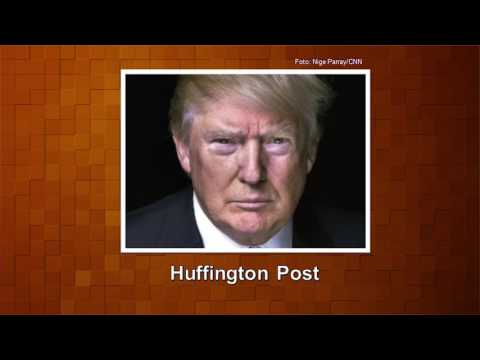
The American site The Huffington Post,
somewhat concerned about the amount of information truncated
which the Republican was giving during the campaign,
decided to scale a team of five professional journalists
to keep up with what Trump was saying for an hour.
In 60 minutes, my friends, believe me,
71 wrong information.
From false absurdities to small slips
that any of us would identify, even though we are not Americans.
And what happened? Anything.
Trump was elected. It is not?
In the audience there are certainly people saying, “It’s Mark Zuckerberg’s fault.”
Ever.
I agree in part.
True, Facebook has an algorithm,
and the algorithm decides what we get in our timeline,
in our news feeds.
I agree too
that recently Facebook made an international, public announcement,
that this algorithm is designed to approach people who already know each other,
that is, our friends, our family members.
I even think that makes sense.
I’d rather know what my husband posted on the internet sooner than yours.
But what does that generate?
Bubbles.
Digital bubbles.
Bubbles where we only live with those who are our friends, our acquaintances.
And then let’s do a quick exercise.
What is the probability of someone on the extreme right
to be a friend of the extreme left?
What is the likelihood of someone in the lambaerobic
to enjoy the yoga galley?
And what is the real chance of someone who likes heavy metal
walk with the axé guys?
And so are we all within our bubbles.
And here comes our share of guilt in this whole story.
Break the bubble!
Turn your social networks into uncomfortable places,
in places that defy your head.
Let us train our eyes to that which is different,
to what is at odds with what we believe.
Because? Because it does well.
Because it takes us out of the bubble.
Maybe you do not know, but false news
is made not only for the pleasure of spreading false news.
Give me money! A lot of money!
There are some Saturdays, the newspaper Folha de São Paulo
made a long report, and located in Poços de Caldas,
in Minas Gerais, a group of young people, like you in the audience,
who learned how to use AdSense,
which is a Google banners distribution system,
and added this wisdom to the ability to build pages on the internet
and generate news and posts on social networks
with titles beyond shocking,
with little truth.
And what happens?
You click, I click, we click.
And they stuff their pockets.
Folha de São Paulo estimated that this group of Poços de Caldas
reached R $ 150 thousand in a single month.
Just so you have an idea of what I’m talking about.
Has anyone heard of Veles? Veles is in Macedonia.
And why do I bring Macedonia to a TEDx in Blumenau?
Because it was from Veles that the pages of “fake news”
that populated the American elections
last year.
There are dozens of reports in the American press
revealing that groups similar to Poços de Caldas
played in Macedonia to influence the American election.
[False news] is all over the place.
It can affect anyone at any time.
And where will it stop, folks?
In my humble opinion, it will not stop.
This study from the Reuters Institute,
which is an institute that monitors the consumption of information in the world,
asked in 2013
for young people living in the urban centers of the world
as they consume news, where they inform themselves.
And 47% of these young people said: social networks.
And the same question was asked last year.
And the answer?
Social networks for 72% of young people.
There is no evidence that the consumption of news on the internet, on social networks,
go stop
And there is also no hint that the false news will stop.
So, I bring you some very simple techniques today.
I’m a fact checker.
data checker, facts, speeches.
I am part of the International Fact Checking Network,
which is the international association of data verifiers.
And these tips I’m going to bring to you are now relatively simple.
to be put into practice and I can guarantee:
if they really are put into practice by you,
we will make a difference as of today; we will leave our inertia.
The first tip is:
a data without a source is of no use.
Where does this number come from?
If you do not know how to respond to this information,
Just ignore this, please.
Two: watch out for relative numbers, folks.
Percentage is a risk.
After all, one thing may have, yes, climbed 100%,
but have gone from 1 to 2 and remain irrelevant.
Let’s combine.
Data mutated.
Be careful when people, and especially politicians,
make comparisons of information such as health and violence,
which are data that, unfortunately, change every moment
and also, unfortunately, are counted
with different methodologies from one state to the next.
They also doubt, especially,
reinforcing the politicians, who hate me,
when any of them say that cause B.
What is the thing, what is the factor of our life that is so simple?
Doubt this information, these simple causal relationships.
They become imbeciles. I lose my temper with that.
And finally, please,
do not tolerate sentences that contain the expression
“the largest in the world”, “the smallest in the world”,
or “the worst” or the “least in the world.”
What is the real chance that guy has checked the whole world?
Zero.
At the very least, he is exaggerating.
Since 2004, I work with “fact checking”,
That’s what I’m bringing you today.
already happens in Brazil.
In 2014, when I was still the political editor of the newspaper O Globo,
in Rio de Janeiro,
we implemented the country’s first “fact checking” blog.
In that 2014 election, we worked for 90 days
and analyzed 374 phrases
spoken by all the presidential candidates of the time,
and by the two leading voter intent polls
of six states.
Of the 374 phrases that we evaluated,
48% had some degree of misinformation.
Now, please imagine what the election campaign would have been like,
and the result, obviously,
if we all, voters, had not been the targets of such bullshit?
Today I direct the Lupa agency.
It is the first news agency in Brazil to devote itself fully to
to “fact checking”.
I select the sayings out there,
I contrast these sentences with public databases
and stud if they are true or false.
I do this because I live in constant doubt,
and this position is pleasant.
I doubt even my husband who tells me:
“Let’s have dinner outside, everyone will.”
Me: “Everyone?”
(Laughs)
“It does not fit.”
But how the hell did I get the “fact checking”, did not I?
The day I attended an event in Medellín, Colombia,
and that there was the Checked,
which is a Latin American reference in checking.
And then I was in the audience, like you, and I watched a video in Spanish
in which the Director of the Checked Question asked thus,
showing a lot of images similar to the ones you are seeing:
“Why is it that we all come together to watch the World Cup,
to go to the football game,
to watch the rock show, to pray “,
and even to come on a Sunday to watch a TEDx?
“Why do we do this and we do not join
to seek the truth?
Why do we come together to do all this?
and not fight the lie? “
Quality information is power, people.
Who has information has power.
If you are well informed, you can decide from simple things,
as in which college I enroll my son,
even very serious things, like who will represent me in Brasilia.
Without quality information you are unable to take
these decisions consciously.
You are being manipulated by misinformation.
And this is why, my people, I came today to say the following:
Let’s set up an army of checkers.
We are all capable of doing all this together.
And it will be a great pleasure to check with you.
Thanks.
(Applause)
”
Be First to Comment