
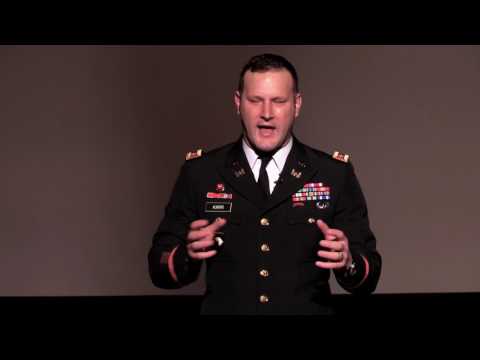
Hello, I am Major Adam Karr.
I am going to talk about translation and war.
I am going to try to encourage you to think about translation and war.
More specifically about the role our interpreters fulfill.
This is not about correctness or employability,
but about their role as a means to achieve mutual understanding
with our target audience and especially with our interpreters themselves.
I give a fictional example.
It is November 2004, Fallujah, Iraq,
the second battle of Fallujah.
The troops fight house to house.
One regiment is preparing
to clear a house
from which it is suspected that the rebels operate.
They fall in, the leader kicks in the door, three others follow.
They go through the hall to the living room.
In the living room they encounter a frightened, unarmed man.
The team leader points his gun at the man,
squats against the wall
and asks via his interpreter:
“Are there more people here and are they armed?”
Behind the door to the next room
is the man his 16-year-old son.
He wants to enter and know what is going on.
As soon as he opens the door, a soldier will aim his gun at him
and have to decide in a flash whether he will shoot.
That decision will mainly depend
of the answers the leader gets to his questions.
In this they rely entirely on the interpreter.
I propose this hypothetical situation because it is symbolic
for the way we see officers, translation, interpreters and war.
They are a kind of medium,
similar to our micros and radios.
We send a message about a secure frequency
that can be heard at the other end and we do not doubt the accuracy
of the message we receive.
We do not understand Arabic better than those protected frequencies
about which we send our messages.
I am not saying that everything is clear and clear to us
or that we are naïve.
We often catch interpreting on the manipulation of translations.
Even if we can catch them, there are two possibilities:
it can be a lack of knowledge.
The interpreter does not sufficiently speak English or the local language,
as a result of which they can not perform their duties in the conflict as a mediator.
Or we can also question their loyalty
and think that they deliberately manipulate the language.
An important remark, I will come back to it later,
is that we rarely look critically at whether we formulated correctly
when we wonder why the message was so bad.
In my hypothetical conflict situation
it is okay to see translation as an instrument.
The interpreter ensures a fast transfer of discrete information
and you want a binary answer,
you want a ‘yes’ or ‘no’.
Language freaks like me amuse themselves with mosquito sieves
about how the interpreter can nuance further.
He may not say gun, but gun, or gun.
He could also say Kalashnikov.
He may not ask if there are other people,
but whether there are men,
because he can not refer to women from his culture.
These are all insignificant nuances.
The soldiers get the information they need
to make the right decisions when necessary.
But your interactions in Iraq and Afghanistan
will seldom be as correct, fast and clear.
We’re talking to officials,
local security agents, village chiefs,
merchants, workmen, you name it.
These conversations seem more like political negotiations
then on a hasty exchange of information
when under fire or during a fight.
In those cases, these minor nuances become translations
quite problematic because of the possible consequences.
Now I want to dwell on these consequences.
What exactly is language?
Translation scientist Lawrence Venuti calls language a ‘chain of indicators’.
‘Indicator’ because words, even if it is never perfect,
refer to a concept, idea or object.
It is a chain because we put them in an order.
Anyone who has ventured to linguistic studies,
know what happens when the order is disrupted.
Then you have a problem.
You disrupt the message when you disrupt the order.
He further discusses the indicators and their relativity.
He uses difficult words, but it comes down to it
that your personal interpretation of a word that you hear,
is based on a very complex combination of factors.
It has to do with education, experiences, environment, target audience,
with the person you belong to.
And like snowflakes,
is the way we interpret an indicator
unique for every person.
What happens on a cultural level,
what he defines as shared values, beliefs and experiences,
is that you develop a shared interpretation within a small group.
Because of their shared values, beliefs and experiences,
cultures feel one and they become homogeneous
in their interpretation of these indicators.
You also know this phenomenon.
You have developed a sub language within your group
with which you are familiar, even if you do not think about it.
So if someone from this audience says: “I have to make hours this weekend”,
everyone here understands that.
Not only the literal meaning,
but you can empathize with it
because you also understand the figurative meaning.
The speaker regrets something here
or is frustrated that he has to give up his weekend.
This term has a lot of charge.
There is a shared interpretation
of this complex concept.
When you would call a friend from your hometown, or other school,
and says, “I have to change this weekend, I have hours.”
Then it is probably a bit confused.
You get the reaction: “What do you have hours for?”
One does not understand what it is about.
And you might also ask: “What do you have to adjust?”
One of my students recently pointed out to me.
This is a funny example of the relativity of language.
But you already feel how this is in serious situations
much more important and can have major consequences.
An easy example is the word ‘democracy’.
When you talk about democracy in most places in the US
you do not immediately think of the definition from the dictionary
or to the Greco-Roman tradition.
We think in function of our own life, what it means to us.
It can be very specific.
When you say the word ‘democracy’
in Iraq, Afghanistan, Syria, Libya or in Ukraine,
then you might get a very different reaction.
At best it is associated with corrupt oligarchs
and in the worst case you get the answer:
“In a democracy tanks come through the streets,
that bring down electricity wires.
That happened the last time when we had democracy.
That’s how I experienced it. “
The connotation is therefore different.
I explain it.
Imagine you are a patrol leader who appeals to the population in an idealistic way
and your main message is:
“I’m looking for democracy.”
Maybe it will be different than you mean.
You may not have the same view as your audience.
Now that we know this more complex understanding of language,
I will discuss a fragment from another story to further clarify this.
The story is ‘Fives and Twenty-Fives’, by Michael Pitre.
The story follows a navy corps through the Sunni triangle in Iraq
in the very turbulent years from 2005 to 2007.
In this fragment the peloton has just stopped at a dilapidated farm
located along a dangerous road and they go to investigate.
They have never been here before.
It is told from the perspective of Kateb,
a native who speaks English, which the platoon and the interpreter do not know.
We read the story from his point of view.
I have omitted the obscenities
because they do not contribute anything, but when it sounds strange at times,
this is because I have adjusted a number of words.
“When they searched everything, they let them sit next to us
and called an officer via their radio.
The officer, a remarkably muscled black man,
came to us, accompanied by an interpreter.
The obese interpreter, from Kuwait,
to judge by his accent and expensive watch,
grinned at us.
“Good morning, I’m Lt. Pederson,” said the officer.
“We are sorry that we have to search everything like that.
It is necessary because of the anti-Iraqis, the bad guys.
I have to ask you a few questions.
What are you doing here, who are you, that kind of thing.
He points to his interpreter.
He says in Arabic:
“This guy, Pederson, he’s going to make your life miserable.
Tell where you have hidden your weapons.
He is the cousin of 50 cents, really. “
Pederson continues in English:
“Do you have guns? Guns? An RPG?
A gun is no problem, one kalashnikov per family. “
He points to the interpreter from Kuwait, who speaks again in Arabic.
“Do you know apostates Abu Graib, this is getting much worse.
Tell Pederson where the missiles are
or you’re going to make a pyramid naked there,
we take pictures of them and put them on Myspace tomorrow. “
This was in 2005, when there was Myspace.
I want to focus on the innocent sounding sentence
‘those kind of things’.
He does not want the interpreter to literally translate ‘things like that’,
he used it as ‘and so on’.
It replaces a series of questions that a patrol must ask
when they come somewhere new.
Questions like: who are you, what are you doing here,
what are you selling, have you seen someone suspicious,
do you have weapons or contraband, has someone recently asked for this?
He has a shared view with his soldiers
of what these questions suggest.
At best, his interpreter simply does not know this,
or, in the worst case, he is lying.
This simple sentence includes a very complex chain of indicators.
Pederson’s unit and units above them have the mission
to create stable democratic institutions in Iraq.
The unit among them decides that to obtain this
they must restrict the violence in such a way
that citizens can approach their authorities
without fear of retribution.
This set of goals touch up with Pederson,
and his job is to eliminate ‘bad guys’.
With this aim he will map their movements,
trace their resting places, etc.
This whole series is covered by the phrase ‘that kind of thing’.
The soldiers know all this, probably not the interpreter.
It is not just a series of indicators,
this sentence is primarily an expression of many cultural assumptions
Pedersons has about his mission.
We all understand that,
such as the universal applicability of Western democracy,
the attractiveness of free-market capitalism,
philosophical assumptions about the relationship of citizens
with their government.
Pederson probably does not mention all these things every time,
but he certainly assumes the assumption
that if he can limit the violence in his territory enough,
the citizens will automatically take over these values.
This is all bundled together
in his first interrogation to obtain cooperation.
When he says “things like that”
he asks his interpreter to ‘interpret’ this.
That is exactly what the interpreter did.
In this story, however, the interpreter himself appears to be malicious,
a spoiled teenager who abuses helpless people
and with a navy corps to hide behind.
Pederson asked him to translate, and that is exactly what he did.
For us it is clear what Pederson wants to achieve.
He wants cooperation and good rapport.
He knows that the people he talks with are in danger.
Because of this he also knows that they also know that they can be prosecuted
by radical fanatics when they cooperate with him.
He tries to convince them that it is in their best interest;
that he can protect them;
that he has confidence in them and that they should have it;
and that they have to take the risk of advancing their country,
long-term.
It is not a simple goal, but it seems pretty clear to us.
But for a resident of Kuwait or Iraq, who lives there all his life
in violent repression by tyrannical dictators,
or American invasions,
or by radical violence,
this goal is not so clear.
They are not on the same wavelength as Pederson, and certainly not as his interpreter.
The interpreter distorted Pederson’s message,
so that he could come to an interpretation that he believed shared with his audience.
That interpretation is, of course, that of a threat.
He is right to assume that the residents of a dilapidated farm
along a dangerous highway in the Iraqi Soenitic triangle in 2006,
not necessarily have a good frame of reference
in terms of creating a stable, sustainable democracy
and have no idea what Pederson’s anti-terror strategy entails.
Instead of explaining something that he knows or thinks about
that the Iraqis will not understand,
he makes something of it that they will understand.
He can assume that they have already heard of Abu Graib
and what happened there.
He can also be almost certain that they know who 50 Cent is
and that they can find themselves in this representation of American culture
and power.
He distorted the meaning of what Pederson wanted to communicate
to an interpretation that, according to him, will resonate with his target audience.
However, I do not want to talk about what the interpreter did.
Another scholar, David Damrosch, said:
“In addition to all the abstraction and relativity of language
you also have good and bad translations. “
I would describe the translation of this fat Kuwaiti as bad.
But I want you to pay particular attention to this translation process,
again, not with the correctness or its functionality,
but in this creation of a shared interpretation
and understanding the cultural and linguistic forces
that affect the translation.
Pederson wanted to convey the deeper meaning of ‘that kind of thing’.
It is about trust and cooperation in a very complex environment.
Taking this into account is a correct translation
therefore not immediately an effective translation.
A correct translation means that you give a literal translation
of ‘that kind of thing’ and that is not what Pederson wanted to communicate.
When we think about what makes a translation good or bad
or about achieving a shared interpretation,
it is obviously important to understand
what the cultural and linguistic dynamics are that shape our interpretations.
There are a number of practical values and some abstract ones.
If practical is important, do not choose idioms.
Do not use ‘that kind of thing’
if your interpreter is not like-minded.
Hopefully you will receive this from smart officers during training sessions.
Also be critical of your own message, pay attention to the reaction of your audience.
If you want to convey confidence, but the reaction is fear,
then you have to start thinking about whether there is a shared interpretation.
The last thing I want to say is: go against assumptions
that are rooted, where you no longer think about in your own language.
You may notice that your audience does not share those assumptions.
I will give you one more hypothesis.
If one were to hide weapons in that dilapidated farm,
especially if they are for a terrorist group,
and at the moment the Kuwaititi is threatening
to throw them naked and put them on the internet,
they would give their weapons promptly,
was it suddenly a good translation?
If you know the answer, please let me know.
I break my head about it.
Thanks.
(Applause)
”
Be First to Comment