
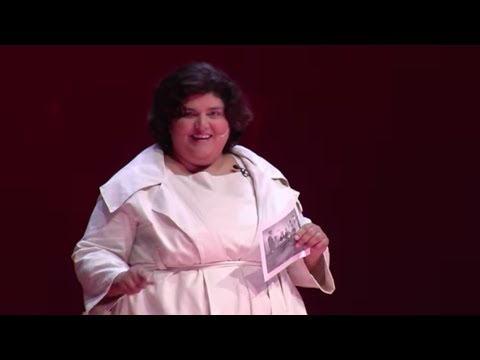
Look at this picture.
I love this picture because I look gorgeous,
so smart in my white suite.
Also, because it best represents my life.
I’m alone, surrounded by men.
Men that feel awkward,
wearing contempt smiles, feeling a bit nervous.
Because I’m standing in a place we women are not allowed to be.
Where men are allowed but not us.
I was the only woman in the National School of La Plata.
The first woman to study medicine at UBA,
and the first foreign woman to get Argentine citizenship.
(Applause)
I’m not here to talk about how unique I am,
but how unique all women can be.
This picture represents a historical event
of great importance for my life and for the lives of all women.
In 1911, all inhabitants had to register for the city elections.
What are the registration requirements?
To be a citizen of legal age and resident of the city,
have a business or industry, practice their profession
and pay taxes.
I complied with all the requirements.
Obviously, women cannot vote,
but they had forgotten to add this.
Or perhaps, it’s so obvious it wasn’t necessary to clarify it.
Anyway, I took my chance,
I went to register and they couldn’t prevent it.
I remember how carefully I kept that ballot.
It was my passport to a new right.
(Applause)
I couldn’t sleep the previous days.
On the elections day, I woke up early,
I dressed in my suit and went to St. John the Evangelist Church.
The soldier guarding the entrance
didn’t let me in.
So, I stared at him and told him:
“I’m going to get in, I’m a citizen and have rights and want to enter.”
The man told me: “It’s a place for voters.”
So I looked at him and said:
“It’s easy to play macho with a gun at the waist, isn’t it?
He was stunned —
(Applause)
He was shocked.
So I plucked up my courage.
And said: From whose womb were you born?
From a woman’s.
Who washed your bottom and fed you when you were a baby?
A woman.
Who will do that when you become a decrepit old man?
A woman.
(Applause)
Maybe I crossed the line,
but nothing is more annoying to me than injustice.
To top it all, I showed him the ballot,
and he had to let me in.
I stood behind the last man in the line.
They all looked at me a bit awkwardly, some were mad.
But I stood there, with my head held high,
calmly looking ahead.
When it was my turn, I gave them my certificate
and like the most ordinary procedure in the world, I was allowed to vote.
It would be unfair if I told you all men laughed at me.
Not all men are against our rights.
Some women sometimes are more tough.
(Applause)
The chairperson was Saldías,
he told me he was proud to sign the first woman’s document
in the suffrage for the city elections,
in the country and in South America.
Yes, I was the first woman to vote in Argentina and South America.
(Applause)
The image pictures it perfectly:
November 26, 1911:
The first women’s vote in South America.
That one sitting down, the soldier there,
isn’t the soldier who stopped me.
He is the one behind me, you can see a bit of his hat.
I got before him so he couldn’t be in the photo.
(Laughter)
I ran to the papers to tell the news.
As a woman I had taken part in the elections with my vote.
Every woman in the country and the world should know it,
it was the chance to start changing things.
Don’t wait for the system to change to attain goals.
Especially, if it is the system what you want to change.
(Applause)
Dig deeper and deeper, until you find a way out.
Then, from the inside, fight to change things.
I learnt from medicine that a very severe disease
is not cured with lotions but with shots.
When a prescribed drug enters the body it starts working.
So I managed to vote and I was after national elections.
Warned about my intentions, they didn’t let me in.
They said I needed the military register.
And, what a coincidence, only men can do military service.
So I asked the War Minister himself
to enroll me in the Army.
Envision me doing push ups in this suit —
No, I didn’t make it. I wasn’t allowed.
But it was better, for them.
Because I kept looking for the legal loophole.
Searching endlessly.
And Constitution said we couldn’t vote,
but could be candidates, instead.
It also said, “Nobody can be banned from doing what is not prohibited.
I asked Angela, a friend, who is a lawyer and an activist,
and she told me I was right.
We could be candidates and hadn’t capitalized it.
I ran for Congress in the nation-wide elections,
filled the city with signs,
and claimed our rights everywhere.
It is incredible that we are ignored by law,
not considered subjects of law,
that all laws are biased
because they are made by men.
The female approach can contribute a lot.
We are nobody’s property.
Husbands and wives must have the same rights.
And on second thought,
marriage should be abolished for it is not necessary for survival.
(Applause)
We also vindicate mothers’ role
as basis for creation itself.
We are children’s advocates,
mostly for orphans, their education, hospitals —
Who else would be better than us in fighting for their rights?
But we don’t stand for women,
because women are not a “thing” needing to be defended.
They are strong, as everyone else,
having been placed in an inferior place by countless prejudices.
(Applause)
Women should stand for themselves,
and achieve all their claims.
Women emancipation should blaze
by overcoming preconceptions,
and no longer imploring rights.
Because, women, you know what?
Rights are not begged for, but conquered.
(Applause)
And we have to seize them.
We have to conquer them.
Look how unfair it is.
If I asked you to raise your hands
and tell me who voted,
it would surely be the hands of men and only one woman: me.
Let’s try it. Who voted?
We did it!
(Applause)
”
Be First to Comment