
Well, as you can see,
non-verbal autistic children are so adorable and loving
like all other children.
The consequences of lack of interaction and social exclusion, on the other hand,
can be brutal both in their lives and in the lives of family members,
and the very lack of connection causes people [underestimate]
the cognitive ability, the capacity for interaction, that these people have.
But that can change.
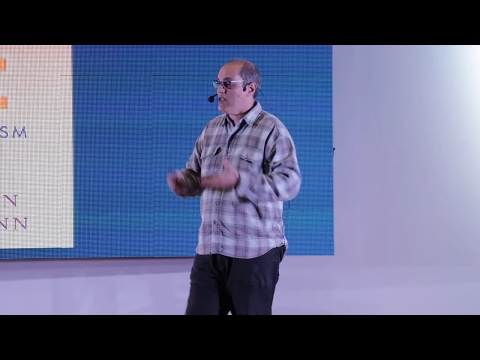
This book here, for example,
brings a story that was very shocking in my life.
He tells the story of an autistic girl, Carly Fleischmann,
that only at 11 years of age
was able to communicate with the world for the first time.
She was in the process of doing therapy and, on the day of therapy,
they realized that she was very agitated, very anxious,
and instead of following the normal procedure of pairing images with concepts,
she decided, to everyone’s surprise, to use the keyboard and wrote:
“Help tooth hurts”.
That is, with this, she showed the importance of language
and the first contact in her life was to call for help, to ask for help.
From that moment, based on the report of the parents themselves,
as she was building vocabulary,
was that they realized that within it was an articulate, intelligent person,
which they simply did not know.
In fact, nowadays, she has a blog, which is very accessed,
and the reports she put on this blog were very important for us to understand
that the great difficulty of connecting the autistic with the world
is due to sensory hypersensitivity
and the distortions they feel in senses such as touch, sight and hearing.
(Loud and uncomfortable) This means that there are probably many autistic
who are aware of the world, want to communicate, want to interact,
but they can not because there is a noise in the communication interface.
(Noise ends)
What I just said is that this report by Carly Fleischmann
indicates that there are many autistic
who are aware of the world around them, want to interact,
but they can not because there is noise in the communication interface,
like the one we just heard and Siri’s noises as well.
It was all armed, right?
So the question is …
In fact, these reports have aroused a great optimism in me,
is a case that arouses a great optimism,
but at the same time a very deep sense of urgency
on what to do to improve this communication interface,
to reduce this noise so that we can see
more cases like that of Carly Fleischmann going on.
Of course the first step is to understand how the autistic mind works,
specifically nonverbal ones.
In general, it is very common for nonverbal autistic
some degree of auditory processing disorder.
What is it?
Although not deaf,
the sound comes full of noises in their brains,
and the same process that generates noises in the information input
can also generate noise when the brain wants, for example,
to command the mouth to articulate words, or the hand to write them,
ie the number of organic obstacles
that the autistic have to develop the language is enormous,
and not only language in its express form via speech or writing,
but language also in its use for thought itself.
This is because the brain that did not develop the language
uses images and sensations to organize his own thoughts,
but does not use words.
Now, you try, for a few moments,
think of anything without using any words.
Go there.
Difficult, is not it?
In fact, I could almost hear from here the effort of some like this:
“Do not think of words … do not think of words …”
This is because our thinking is inherently structured
and organized by words.
Words are logical tools
that help us organize the information that comes to us.
Words allow us to talk to ourselves
about our experiences.
Now, imagine what it’s like to live like non-verbal autistic,
who do not have this resource, the cognitive difficulty that this imposes.
In addition, in general,
it is known today that the mental universe, the inner universe of the autistic,
is a very intense universe,
according to these reports that I just described to you
and according to scientific results
of research done with both humans and animal models,
which indicate that the autistic brain is different.
They have much more interconnections between neurons
and neurons are much more active.
This explains, for example, hyperactivity,
explains the sensorial distortions
and explains phenomena, for example, as is the case of synesthesia.
Synesthesia is a phenomenon
through which the stimulus of one sensation invades that of the other.
In the case of autistic patients,
the sounds form images in the region of the brain used by sight.
It is as if the autistic see the sounds,
or rather, the sounds interfere with what the autistic see.
So, in the face of all this,
What can we do to reduce the distance?
between our minds and the minds of the autistic?
Well, I believe there are two complementary paths to that.
The first path is in the sense of bringing them closer to us,
trying to decrease their neuronal overactivity
using cannabidiol, which is a compound derived from Cannabis,
to try to reduce hyperactivity
and other symptoms related to excessive neuronal activation:
attacks of nervousness,
sensory disturbances, etc.
The other way is to use tablets,
those of touch interface,
for the visual teaching of the word and digital writing,
leaving aside the phonetic structure of words
and manual cursive writing.
In relation to the first case, the first path,
I wanted to say that we have results with cannabidiol,
our group and other groups, very promising
and in relation to the second path, I wanted to introduce you to Lietro.
Lietro is an application package
designed for inclusive education
of written language
and teaching the use of words for thought.
The Lietro is composed of several modules.
Each module uses different strategies.
One of the strategies used, for example,
is to use the touch relationship with the image to create a functional link
between words and their meanings,
that is, words are learned whole, as icons.
Once they are learned, then,
these icons can be rebuilt
through the drag of small pieces with letters or syllables
and possibly with the use of adapted keyboards.
There are also modules in which there are games
that stimulate the mental use of words.
In addition, the entire system can record
not just the performance of the user in the proposed tasks,
but his own interaction with the interface,
how it interacts with it.
All this is registered
and can be used to optimize the interface for each individual,
to optimize the method as a whole
and can make this system a tool for research
and optimize, say, an inclusive neuropedagogy
and specific to each individual, in fact.
Well, this is Cauê, my autistic and non-verbal son,
who this year, at the age of 11,
coincidentally the same age as Carly Fleischmann,
communicated for the first time.
And the first time he spontaneously approached
to take something that was in his mind and say what it was,
I was on the computer…
there, he took the keyboard and began to write, letter by letter,
“A – D – V – E – N – T – U – R – E – S”, also in English, without copying …
I, looking at that, haunted, “What … I’ve never seen this …”
I thought I was psychographing a gringo spirit …
(Laughs)
Then, as I recovered,
I understood what he was talking about.
He was talking about a series that we really like watching together.
and that we only have in English.
In English, it’s “Bert and Ernie’s Great Adventures”,
“The Great Adventures of Bert and Ernie”,
and it’s a series that we like very much to watch and watch together,
and every time I watch this episode specifically,
I tell him that I believe
that the next great adventure of humanity
it will not be the discovery of intelligent life outside the Earth;
it will be the deep contact
with the fascinating universe of the non-verbal autistic mind.
Thank you very much.
(Applause) (Live)
”
Be First to Comment