
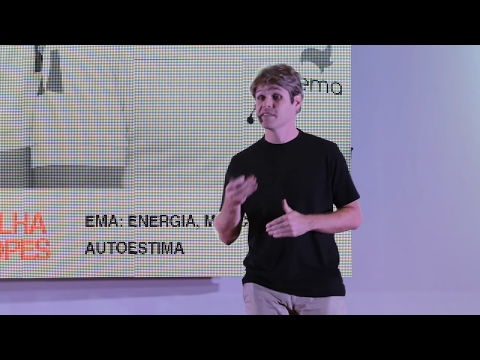
I was a triathlete for many years
and when I stopped competing, I felt that thump,
that lack of disposition that accompanies those who stop training abruptly.
But in fact, when I say that I have stopped training,
I did not really stop, I did not stop completely from doing physical exercise,
because I kept walking, climbing stairs.
Now, imagine you, who are sitting a few hours ago,
if they had been sitting for years,
unable to move the muscles of his own legs?
Imagine the benefit you would feel
if they could exercise their own legs again?
For it is precisely this population
I would like to talk to you here today,
of people who have suffered a bone marrow injury.
Depending on the level of the lesion and the height at which it occurred in the spine,
these people can lose the movement of the legs or even of the hands,
but this is not one of the major challenges these people face on a day to day basis.
I think the most difficult
is, in fact, a non-inclusive society,
a non-accessible environment, a limited technology.
The wheels are the legs of a wheelchair,
but when he comes here and finds a ladder,
he can not get where he wants to go.
Our hands allow us to write, create, make music,
but today’s medications
they can not restore these lost movements.
We need technology that empowers, through mobility and autonomy.
This technology already exists today: it is functional electrical stimulation.
By means of low energy stimuli,
applied on the nerves, or even on the skin,
we can activate the muscles, generate strength,
but it is something different from those mechanical exoskeletons
which we put on the skin,
because the electrical stimulus is perceived by the body
as a command of the brain itself.
Electrical stimulation [speaks] the natural language of the nervous system.
In this video, we see Mariana.
Mariana can not control her own movements.
Today, she is experiencing electrical stimulation for the first time.
Here, we can see that we can control the movement,
generating this alternate movement that we wanted,
but are still irregular movements.
There are spasms, there is an accelerated fatigue.
Unfortunately, today, this technology still
that we can restore complex movements,
like walking,
but some types of movement have already been restored
with this type of technology.
Nowadays, it is already possible to pedal.
This is EMA Trike.
In this tricycle, we board computers, sensors and an electric stimulator.
to allow people with paraplegia, without the control of the movement of the legs,
can exercise those legs again and, perhaps, even pedal.
This system controls several muscles,
precisely activating the muscle at the instant it needs to be activated
to generate the pedaling movement.
But this one is not just a history of advances in science and technology.
This is also a story of how to really get things done together.
I am an engineer.
As an engineer, I feel great pleasure in doing things,
but I found my greatest motivation developing technology for health,
and this technology we do not develop alone.
We need, before designing, to program, to talk to one another,
to listen to reality.
So, to understand a little more of this world,
I invite you here my friend Estêvão Lopes.
(Applause)
Estevão Lopes: Brasilia, March 7, 2012.
I remember one Tuesday night.
I’m getting ready to go to a friend’s birthday, I’m making myself,
I’m going to the birthday party, I have fun, the party is wonderful.
When it’s time to leave, I head for my car
and, to my surprise, there’s an exchange of shots.
A stray bullet hits my back.
From that moment, I lose the movements of my waist down
and I do not feel my legs anymore.
I become paraplegic, needing a wheelchair to get around.
I can speak with propriety on the subject exposed by Antonio
because for three long years I was in this situation,
without even seeing my leg having any kind of movement,
but then I got to know the electrostimulation.
I confess that in the beginning I was afraid because the advances proposed to me
were advances that, in three years, I never imagined I could reach.
I remember that even my physiotherapist said the following:
“Dude, you can go back to pedaling.”
I said, “Dude, back to pedaling?
I do not move a finger, let alone pedal.
What are you talking about?”
Anyway, it was more a new technology.
Why not take the risk and test it?
I tested it and, to my grateful surprise,
really the advances that were being proposed there
happened in a way bigger than I expected.
I quote a legal passage, which is as follows:
everyone there, or the vast majority, must have looked, practiced academy,
and you know how hard it is for you to have a gain in muscle mass.
With more or less a six, seven months, of training with the electrical stimulation,
I reached 12 inches of hypertrophy on my thighs.
Not only that: my circulation, my skin, improved.
I saw in my leg there a normal leg
and with it all, [came] the gain of self-esteem,
to be there with my legs like they were before.
So sensational.
Antônio Padilha: Estevão, but tell us people
How did it feel to regain control of your legs again?
EL: So you imagine,
for a long time there without even moving the leg,
and I began to take the first few pedals, half disconcerted, anyway,
but there, finally, they were pedaled.
I was seeing myself in a pedaling situation,
an indescribable, surreal sensation.
I came out of another world, from a world where I did not move my legs,
and there he continued to pedal again.
The most important is what?
This new technology that was passed on to me
I would not be alone with myself as a high-performance athlete,
that I am a Paralympic athlete.
This technology would extend to normal people:
the wheelchairwoman who is a housewife, who has an idle, sedentary life;
the retired gentleman who has the dream of pedaling again.
And then, it made me even more enter into this project
and I dedicated myself.
It really turned my life project
and I joined and became the pilot of the EMA project.
And then, the training became constant and daily training.
The conviviality with the team, every day,
there getting better, seeing that pedal improve,
it has passed us a level of team and we have become a family.
And today I speak with propriety: we are not the EMA team;
we are the EMA family.
AP: This story stayed here in Brasilia? Did she go somewhere?
EL: Cool. Guys, I’ll show you around.
Look at this, man.
Let’s watch with me.
A guy who did not even touch his finger.
Look at this.
Is not it surreal? Is not it sensational?
Look at this!
(Applause)
This is a competition called “cybathlon”,
popularly called “bionic Olympics.”
This competition brings together the world’s largest technology companies,
the world’s largest universities, seeking the best technology.
There were Japan, USA, the whole world.
and, to my great surprise, and to gratify this whole team,
we got to the end.
Today, I get upset and creepy because today I pedal, I’m a cyclist,
I am pilot of the EMA project.
You will see a wheelchair driver in Brasília pedaling,
not with the hands, but with the legs.
Thank you guys!
(Applause) (cheers)
”
Be First to Comment