
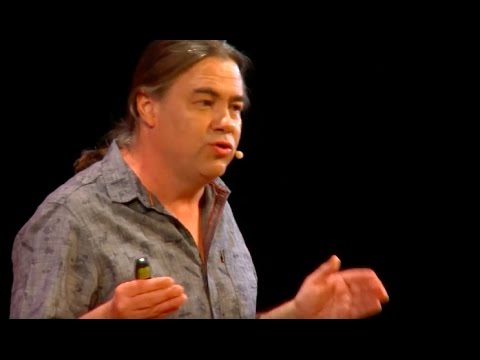
This is my grandfather Enrique.
The one sitting here beside me, with the typical dazed expression
that I usually have when I have to wear a tie.
My grandfather was a surgeon.
I will never forget the day when he told me:
“A surgeon is a person who has the lives of others in his hands.”
When my grandfather started to work
penicillin had not yet been discovered.
Therefore, the fate of the operation and of the patient
did not depend completely on the surgeon,
but from the possibility of an infection developing.
My grandfather lived a pivotal moment for medicine
because, starting from the appearance of antibiotics,
not only were operations possible,
but it was also possible to treat injuries, carry out transplants.
Only during the Second World War, penicillin allowed to save life
of six million injured.
Here I am with my parents, on my first Christmas.
My father was a pharmaceutical representative
the main product that sold his laboratory
it was just an antibiotic.
As you can see here, I’m happy,
although maybe I’m more distracted
from the balls of the tree that plays.
I’m happy with games and gifts.
However, if you see me healthy and robust, it’s because in my house
there was a good culture of health care.
As you see here – I do not ask to read it – there is a note written by my father,
which he left to my mother, with the times when she was supposed to give me the bottle
and the medicines.
What I would like to tell you is: my parents and I lived in a world
in which antibiotics were part of our daily culture
and by now nobody lived with the fear of dying because of an infection.
Unfortunately today, in the 21st century, the scenario is completely different,
because the bacteria are becoming resistant to antibiotics,
and these are ceasing to work.
In the United States alone, two million people are infected every year
from antibiotic-resistant bacteria,
and 23,000 die from these infections.
So what should we do?
I ask myself that I am a researcher, a fairly interesting profession
to be invited to give a presentation to TEDx,
but that does not guarantee that they invite me to a room where we talk about this.
In my laboratory we try to understand
how some bacteria converted into superbugs,
that is, capable of resisting all types of antibiotic,
and understand how they can be blocked.
Here’s how you think, generally,
see a superbug with a microscope:
a monster that flies, full of fangs.
The reality of detection of the superbugs, however, is a little different.
I discovered the day when they brought an isolated clinic to the laboratory
of a seven-year-old patient suffering from bacterial meningitis,
hospitalized at Clemente Álvarez,
who died because no antibiotic could cure it.
I would therefore like to share a couple of questions with you.
Why do we find ourselves in this situation? How can we get out of it?
Antibiotic resistance is an inevitable consequence
of the use of antibiotics.
World production of antibiotics
it is 100,000 tons per year.
This is equivalent to the weight of a 300 m wide, seven-storey cruise ship.
Two thirds of this production
is dedicated to the improvement of animals.
Only the rest is used for human health.
Of this part, used for human health,
half is used to treat colds or flu, which are viral diseases,
that do not require antibiotics.
This means that, year by year, we use tens of thousands of antibiotics
for anything, disseminating them in the environment.
In this process, we are practically
selecting the most suitable bacteria to survive.
We are accelerating their evolution.
Since we are talking about evolution, I will give you an example familiar to everyone,
that is the case of the cheetah, the fastest animal
that exists on this planet.
It was selected so quickly by evolution
because in this way he can catch his prey
and avoid starving.
In turn, gazelles, which are habitual prey of cheetahs,
they have developed other mechanisms, like running in a zigzag, jumping
or have more resistance, because otherwise
running slower than cheetahs, they would end up being their dinner.
The game we are playing nowadays is quite similar.
We must therefore ask ourselves how we are running
in this evolutionary race against bacteria.
We will see an experiment
in Roy Kishony’s lab at Harvard,
in which, at the tip of this table, bacteria are grown.
In the tip of this table
you can easily see where there is zero, that there are no antibiotics,
while going towards the center,
the amount of antibiotic increases gradually.
At the beginning, immediately after sowing,
we see that they grow, obviously in the area where there are no antibiotics.
But then, it’s just a matter of time:
the bacteria start to change, to adapt and grow up to the internal areas.
This video shows how, in just 11 days,
the bacteria managed to adapt to a concentration
a thousand times higher than antibiotic.
What is our speed?
We take 15 years to develop a new antibiotic.
It means therefore that there is no way
to be able to win this race against bacteria.
This happens because, if we think about the evolution on Earth
and we want to represent the history of the planet in 12 hours,
we human beings came to Earth at the last moment.
The dinosaurs appeared at 11:00 an hour before.
The land plants appeared at 10:00.
And the bacteria, as you are wondering, appeared at 2:00.
This means that we live in a world
which has been modeled for bacteria and bacteria.
And in a very superb way we believe we are in an anthropocentric world.
There is therefore no way to win them.
Not only because they are much older, but because they are more.
If we think of the world population, which is 7,400 million people,
the population of bacteria, as you can see,
it is immensely bigger.
They are not just more,
but they can live in the most extreme places you can imagine,
since bacteria can live in a geiser at 90 degrees of temperature,
at the Poles and in the deserts
and even in the White House, imagine yourself.
And so, finding themselves anywhere, they live inside us, in our bodies.
Each of us has in his body
more cells of bacteria than human cells.
We could therefore ask ourselves:
“What are we, are we bacteria or are we human beings, will they kill us?”
Not so, it’s all the opposite.
Precisely, the set of bacteria that are found in our body
allow us to be healthy.
This set of bacteria is called “human microbiome”.
It provides us with nutrients,
train our natural defense system,
it helps us digestion and even modulates our moods.
It is an excellent example, in nature, of coexistence in diversity.
Having started by stating that the bacteria are super-villainous,
now I will talk about the bacteria as superheroes.
What you see is called Clostridium difficile ,
and it is the cause of an intestinal infection that no antibiotic can treat.
The treatment is done by transplanting faecal matter.
Yes, of poop, to translate it more easily, of a healthy patient.
In this way
all the healthy patient’s microbiome can colonize the diseased intestine
and exterminate the Clostridium difficile .
Another example where we can see bacteria as superheroes
it’s taking these little mice, Ovi the plump and Leni the thin one.
They are twins, that is they are genetically identical.
So you might think that Ovi spent a lot of time at McDonalds,
while Leni made an apple diet.
But no, both followed the same diet.
The only difference is that Ovi underwent a poop transplant from an obese man,
receiving all his microbiota.
Leni instead received a poop transplant from a skinny man.
How can we improve the situation of Ovi?
We put them together in a cage,
they have the healthy habit of eating the poop of others.
So, if Ovi eats Leni’s poop, he will lose weight.
However, I do not want you to think or pass the message
that with the poop we will save and that with poop we can lose weight.
You will also realize, in this regard,
why they do not willingly invite me to talk about what I do.
(Laughs)
So that you do not bring your poop home:
why do I talk to you about this?
I would like you to reflect on the fact that we live in a world
in which so much bacteria as antibiotics
they are part of our natural resources.
And that with bacteria we live together in diversity,
they are cultural values that also exist in nature.
And so we have to take care of the antibiotics and safeguard them.
There’s no way to win the race against bacteria,
you have already seen the distinct speeds we have.
If we can not win the race,
we can still win the marathon.
To safeguard antibiotics
we need to manage resources over time, like in a marathon.
This is why I invite you to commit yourselves together,
in the first place,
so that antibiotics are not administered to animals unnecessarily,
since there are other, more sustainable alternatives to the environment,
that do not cause resistance.
Secondly, that antibiotics are not sold as if they were sweets,
without a prescription.
You say, “What can I do?”,
because these actions undoubtedly concern public policies.
There is much we can do and we can do it right away.
First, if we have a cold or a congestion,
please do not take antibiotics for free.
Secondly, if a doctor prescribes an antibiotic
and tells us that we have to take it every eight hours, for seven days,
we do not interrupt the recruitment,
we have seen how quickly the bacteria reproduce
when we give it the opportunity.
We therefore respect the administration.
I would like to go back to my father’s schedule to give me the bottle.
I allow you to share something so personal
because it’s important to me, but also for you.
My grandfather lived a pivotal moment in the history of humanity,
from which the life expectancy of everyone changed.
Now we run the risk of living another pivotal moment,
because the antibiotics that saved millions of lives, for 70 years,
they are ceasing to work.
That’s why I would like to invite everyone to save antibiotics.
All together we can save antibiotics.
Together we can save lives.
Remember that we have the lives of many people in our hands.
(Applause)
”
Be First to Comment