
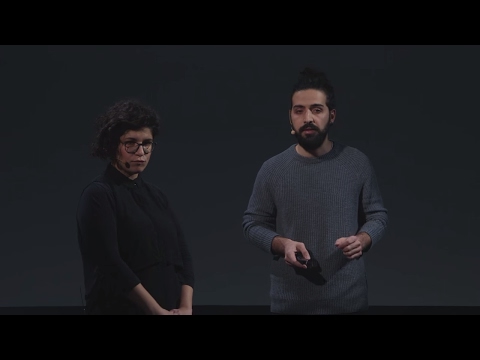
Good afternoon everyone, today we will present the MOOOR project
I’m Marco, I’m Fabia and we’ll show you what we mean
for kilo technology
Let’s start with a word that has been very popular in recent years:
or “personalization”
What do we mean when we talk about personalization?
Surely we can think of the idea of differentiating ourselves from others,
that is, to highlight our qualities, our tastes,
our character, and essentially bring out what we are
How can we personalize the world around us?
Surely acting on the objects that we all have around us,
or trying to choose between more or less defined solutions,
between colors, materials and shapes, and therefore in a certain sense transmit
what we are in the objects we have around us.
It is not said, however, that all attempts at personalization are effective,
since we often go to act only on what is the pure aesthetic form
totally ignoring the part that is, let’s say,
a bit ‘the heart of the object, a little’ part of the performance.
For this reason we try to introduce you what we mean by
customization
and to do so we use two examples that were a bit ‘the starting point
for what was then the development of our project
The first is Re-Phone, and is a Seeed Studio project.
It is proposed to be a smartphone and a smartwatch;
its particularity is the fact that it can be assembled directly
from the user, starting from a basic kit.
This kit consists of modular elements that are connected to each other
to get to have a basic function as happens in this example.
Obviously, going to add other modules,
I can go to implement the functions
having access to many more possibilities than the starting ones
for example, I can always know when my bicycle is stolen,
or set the automatic switching on of a certain light in my home.
As well as I will be able to know, through a text message,
if at home I will have reached the temperature I wanted to establish earlier,
or if I had to forget the open door, a ringtone rings.
Still remaining in the sphere of modular smartphones,
another very interesting project for us was Phonebloks
Phonebloks, purchased by Google and renamed Project ARA,
it was designed for a couple of years and closed last September.
Despite being terminated as a project,
it was interesting because it was the basis for developing others like it
ie PuzzlePhone, Finnish, and Fairphone, which is Dutch.
What do these smartphones have in common, and especially in particular?
The possibility of being able to associate with the functions of the modules.
So what do we do?
I choose the function that interests me most,
I compose my ideal smartphone, that is, I assemble all the modules
in such a way as to adapt it to my needs.
In addition, these modules are very useful to be replaced by me
without having to go to a repair center and then
if they get damaged or become obsolete
I can simply order others and buy them and change them.
Ok, if you have this face, let’s try to …
Go a little slower, talk a little easier
bringing as an example three foods, for example a cake, bread and pasta.
We can see these foods from two points of view,
the first as already prepared, ready-made foods
that I’m going to buy as they are made.
The second point of view instead is to imagine these foods
like a list of ingredients, and these ingredients,
combined with each other, they form the food itself.
What changes between the two visions?
Change that in the first hypothesis I, if I buy a cake,
I can not buy bread;
in the second hypothesis, if I have a series of ingredients
I can give life to an almost infinite possibility of food
For example I can use the flour to make pizza,
how can I use it to make custard,
or I can use milk to make cookies, rather than an omelette
Not to mention that, going to add more ingredients
I can still expand the possibilities, for example I can decide
if I prepare a cheesecake or a tart with jam
So, that’s the point? We are getting there.
Our project has developed having as a vision that of the ingredients,
rather than food.
And so we introduce you to the MOOOR project
MOOOR starts from a final synthesis laboratory at the Milan Polytechnic
and has as its objective the realization of devices for the home,
customizable and assembled.
Devices that replace the current ones, those technical devices
that have always been a bit relegated to the corners
and still have predefined functionality.
MOOOR is customizable from an aesthetic point of view by choosing materials
that are not the plastic ones, always relegated to the usual technical devices,
but being able to choose between steel, rather than stone or wood.
But the real potential of the MOOOR project is the possibility
to customize the functions, or these are the ingredients
with which we will compose our recipes.
Being a project in development was born, as I told you, a year ago
during the final synthesis laboratory
and we have used considerable analytical tools to get to its realization
One of these is the Role Play Game, which means we have created mockups
cardboard with which we tried to make people interface
that they were totally ignorant of the project to analyze and study
what were their gestures and what their interaction was
compared to devices that were decomposed
compared to the usual ones that are all aggregated together.
And so we have analyzed the various gestures that were done in front of objects
in a certain sense unknown, only the basic function was communicated
to then collect them, analyze them one by one and then get to the next stage
that of trying to sort all the various gestures in the form
of cardboard mockup, to understand also what was the best arrangement
of these devices inside the home.
One of our main objectives was not to hide our appliances,
We have the intercom next to the door, and sometimes we forget to have it.
We wanted to have a real control wall that would give life
to the operation of the various functionalities of a domotic, technological house.
The project was further prototyped,
because we were lucky enough to participate and be among the selected
of the “Next Design Innovation” competition, promoted by the Lombardy Region,
prototyping the devices in Polifactory, Makerspace of the Milan Polytechnic
Here in Polifactory we have been in close contact
with all those machines that are always talked about
that is digital manufacturing, then 3D printers, laser cutting
or numerically controlled drills, and also with engineers
who took care of the heart of MOOOR, or of the electronics.
This competition and the development of the prototype in Polifactory brought us
at Fuorisalone 2016, where we exhibited in the organized exhibition
always by Next Design Innovation with the help of the Lombardy Region,
and there we had the first feedback with the public.
We have seen how users interface with our devices
what are the things that are understood, those that are a little more difficult, to be improved
in general we have had a good response
Going forward, we were in September in Turin
at Casa Jasmina.
Casa Jasmina is a pilot project of Officina Arduino,
here we had a residency for a week,
that is, we worked closely with engineers
a week, day and night, to try and get a third prototype out,
and therefore as you can see there is also the part of the Fablab of Turin
and we also tried to have some fun
we worked literally day and night,
exploiting as much as possible the spaces we had available.
This adventure also brought us to an exhibition,
the exhibition in question is the Maker Faire of Rome,
we came back in October and we attended this fair
inside the stand of both Casa Jasmina and Polifactory.
There we had the second feedback with the public, which was an audience
very different, because it was for the most part not insiders,
families, children, people who wanted to spend a different day.
All this however, this digression to lead to say what?
That the MOOOR project is still under development,
the three modules we showed you are only a part of the family,
of the ecosystem we would like to develop, naturally, the more devices we have,
that is, the more ingredients we have, the more we can create new recipes.
All this because, coming back a little to our starting point,
we want to avoid having a single function relegated to a single device
but we want to make sure that more devices, then more modules,
can share different functions.
For example, going to connect a speaker that also contains a microphone
a controller and a hub I can get both an intercom and a thermostat,
that a kind of domestic answering machine.
Going to add a video camera, for example,
I have a complete video surveillance system throughout my home
Obviously all this can be implemented by other ingredients, which can be
of sound or light outputs, according to the needs inside the home
All this to tell you what? What we think the direction
that technology should take is a bit ‘to choose
which ingredients to use to compose
our favorite technological recipes. Thank you
”
Be First to Comment