
Oh. Thank you. Thank you, all.
We are now about 20 years into a revolution
in information technology, in IT.
And like any journey into uncharted territory,
it’s exciting and it’s disorienting;
it can be fun; it can also be very dangerous, right?
And it can be frustrating.
As we increasingly move away from a world of ink and paper,
so often, these new technologies don’t seem to live up to their potential,
and we ask, like,
“When is it going to be easy?”
“When is it going to be awesome, like it ought to be?”
Right?
The last time there was a revolution in IT of similar magnitude
was so long ago that we forget that it actually involved technology.
And so the idea I want to share is the perspective that we can gain
on our present and the future of information
from looking at the first 2,500 years of information technology,
which was a period
when inadequate, inconvenient technologies incrementally evolved
to a state of perfection that was dominant for a millennium.
So …
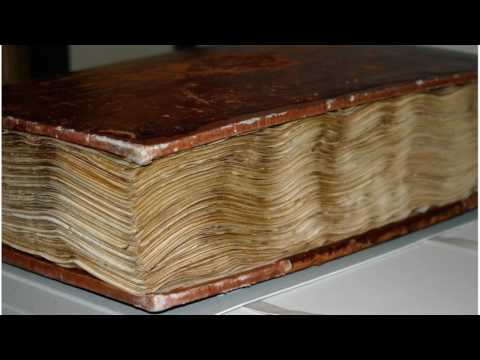
what you see on the screen is an 1,100-year-old manuscript.
We call it the Venetus A.
It’s a handwritten book in Ancient Greek.
The text in the middle – the big stuff – is “The Iliad,”
and the text around the edges is a commentary on it.
I want to invite you to look at this manuscript
and see a device:
the state-of-the-art IT from the year AD 950.
And I want to talk about some of the innovations
that stood behind this technological package.
So, this is an example of the earliest writing in Greek,
and it’s from about 1500 BCE.
We call this kind of writing Linear B.
Linear B was invented
as an inventory management system for large enterprises –
Bronze Age palaces.
It was a technology for recording data about objects.
This particular example
is from part of an inventory of chariots in the garage of a palace,
and it says there are a certain number of chariots,
fully assembled, made in a fancy way, with ivory.
Like a lot of enterprise systems, Linear B was not user-friendly, right?
It had 200 characters or more;
it was only usable by a few highly trained professionals.
It took 700 years
before the Greeks got what Steve Jobs might have called
writing for the rest of us, right?
The Greek alphabet.
When it came, it was awesome: 24 characters, super easy.
All of a sudden,
many, many, many more people were able to create, consume,
and share information.
And with more users came more innovation,
and particularly data storage, it improved, right?
Just as in my day, floppy disks gave way to hard drives,
back in the day, broken bits of pottery and clay tablets gave way to papyrus.
And as ever, if you give people more storage space,
they come up with more information to fill it.
First, written-down versions of stuff that they’d been singing,
like “The Iliad,”
and later, new categories of information
that were created with the new technology in mind:
long works of history, of science, of theology.
Now, papyrus comes in rolls because of how it’s made.
You carried an individual papyrus roll around in a little leather tube.
If you had a bunch of them, you’d carry them in a bucket.
You’d store them in diamond-shaped cubbies.
Singing, storytelling, lectures: these are linear processes,
and a roll of papyrus was great for capturing that.
For the first thousand years, reading was something you did out loud.
A papyrus roll stores data that you read aloud, okay?
All papyrus came from Egypt.
This could cause supply chain problems,
so in the third and second centuries BCE,
librarians – engineers of information technology –
perfected a new storage medium: parchment, made from animal skins.
It was more durable than papyrus.
Sheep, goats, and cows could always be locally sourced.
Parchment doesn’t come in rolls, it comes in sheets
because of how animals are made.
For big data – bigger than one sheet – you could create an array
by stacking a bunch of sheets up and sewing them together on one edge,
thus creating a codex, or what we call a book.
Now, codices were big, blocky objects.
They were heavier than papyrus rolls.
None of your papyrus accessories worked anymore.
(Laughter)
But …
(Laughter)
there were benefits to the new technology.
For the first time ever, you had random access to your data.
You could jump to the middle of a book
without scrolling interminably from the beginning.
And citations and cross-references became possible,
instead of a cruel joke, right?
(Laughter)
With citations and cross-references,
you have books that can talk to each other,
like a relational database
or, if you will, a kind of web of information.
And this was a big deal.
It can take a while, though, to fully exploit any new technology,
and so, this is from the fourth century of the Common Era.
It’s a folio – a page –
from the earliest complete Christian bible, the so-called “Codex Sinaiticus,”
and even though it’s a codex,
you can see that its engineers
were still using papyrus thinking when they made it –
these little narrow columns of text, as if this was something
that you read aloud as you were unrolling it.
Six hundred more years
before they fully exploited the new technology.
This is not a thing you read aloud from;
this is a reference book.
The scribes first recognized that texts could talk to each other
and that you could put more than one text in the same book,
even on the same page.
And we can see other innovations
between the fourth century and the tenth century:
spaces between words.
Data scientists call this tokenization.
As the world contained more and more things to read,
people started reading faster, which meant reading silently.
And white spaces between words
was a technology that was invented to serve this new practice.
Other ways of adding information to the page – I don’t know
if this shows up on the screen,
but these pages have scoring on them.
Before page layout software, before the printing press,
there was page layout, and this book was deliberately planned on a grid,
and the grid adds information.
It makes it clear what the main text is and what the secondary text is.
You don’t have to read Greek
to see that some of the letters are shaped differently, right?
The more blocky ones in the upper corner are a quotation from “The Iliad,”
and the rest of it, in a different style of handwriting,
is the comment on it.
We’re totally used to this:
small caps, boldface, italic –
adding information to the words on the page.
But it had to be invented, and it was invented by the tenth century.
And then nothing fundamentally changed for a thousand years.
Not by 1580.
Not by 1780.
And not by 1950.
OK. We got the printing press. Big deal.
(Laughter)
The Linotype machine, bigger deal.
You have typewriters, photocopiers, word processors,
but these were all simply ways of making faster and cheaper copies
of the same thousand-year-old technology that was very close to perfect for that.
Technologies go obsolete when they’re at their most perfect.
And they get replaced by technologies
that are at the worst they’re ever going to be.
It’s been less than 20 years since we stopped assuming
that our most important ideas are destined to live on physical pages
that look like the Venetus A.
All right. The Greek word for papyrus is χάρτης.
The Romans turned it into charta; it referred to any page you write on.
The medieval Latin speakers pronounced it charta.
We are literally entering uncharted territory.
I don’t know what the future will hold,
but I am confident
that we have not gone back 3,500 years in our information technology
and that, with the help of vigorous criticism from technological skeptics
and ingenious invention from technological enthusiasts,
it won’t take 2,500 years to reach another IT millennium.
Thank you.
(Applause)
”
Be First to Comment