
Hello everyone.
It’s really nice to be here because the last time I was there,
I said the following sentence:
“Gentlemen of the jury,
Mr. Chairman of the jury, honorable assistance, hello. “
In fact, I was supporting my dissertation at the INC and it was 15 years ago.
So, it makes me really happy to be among you.
(Applause)
So, in fact, I was very often asked the question,
I was told very often:
“How do you explain or what is the secret of success” –
because we think it’s an adventure that has succeeded –
“What is the secret of the success of Djmawi Africa? “
So I answer very often by the following sentence:
It’s not just music to make music.
And that’s what I want to share with you today in my speech,
during those 18 minutes,
to show you a little behind the scenes,
what’s going on behind, what’s going on behind the scenes,
and what makes music come to your place.
In Djmawi Africa, I have several hats:
so, I’m the guitarist, I was the manager
and then recently, the producer of the group.
Many people also say to me, “How do you manage to do both? “
And I say, “Because I did the INC. “
(Applause)
In fact, first notion, what I often say,
is that an artist or a musician is an entrepreneur.
An artist is not a marginal, an artist is not crazy,
is not someone who makes music to have fun or to entertain people.
An artist is an entrepreneur because he will undertake projects
and will make it a job, a profession in its own right,
a job that will earn him his living and a job with which he will live.
Very often, what we have as an idea when we talk about musicians and artists,
but especially musicians –
I’m going back to the speech all the time about perception –
we often have this image
or this image that comes to our head:
a guitarist, a violinist, very often a pianist,
recently [they], they were very good,
we can still applaud the group that passed earlier.
(Applause)
But in fact, for professionals, an artist is that. Wow, it’s complicated.
In fact, there, we do not see my slide,
but this slide represents a little bit all the trades,
or what’s behind being a musician or being an artist.
The green arrows represent the contracts that are to be signed,
and we do not see well, there is yellow too,
it’s a little bit the financial flow.
So, there is the artist who is at the center of it all,
but there are plenty of trades around:
manager, producer, turner, press officer, broadcaster,
publisher, distributor.
So, in fact, it’s trades,
and it’s trades that are very, very little known here,
and these are crafts that artists would like to have.
So, back to a little bit of concepts that you know here,
the marketing mix,
so, in fact, in music, we will have several products.
It can be a record, it can be a vinyl,
but above all, it can be a live show.
What you saw earlier is a product, which has a price,
and who needs to be distributed, okay?
and who needs especially promotion.
Now, there are several things that are done.
There is digital distribution, what is called digital,
but there is a real mix to consider in music.
Some numbers,
just give you a little bit of the importance of this industry.
In fact, the global record industry is worth $ 15 billion.
$ 15 billion!
The live industry will be almost double:
$ 25 billion.
That’s the most recent numbers we have.
I put a small special square that is dedicated to digital,
because, now, 45% of the music is digital,
and that too, it creates a lot of new jobs.
I advise you to go to this site called IFPI,
you will have lots of information on the different statistics.
International market.
The local market, the numbers:
(Laughter)
Unfortunately we do not have one.
I can not tell you.
Well, doing some analysis or research,
we can find how many record stores there are at NRC,
but we really have no idea about the local market.
Yet there is music, record shopping,
however, there are groups.
I can just give you a little indicator
to show you a little difference.
It is that when one sells a CD in Algeria, the artist gains ten dinars.
Ten dinars, that’s all.
When the artist or the musician makes a live,
on average, he earns 20,000 dinars.
So we are really a live market.
That is to say, for a musician to live in Algeria, he needs to do live.
Because making CDs is good, but he will not be able to live with it.
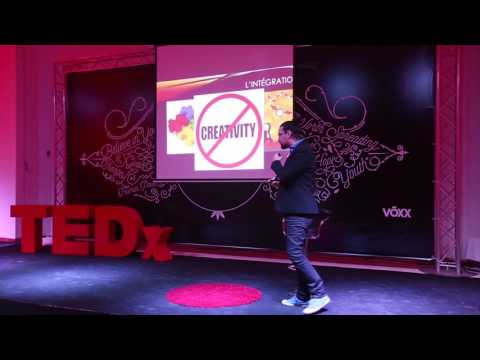
The musician in Algeria finds himself doing integration.
It will do upstream integration and downstream integration.
That is to say, he will do many things besides being an artist,
in addition to having to create.
He will have to take care of his production,
to find the means to produce his records,
to manage,
to do all the other trades,
all the diagram you saw earlier,
and do it alone as an artist.
And that takes time, it takes a lot of time.
And unfortunately,
when we integrate trades that are not ours,
especially, not artistic, we will kill creativity.
Bein yes, because we’re going to spend more time
to do things we are not supposed to do.
So, we’re going to spend less time creating music,
to create works.
So very, very important, this idea of integration,
and that’s why I wanted to make this speech at the Institute level,
to show you that we can also work
in the intermediate trades of music.
And I will talk to you at the end of my presentation,
of the project I led.
Very important,
music or art can be exported from here.
I advise you to read an article that came out on El Watan, yesterday I think,
who talks about the new policy of the Algerian Ministry of Culture,
who talks about privatization in the field of culture.
We can export music
and it can be a non-hydrocarbon export product.
So, we can invest in music,
we can create societies in music, or in art,
I’m talking about music because I take it as a practical case,
but it can be in the other arts too.
I will tell you about the agency we created with the group.
In fact, we started playing in 2004,
and 12 years later, we thought:
“Yes, we did a lot of things, we learned a lot of trades,
why not do a business too,
to precisely give a shortcut to musicians or artists
who want to develop in a professional way? “
I say that because it’s a job.
So we created this box called Sub Floor,
and in fact, the first idea of the basement,
it was already creating a rehearsal room,
because there are no rehearsal rooms in Algeria.
We, for 12 years, have struggled.
We moved from one place to another to be able to repeat our music.
So we created a rehearsal room
where people can come rent the studio and repeat.
Then we thought:
“Wait.
We, we learned to do things,
we did integration upstream and downstream,
why not also offer this service to the artists who come? “
The idea has developed
and we also became a box that will be able to frame projects,
who will be able to advise
and who will be able to bring an experience and ideas,
on career management.
We started to do some booking.
Non-hydrocarbon export product,
we started to try to book artists internationally.
To begin with us, obviously.
So, we also did some booking.
And the last project we are doing at the basement level,
it’s about being able to create video content on the web for artists,
by making lives inside the basement.
So this is a project that will have several repercussions.
Artists will have video content
cheap.
They will have video content in a very, very simple way,
because these lives will be filmed exclusively with phones.
The idea for me today was to explain to you,
that to make music, there is really not only music.
And musicians and artists need people like you,
need people who understand the trades that are around.
Management, marketing, communication, distribution,
to return just to the basics you are learning in this Institute.
So, look at the music differently, do you document,
and above all, try to lead projects in this direction,
and invest in culture because culture is important.
Thank you.
(Applause)
”
Be First to Comment