
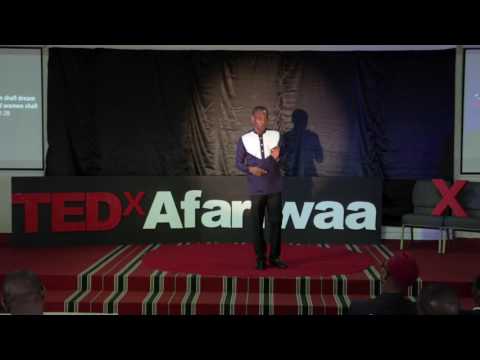
I used to be an introvert when I was a child,
and I just loved to be alone in my corner to think and dream.
You know, usually, after watching –
I called this “moments of mind imagination trips,”
and usually after watching Superhero movies
like Batman, Captain Planet, and Superman,
I’d just go back to my corner
to imagine myself flying over my community,
catching the bad guys,
putting smiles on the faces of people and making a difference in my community,
at least, making people smile –
well, obviously not the bad guys.
You know, these adventures that I imagined were epic.
And I actually cherish my imagination’s dreams and trips
because I didn’t really grow up living with my parents.
At some point, some of the other family members that I lived with
would call me names, some would call me dumb,
you know, this kind of words.
And some friends in school as well would call me funny names,
so I just loved to be alone with myself to think and to dream.
Fast forward, ten years down the line.
Here I was, a teenager trying to discover myself,
trying to discover my passion, my purpose, and my potentials.
And my childhood imagination trips had done something profound to me,
it developed in me the passion to see change in my community –
at least, imagine myself being Captain Planet making a change.
And probing later into why in the first place
we had challenges in my community and other friends’ communities,
I later discovered, at age 17, that our problem was leadership.
Two years down the line,
it was time for me to go to university to study computer science.
And here again, in the university community,
I saw challenges.
I had my personal share of challenges.
For example,
I studied computer science for four years, but I never owned a personal computer.
I was part of the less than 10% of people in that class
that didn’t have their own computers.
We had to do whatever we could because we couldn’t afford it,
and there were not enough computers in the lab.
And as I remember, you know,
we’d borrow computers to study at night
and learn how to code, develop websites, and do designs.
I remember my very first website that I designed,
I had to use four different computers.
Because each time in the middle of programming, the owner,
“Hey! My computer.”
And I’d put everything onto a flash drive,
find the next available computer, and do all the installations again.
Four different computers.
And I was like, “God, this website has been through a lot.”
And this experience and other experiences on campus made me become an entrepreneur.
I began solving basic IT problems to get some money to survive on campus.
And when I was in school,
I loved to volunteer to find challenges
in rural communities, rural Ghana villages.
And at times, some of the stories we saw on the ground were heartbreaking.
But just the thought of being able to put a smile on a child’s face
would make me glad.
A few years down the line, this passion of mine thickened,
especially because I was hearing on the radio, watching on the news:
that African country, this has happened; this African country, that has happened.
And I recall at night,
I’d just be in the room at dawn 2:30 am or 1 am,
just thinking and shedding tears.
“God. What is wrong with Africa?!”
“What is wrong with us!”
“Why are we still poor!”
And it was a typical passion state like this
that led to the development of 1 Billion Africa.
And just the thought of 1 billion problems
being tackled with 1 billion projects by 1 billion Africans
to create a better Africa formed the “aha” moment for me.
And so we studied 1 Billion Africa,
and it’s developed to become a problem-solving movement.
A social society organization that inspires and empowers Africans,
especially the youth,
to find problems in their communities and to turn them into projects.
And so, the journey has been an amazing one,
and we are in over nine other African countries,
we’ve run about 19 projects that have impacted about 10,000 Africans,
the majority being youth and children.
Thank you.
(Applause)
And, you know,
Charles here is a typical example
of a youth within the 1 Billion African network
who found a problem in his community and turned it into a project.
So, Charles comes from the northern part of Ghana,
and in his community, interestingly enough,
some children in the community don’t love –
of course, it’s not interesting enough,
not all their children are allowed to go to school.
But the most surprising part of it is some parents
would rather have their children accompany them to their farm
than go to school.
So Charles, being inspired by the 1 Billion mission,
decided to turn his problem into a project.
And he’s come up with beautiful project called “a child to school” project
that uses innovative activities to make children fall in love with the school
in their community.
And there are many more problems to project stories
in the 1 Billion Africa Network, in Ghana, South Africa, Namibia,
and in other African countries.
We have a project that is starting soon in Botswana.
And this had inspired us to begin to develop regional units
in Sub Saharan Africa to help coordinate some of these projects
that go on in these places.
Very soon, we as well are coming up with 1BA Summits.
It’s going to be a very inspiring environment
where all these change makers
come to share their problems to projects stories
and to engage with global leaders.
But friends, it hasn’t been all easy.
The road hasn’t been all rosy.
My team and I have had to deal with disappointments,
and some very crazy challenges.
For example,
we had this very important Skype meeting with a key partner in the United States.
And I was all ready for this guy.
It was supposed to happen at 5 p.m.
Just one minute – I was doing the testing, sound-checking and all those things …
One minute to 5 pm – can you imagine this? –
the lights went out, the whole area, including the next area.
How are you going to explain this to a partner in the United States?
But all these hindrances didn’t deter us
from what we want to achieve.
And I actually thought that –
Thank you.
(Applause)
I actually thought that our challenges in Ghana were unique to us
until I heard the story of Charles Batte from Uganda,
and that’s another one.
So, that’s Charles.
That was the same year I made a new year resolution to stop:
It’s enough making friends in Ghana,
I want to move outside Ghana.
How many of you here have at least 20 friends from other African countries.
20 friends? Okay.
50 friends?
100 friends?
Okay. Two friends?
(Laughter)
Yes, so I discovered the story of Charles.
Charles comes from a community in Uganda called Kamwokya.
This is one of the most impoverished slum communities in Uganda.
Growing up in this community
characterized with poverty, poor health, crime, drugs,
and so on, lack of opportunities,
he developed the insatiable desire
to be Captain Planet in his community,
to cause a change over there.
So when he was 20 years old,
he’d gathered some savings that he’d gotten from a part time job
working at a car garage,
and he started a farm in his community.
And this farm grew to employ 50 people
at the end of each season.
And three years after, in 2011,
Charles gathered some money from the farm
to start a family health center in his community.
Now, when I read his story, I was so inspired.
But I discovered there were challenges,
that word again “challenges,” in Charles’ story.
In fact, Charles’ story inspired me to probe into what was happening
all across Africa.
So, that was when I discovered
the story of Tshepo Seloane from South Africa
and what he was doing through his project in MBEWU.
And that’s Tshepo over there.
And I read about Rana Karana from Mauritius, how passionate she was
about making a difference in her environment.
I watched videos of Ory Okolloh sharing her story.
How passionate she was about Kenya and Africa.
And at the same time,
I discovered the beautiful thing Fred Swaniker was doing
with Africa Leadership Academy in South Africa.
I want you to follow me as I share these stories.
Because their stories and my story
made me come to a single conclusion.
I thought maybe our destinies as African youth are connected together.
And I believe that there are so many challenges around this,
but if we continue to persist and thrive,
gradually, we can make Africa a better place.
And this is the rule that I believe in,
that as African youth entrepreneurs
or as African youth,
our role is to help build Africa from the ground up.
So when we roll our sleeves,
1 Billion Africa project,
we are helping people on the ground to develop their problem-solving mindset.
My friends, Jessica and Yawa are also doing their own.
Gradually,
we help build Africa from the ground up.
And for the good leaders we have on the continent,
they affect Africa from the top to the bottom.
That is the route that I believe in.
You know, I believe Africa’s transformation story
would not only depend on President Buhari from Nigeria
or President Paul Kagame from Rwanda.
Africa’s transformation story also depends on you.
I want you to look at your neighbour
and tell that person that the story depends on you.
Yes, it’s very true
because the transformation story of Africa
would also depend on our decisions, as young people.
Not just that, but as well in our indecisions.
I discovered a prophecy, recently, in the Bible about Africa.
And I was excited:
“Hey, Africa in the Bible.”
And it’s found in Joel of 2:28.
It says that your old men shall dream dreams,
and your young men shall see visions.
Now, I paraphrase: “Your old men and women shall dream dreams,
and your young men and women shall see visions.”
It meant a lot to me.
To me, it meant that the Kwame Nkrumah’s and the Patrice Lumumba’s
would dream dreams of a better Africa.
But the Kaffir Boys and the Yellow’s and the Jessica’s
and the Lumumba’s in South Africa
are the ones to help behold that vision.
Are you following?
To break that dream to reality.
To see that vision.
And that is our role as young people in Africa.
That is why I believe we’re the ones Africa has been waiting for.
And this is why we can’t afford
to play the blame game and be pointing fingers,
“Hey, you are supposed to do that,” “You didn’t do that.”
This is why I believe we have to act
to fulfill the dreams of our old men and women,
and that is why we can’t lose the sight of the ultimate
to settle for the immediate.
And this is why we need to take the responsibility
to effect the change we want to see in Africa.
Demographically,
Africa is the youngest continent in the world,
with over 70 percent of the 1.1 billion people in Africa
being young people;
we’re the youthful continent.
We can’t afford to waste time growing up with the victim’s mentality
but to embrace the victor’s mentality.
And I believe for the African’s youth who truly –
and I emphasize the word “truly” –
who truly want to effect change or see change or see Africa transform,
that person or that youth would not waste time
highlighting the red lights on the continent.
We know the red lights right?
The corruption, the diseases, the famine,
nowadays, we don’t even have famin.
All these red lights.
That African youth would rather highlight on the green light
we have on the continent.
Yes, we do have green light.
That African who truly want to see the transformation on the continent
would at least attempt to make an effort,
attempt to make a move.
Even if it has to do with dirt road diaries or fashion.
You would attempt to at least take the problem to a different level.
And for example, we see some good leaders on the continent,
Strive Masseur, Tony Elumelu,
Kofi Annan through his foundations,
and many more examples.
Even when you come to the level of our youth,
they are all talented, so guys, it is possible.
1 Billion Africa, through our project,
keep empowering and inspiring the African youth.
That it isn’t a fairy tale
to attempt to find a problem and turn it into a project,
that it is possible.
People, Madiba believed in the power of the youth.
Bill Gates gave a lecture, recently, I think a few days ago, in Pretoria.
And he quoted Madiba,
emphasizing how he believed in the power of the African youth.
We need to identify and understand this youth,
this power that we have within us.
Let me end this talk with a call.
And I’ll make a call today to our leaders in the African Union offices
in Addis-Ethiopia, and the rest of East Africa.
I make a call today
to the new leaders that we have seen.
Imagine, from the leadership corridors of Cote d’Ivoire,
and some other parts of West Africa.
I make a call today to our leaders and civic leadership,
and public management and in government in the Southern Region,
including that head teacher in Tembisa community in South Africa.
I make a call today,
to our leaders in North Africa,
and to our mothers and fathers in Central Africa.
I make a call today to them
to help develop the support system we need in Africa.
To involve us in creating the enabling policies,
that Jessica’s fashion business and dirt road diaries will drive on.
I make a call to our leaders
to make us their priority, to trust us and to invest in us.
And then I’ll make my second call to you here,
to the ones who would watch this talk,
to the Africans in the Diaspora.
That guys, this isn’t the time for juvenile stuff.
Say,”Hey, you’re better than this.”
“Hey, I’m better than you.”
“I want that award, you aren’t doing anything.”
You know this isn’t the time for all of these things.
This is the time to lay our bricks together.
(Applause)
Each brick is important to help build the walls of Africa.
This is the time to move Africa forward in our actions,
than keep Africa stationary in our inactions.
Thank you very much. God bless you.
(Applause)
”
Be First to Comment