
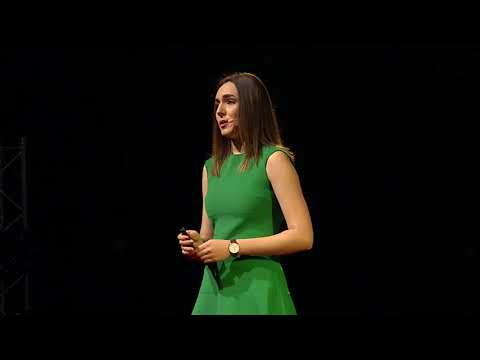
Ashton Cofer, an inventor who has discovered how to recycle polystyrene,
that material that we use, for example, in packaging,
and that until now was accumulated in our landfills.
With only 15 years old,
he has managed to transform this polymer into activated carbon,
a very valuable material that is used to purify water.
In this talk,
he himself tells how he failed numerous times in previous experiments,
and how the adults told him it would be impossible.
But maybe for being a child
and not being corseted by years of social conventions,
he kept trying.
She is Olivia Chapman.
Olivia is 14 years old and is convinced
that the solution for our schools is not equality, but equity.
Although historically we have fought to achieve equality,
Olivia defends that while “equality” means uniformity,
“equity” implies equanimity or justice,
so it allows us to adapt to the needs of each student,
understanding that we are not all equal.
And is that as she says,
each plant needs different conditions to flower
and the same happens with the students.
And he is Sean Fredella.
With only 16 years, and after having faced four times against cancer,
Sean has launched the More Than 4 campaign,
to raise awareness about pediatric cancer,
and the scarce financing that it receives,
only 4% of the total funds allocated to cancer research.
But Sean wants this to change,
and for this he is using the visibility of a sport
as well known in his country as American football,
convinced that involving these athletes with the cause,
You will get much further.
Ashton, Olivia and Sean are just 3 examples of the 17 talks I could hear
just over a year ago at the headquarters of TED, in New York,
during an event known as TED-Ed Weekend.
On a cold weekend in December, we met young people from all over the world
to learn from each other and talk about what excites us,
we are worried
Imagine my surprise when they invited me,
but even more, when you get there,
They asked me to interview Tim Urban from the stage.
Tim Urban, the famous procrastinator,
whose TED talk has been viewed more than 16 million times.
Yes, I was shaking on that stage,
but the truth is that at that time I knew I was in the place
where I wanted to be
I have always been passionate about communication.
In fact, when I was studying high school,
I carried out a research project about oratory
and that’s when I realized
of the true lack we have in our educational system
in terms of communicative skills.
So I wanted to contribute my bit
and I decided to start a TED-Ed Club at my institute
to learn, together with my colleagues,
Some tools that help us share our ideas in public.
But what are the TED-Ed Clubs?
They are clubs without any cost
that take place in colleges and institutes around the world.
They can be started by any student or teacher
and its goal is to give voice to all those students
have an idea to express.
And in the TED community,
We believe that we all have something valuable and unique to contribute.
Therefore, TED has created a methodology
that puts in the hands of the teachers of these clubs
through various resources, such as a web platform
or a notebook with proposals for sessions and activities.
Thus, the student follows a process
that begins by learning about their own passions,
then go on to identify what makes an idea great
and be able to find one in their passions.
Then, learn to structure the idea, that is, to create the script.
And finally, communication skills
that will help you give your own final talk,
his mini Chat TED.
These are recorded and included in the YouTube channel of TED-Ed Clubs
along with the rest of the students from all over the world.
The program has only been in operation for 4 years,
but more than 6000 clubs have already been created, 73 of them in Spain.
Currently, there are more than 1,600 active clubs around the world.
In addition, 4 times a year, Connect Weeks take place,
a few weeks in which videoconferences are established
among students of TED-Ed Clubs from around the world.
Imagine a conversation of about an hour
moderate by TED, in which students from the United States,
Spain, India and Poland can talk with each other
and ask the rest about their concerns, their customs,
the processes that continue in their respective clubs.
These exchanges serve to foster understanding and empathy
among apparently very different young people.
But it is that in them,
they realize that there are many more things that unite them,
what things that differentiate them
And there’s even more, TED-Ed Weekend,
an event that takes place annually in New York,
where teachers and students of clubs from all over the world meet
to learn from each other.
The speakers of this event, such as Ashton, Olivia and Sean,
are some of those students who uploaded their talks to the YouTube channel
and that during this mythical weekend, they have the opportunity
to go back to work with the TED team of experts
and with very powerful new tools.
When I was there, I remember they recorded with a 360 degree camera
from the red point of the stage,
while in the audience we made as if we listened attentively
to be able to rehearse an immersive virtual reality with future speakers.
Thanks to TED-Ed Weekend, I’ve realized how important it is
a global network convinced of the importance of giving young people a voice
and not isolated clubs, because the impact multiplies,
allows to learn from the best practices of others
and establish new relationships and synergies.
Since then, I work with others, like me,
they believe in the potential of young people and want to help them develop it,
creating a TED-Ed Club.
And little by little, between all
we are increasing the number of students who believe in their own ideas
and that they are not afraid to share them with the rest.
And it is clear that oral communication is a fundamental tool
for all the adults of the future and that we must master it.
However, a child starts talking when he is between 1 and 2 years old.
At 4 or 5, he already communicates fluently.
And at 12 he has a vocabulary of about 1000, 2000 words.
But from then on he only learns more vocabulary.
In the best case, if he becomes an actor or singer,
he will learn to modulate his voice, to recite, or to move on a stage.
But from that moment, in which we express ourselves with real capacity,
we are not educated again in the spoken word,
we are not taught to transmit emotions, to convince,
to contribute arguments and to talk,
and also not to speak in public.
The word is essential,
but even the most sophisticated oratory is useless if it does not contain a message,
an idea.
And we do not strive to teach to recognize
the ideas that have the potential for change,
nor for creating a safe environment in which the youngest
can play with their own ideas,
learning at the same time from those of others.
And what better recent example of the power of communication coupled with ideas
that the Me Too movement, started on Twitter
in October of 2017 by the actress Alyssa Milano
when he encouraged his followers to share their own experiences
with sexual harassment, to make visible the magnitude of this problem.
The hashtag became a trending topic in more than 85 countries,
coming to use more than 3 million times.
It all started on social networks with the brave denunciation of a woman,
but he has not stayed there, but Me Too has motivated
thousands of conversations around the world since then,
even becoming the protagonist of the last day of the Golden Globes.
In a huge display of activism,
many of those present claimed the need for change.
But the true protagonist of the day
was the speech of the journalist Oprah Winfrey
that ended with a loud ovation from all those present
and its consequent media repercussion.
But historically,
we also see the transforming force of ideas linked to communication,
and in many cases, by the students.
Many social movements have their origins in the student field
like Los 9 de Little Rock, in 1918, in the United States.
Nine African-American students
in a school until then racially segregated
that they had to go to classes guarded by the police
for danger of lynching
and that became the center
of a movement against racism in education.
Or the students of the French May, in 1968,
that provoked a series of protests
that led to the biggest general strike in the history of France,
causing the president to cease in advance of the elections.
Or in the same year, in our country, the student struggle against Franco,
with such peculiar events as the concert at the Complutense University
of the singer-songwriter in the Catalan language Raimon,
that in spite of violating the prohibition of the right of assembly
and the prohibition on the right to express oneself in languages other than Spanish,
gathered thousands of students in protest symbol.
All these movements began with words,
with young people denouncing, claiming a better future,
presenting a world not as it was, but as it could be.
We have to reclaim that active and innovative role of young people
because, as I could see in that TED-Ed Weekend in New York,
even the smallest are full of ideas with a lot of potential.
With TED-Ed Clubs, or with other tools,
we have to give young people a voice so that they too are part of the change,
and this is something we have to stop procrastinating about.
Thank you very much.
(Applause)
”
Be First to Comment