
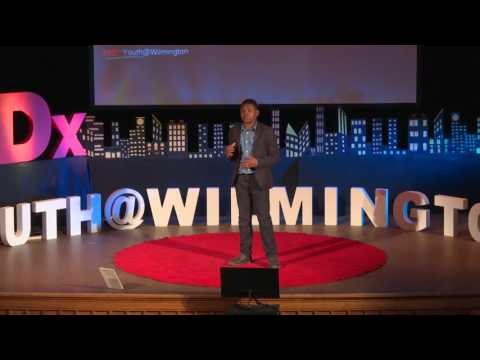
I am a ninth-grade student at a high school in Wilmington, Delaware,
one of America’s poorest and most dangerous cities.
I’m here to tell you
that my high school and many high schools like mine
may not be fully preparing students for life after high school.
But before you brace yourself for another cliche talk
about the declining quality of American public education,
you probably should know something very important:
I actually attend a private school.
And while my school like many other private schools
gives me access to abundant resources, top-of-the-line facilities,
amazing teachers, and a curriculum that would challenge and engage me,
it masks something very important
that me and all of my peers will need to be successful members of society:
racial and socioeconomic diversity.
Please don’t get me wrong;
I am super fortunate to have received such a generous scholarship
to one of the most prestigious, private institutions
Delaware has to offer.
It provides me with opportunities
many of the kids in public schools, where I live, are never afforded.
In their schools, classes are crammed and crowded,
teachers turnover rates that creates instabilities for students.
Students had to worry about their safety as much as they worry about their studies.
Expectations to students learning and their abilities are low.
Many students graduate high school
without the right tools to be successful in college.
And yes, while I understand
a private school education is a game changer for me and my peers,
we’re missing something very important.
We’re missing the fact
that the system of segregated education that we’ve implemented
is hurting all students, public and private.
Let me give you a rundown of the typical diversity in my week.
In my Biology class, I’m the only African-American.
In my Math class, I’m one of the two African American males.
And so far in high school, I had no teachers of color.
Ha, sometimes I sit in class and think, “I am definitely not in Kansas anymore!”
(Laughter)
But you know, I am definitely not in my previous public school either,
where 98% of the student population were African American,
and 79% of low income.
The multicultural road outside of school will easily be a cultural shock
for those students segregated by race and socioeconomic status.
If you didn’t notice, America is changing.
Just a few years ago, for the first time in American history,
more than half of all school children were considered low income,
and by 2020, half of the nation’s children
are expected to be a part of a minority race or ethnic group.
And by 2060, researchers project that my tiny home state of Delaware
will be one of the most diverse states in the nation.
And if we stay in our current segregated path,
we will occupy a future of racism,
misunderstanding, division, tension, and disparity.
In order to see change, we will need
to immerse ourselves in diverse experiences
like our school requires us to immerse ourselves in books.
We would need to learn about race relations
and how to overcome division
like our school makes us learn about poetry or geometry.
We will be going to have to diversify our curriculum
so it does not ignore the excellence and the impact
of those not of European descent.
All of us are going to have to prioritize diversity
when we make decisions on where we want to live and go to school.
Because ultimately, our schools are segregated
because that’s what our neighborhoods look like.
During his famous “I have a dream” speech, Reverend Dr Martin Luther King said,
“100 years later, the life of the Negro is sadly crippled
by the manacles of segregation and the chains of discrimination.
100 years later, the Negro lives on a lonely island of poverty
in the midst of a vast ocean of material prosperity.”
Martin Luther King Jr. had a dream that one day, on the Red Hills of Georgia,
sons of former slaves and sons of former slave-owners
would be able to sit down together at a table of brotherhood.
More than 50 years
after Martin Luther King Jr.’s “I have a dream” speech
and the Brown versus Board of Education decision
that found segregated schools to be unconstitutional,
we are back at a place
where our schools are segregated and unequal.
Because as powerful as the courts are in this country,
they cannot make our hearts and our minds just.
We are going to have to want
to get a different future and a more perfect union.
So today, I have a dream:
that one day, we will arrive at a future
where segregated schools and neighborhoods will be a thing of the past.
Thank you.
(Applause)
”
Be First to Comment