
thank you for what I want to talk about today
how we see the world the point of view
of the physique of what I speak I speak of the
relationship that exists between physical reality
that is outside us and perception
that we have inside us this is a
problem we have always dealt with
because maybe we all had
at least once a question of but that
red color that sees my friend is
same as my red color is the same
red color that I see because this
it’s the only thing that really does
we can ask all the way
and then this is a new question no
it’s a question that basically
many have had to think about the o part
of leopards of moral operettas says
the vulgar is deceived by thinking that i
colors are quality of objects
when they are light and it is a lot
deep leopards but is incomplete
because the reality around us then
we perceive does not depend only on the light and
from objects but from something more
it would be nice for the body if the
reality stopped here in a light that
affects the object is an object that the
reflects but to talk about perception
we need something more
what is missing in this figure for
talk about perception
missing a god who sees it takes a me that
see to be able to talk about perception
in fact I would say more it takes a mine of mine
see to be able to talk about knowledge
because knowledge is always
the encounter between an external object of us
it is a subject from this exchange born
what we call knowledge e
perhaps dante said it best of all
when he says why so sensible
he learns what makes pochade intellect
worthy what makes pochade intellect
worthy we learn it from the world
sensitive but
then we put on ours and this does not
it is subjectivism that is the beauty
of the human cognitive adventure we see
some examples let’s look, for example
this image you see if you are a physicist
I define a greatness that is called
luminance here is the luminance that
what is the quantity of light that comes from
surface comes to our eyes
and in this image created double 8
we see a dark gray image and below
a clear image
try to ask yourself how many times
the image below is brighter than
the one above two three four times more
bright ask yourself this question why
to make science you have to make yourself
questions and you have to try some answers
the experiment will be correct or not
attempting the answer is part of
face the problem
well you have replied I give you the answer
correct
how many times the part below and more
bright is exactly the same there
do you believe
it would be interesting to ask how many there
they believe but the most correct answer
probably do not believe it because it is
true but it is hard to believe it then
let’s try to convince ourselves that it’s true that
it is exactly the same luminance above
and below find now depending on where
you are sitting with two three four fingers
try to delete the central area
try to delete this area here and
tell me if the two images do not become
very much much more similar to each other
because and this is the beauty of this
image
our eye is not a detector
absolute light does not tell us the
amount of light that comes in that
moment always gives us another
information the contrast ours
eye also physiologically
inevitably always makes a comparison
between two areas
in this way it gives us information on the
contrast of the image
often when you see these images
we say our brain is wrong
wrong because interpreted bad but not
it’s true this is a force
brain that makes us see in this
Reality in this way for now
help us see it better to help us
see the contrast better, however, for whom
still not convinced we see if
I really convince myself with this
animation still there is difference
but now I’m really completely
the same is the beauty of our brain
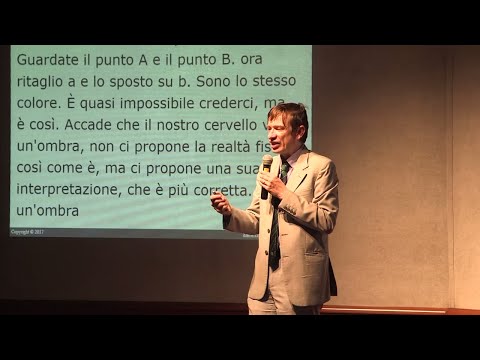
do not stop here look at this
chessboard and adelson chessboard
look at point a at point b
the dark point and the light point of the
chessboard
now I simply what
I do is cut to and move it to b
look again I’m exactly there
same color is almost impossible
believe it but it is so
what’s happening right now
what is happening and what ours is
brain sees a shadow and then there
proposes physical reality as well as ma
he offers us his interpretation is
more correct because it tells us hey says
a shadow and if there is a shadow there
true color is a bit clearer than
what you’re really looking at
because there is a shadow then certain
in this situation created ad hoc
wrong but in the other thousand situations
that our reality every day
find dealing properly and there
show reality beautiful see how
it’s really always a meeting between one
object is a subject the next is a
very important experiment to understand
this you must follow then the
very good directions set the
black dot in the middle of the slide
and do not move the eye do not move
the eye until I’ll tell you ok
in a few seconds I will change
slide but you do not move the eye
move it only when I say it
move at that point you can but up to
that moment even if change is
positive do not move the eye ok there
we understood it myself
then I proceed fixed
fixed begins a countdown
10 9 8 7
well soon change baboi slide
please do not move the eye here I am
to change, do not move the eye
move the eye do not move the eye
move now well you have seen the colors
you have seen the blue sky the lawn
green all these beautiful things
Well, I’ll give you the green lawn
the blue sky are not present on the
My computers have never been
let’s try again so let’s see if
believe it
fix the dot when I change
if you keep the fixation you will see i
beautiful colors look bad
putting you are putting you
because you are seeing colors
complementary to those just yours
retina adapts to complementary colors
of the right one all the visual system
it fits and when I show you the
white you instead of white you see
white minus the color you are in
adapted also this weakness becomes
a force of our visual system
when then we find ourselves in environments
think of the south pole all white and there
we must adapt to that white of
ready background 5 4 3 2 1 way to what beautiful
blue sky that green lawn but it
you are putting this but you do not think about it
be subjectivism this is the beautiful
of the encounter is an object is a
subject
this is for those who are passionate and
he wanted to make an image of himself
kind with some knowledge of
photo editing can us at the institute
national optics we also do
research precisely on the relationship that
there is between light and visual perception
trying in some way to measure
the immeasurable because we really want
test the relationship that exists
and then for example we tried to
experiment to see the
subjective preference of the paintings
compared to the lights we use for
enlighten
you know that now there are new ones
LED lights that offer new
solutions and we have made a series
of experiments in a laboratory that
we have at the stone factory
hard and nice to have a laboratory
to the hard stone factory because
if you ask something for an experiment
said the need for a painting and theirs
they make raffaello can go and say
that can happen worse for one
experiment of visual perception that
raffaello and in this painting and also
we have chosen a painting by an artist
contemporary giovanna rasario we have
then seen how we are adapting today
new lighting sources a
innovative LED begins to be
really beautiful and appreciated and then
we begin to appreciate these very much
we are starting new sources
adapt to new forms of lighting
measure the immeasurable then a
try but look at that really
relationship between light object and perception
important visual look at this
movie in which taken by super quark e
when they came to ours
laboratory in which you see how it is to
foods both paintings change appearance to
change what the light sends up
of them but this really is
fascinating because then you understand
that also use in light
lighting also use light
the lighting as you see becomes one
sort of interpretation of what
we have before and one could say but
is correct it is correct to interpret the
reality is correct to offer
an interpretation , reality does not
we should philologically present only
what is there
I say well not only is it correct
inevitable when we look at the world
we can not do it except in a light
and therefore the work of those for example
illuminates a painting like the chapel of
eleonora di toledo in the old palazzo
so it was illuminated by the lamps
incandescent
so it is illuminated by the LEDs or for example
sant’agostino in the study
here it is illuminated by the lamps a
incandescence
illuminated by the LEDs becomes the work of
an interpretation that however can not be
do not do it because without the light
we can not see reality like this
as if you listen to mozart you can not
read the score but you must hear it
interpreted and which mozart you prefer
you prefer the requiem of his
philological interpretation with the voices
white the vintage instruments or later
I would have von’s interpretations
karajan was more romantic less
philological depends however there is no doubt
that this interpretation is a work
continuous is a continuous work that puts
what is and is at stake in reality
we and from this continuous exchange the
knowledge that is never fixed but goes
forward and always becomes something and of the
search one notices that what
it was a point of arrival it became a
starting point then to move forward
how much is really significant then
what one of the most important
scholars of science the visions receive
Gregory says in one of his volumes when he is there
he points out that putting pieces together
we do not have the definitive answer
we can not understand the clock is not the
simple sum of the pieces that lo
make up
so the reality and our perception
it is not the simple sum of the pieces
what’s back we find it’s not this one
sum of our perception and say
gregory the time the clock measures
it’s another thing even then this is it
really the challenge that we find ourselves at
face up to
sure one could say but then there is
still much to understand
in the relationship between visual perception la
reality, the light is still there
so much to understand and we are happy
it means that there is a lot of work to do
because scientific work and so is
a work that continually places us
in front of new questions the desire to
knowledge continues to be true
and continues to ask new new questions
challenges to be faced
and the beauty of a continuous relationship
of knowledge that is always something
which is not fixed but born of one
exchange between us and the reality in which
everyone has something to say about it
truly the charm of adventure with
which every one of us clashes with each other
day doing each of the things it does
thank you
[Applause]
[Music]
”
Be First to Comment