
“Ilustríssima”, “digníssima” …
You’ll call me a doctor soon.
There are people who think that it is chic, that it is beautiful.
Nor do you know that these treatments have been dispensed since 1991.
Look at this document here.
“Compliments to you cordially,
I request the good services of Your Lordship
in order to clarify points referring to the epigraphado process.
Certain to count on your collaboration, I anticipate my thanks
and I take the opportunity to renew protests of high esteem
and consideration. “
Then there will be people who will look and say: “It’s beautiful!
How many difficult, cults!
That person writes well. I did not understand anything, but it’s beautiful! “
Look at that beginning: “Greet him cordially.”
The official document was not meant to greet anyone.
“I request the good services of Your Lordship …”
It seems like I have to do that,
I have to pull someone’s sack to get something.
“In the sense of clarifying points regarding the epigraphado process.”
“Points for the process …” What points are these?
“Processed epigrafado”?
Do you know the meaning of the “epigraphic process”?
It is because, formerly, that passage there, “subject”,
it was called “epigraph”.
Nowadays, it is called “subject”,
but people continue to use “epigrafado”.
Looks like it looks more beautiful.
And continuing: “Sure to count on your collaboration …”
The secretary did not say whether he will collaborate,
but I’m already “right” to have the collaboration.
“Ah, but it’s a bit of a jerk, a little jerk.”
If that is the intention, use the future:
“I look forward to your collaboration,”
“We will be grateful for your cooperation.”
“I take this opportunity to renew protests of high esteem
and consideration. “
Wow, that looks cool.
You know that in 1937,
we had 15 official locks.
Today, there are only two, “respectfully” and “respectfully”,
but there are people who continue to use it. “Ah, because it looks beautiful.”
It becomes false.
Sometimes I do not even know the person, nor do I know who he is,
nor do I have “high esteem and consideration” nothing.
And this one? Who has seen?
“Oh, how could that be?” A line.
“I request clarification of the start date of the consulting service
hired through the process number such. “
So, more objective? More accurate? I say what I want?
Who has seen a document that ends like this:
“We are entirely at your service.
for any clarifications that may be necessary. “
“We are entirely at your disposal.”
It is false, it is a liar, nobody is at the entire disposition of anyone.
So let’s go home, wash, iron, cook …
“For any clarification.”
Oh yeah, so tell me, do you get how much?
Married single?
“Any clarification”; I can ask whatever I want
But the person complements and says, “What if you need it.”
Will someone ask for clarification that is not necessary?
“Ah, but I want to be kind.”
“We are at your disposal for further clarification
referring to the process, to the subject … “
It is much more objective.
Only I’m sure
that there are people who, in thinking of these sentences, in these texts,
remembered the times when we wrote
or typed in this beautiful typewriter,
because these passages are old, from an old essay,
of a culture that has changed.
And I’m sure that if you propose changes to a superior,
he may say:
“But why do you want to change? It’s always been here!”
It looks like that “Ctrl C / Ctrl V”, “copy, paste, save as”.
Why do these documents continue like this, if they have changed so long ago?
Certainly because we do not learn at school to do a craft, a memo,
a report, an opinion.
Go to college, go do an article, a review, a summary.
Go to Public Administration, have to make a letter, a memorandum,
technical note.
Where did we learn to do these documents?
There, a generous soul appears, there comes a being and says:
“Take this template here. Use this template as a reference.”
And, as it came to you as a light, that model is getting and staying.
Sometimes you even, at first, had
that those elements would not be adequate,
but you have also been using, using,
without realizing that they are old and even old-fashioned elements
for a more modern public administration.
Today, when we speak in the concept of communicative competence,
which is what I want to share with you today,
is that competency brings together three basic concepts:
I have to have knowledge about the subject I want to convey,
information;
I also have to have knowledge about the format of that document,
what is the appropriate vocative, addressing,
what is standardization;
I have to also have the ability, which is the know-how,
know how to write properly.
But that’s not enough.
The most important thing is the attitude,
the attitude of wanting to do well.
When someone then asks you, “Why change if it’s always been like this?”,
answer: “Because I want to make a difference,
for us to have a better institution. “
Those ancient practices demonstrate, reveal,
a culture of an ancient institution.
If I want a modern, renovated institution,
thinking about who will read that document,
I have to change my practices.
Thank you.
(Applause)
Adriano Siri: Paula, look,
Could your lordship approach me?
Because I have a little doubt.
If people have not changed the way they write so far,
Do you think you have a chance of that happening today, from here?
Paula Cobucci: Do you think we can make the change?
(Plateia) Yes.
PC: Do you believe we can make the change? So get up, quickly, everybody.
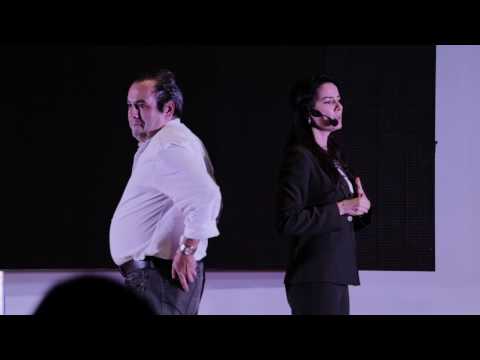
Two by two, facing each other. Come here, Adriano, help me.
Quickly, quickly.
Quickly, you will look at this colleague.
and you’ll see how he’s there: clothes, accessories, hair.
Backwards! Ended! Quickly. On your back … on your back …
Attention! Each one will make three changes. Quickly!
The clothes, the hair, an accessory, whatever you want to change.
It can be a big change, a little change.
I’ll count to three.
In the third, you will face your partner
and will identify in him the changes he has made.
One two Three.
Oops.
AS: But I’m all wrinkled … too, there’s no point.
PC: It got there … here, there …
AS: Oh, you opened it here … PC: The button?
AS: He opened the button … you opened it here, you unbuttoned … that.
You put your hair behind the … no, I do not know.
Oh, people! (Laugh)
PC: Was it difficult? Was? You can sit. anyone who finishes can sit down.
If the colleague could not, you can tell him.
I want to know: who noticed the three changes?
Raise your hand high I want to see.
PC: The three changes.
AS: I did not realize it.
PC: Only two. Only two?
AS: I noticed one. PC: Just one?
Who did not notice anything?
(Laughter) AS: That’s good.
PC: Which was easier to perceive:
the big changes or the small changes?
Of course, if I turn and the person is wearing my clothes all crumpled in front of me,
is almost in the face.
AS: “Date came,” I beg your pardon for my …
PC: But I want to know: who here the colleague made a small change
and did you realize?
A little button, and did you notice?
All changes are important,
the big changes and the small changes.
Maybe you have one more important than another,
but all the changes make the difference.
Do you think you can make the change? Can you?
So, look, I’m going to need concentration from you guys.
We’re going to make it like that stadium “wave”, you know?
Anyone who has something there strips, strips,
because we will need concentration and the participation of all,
because, in fact, to make the change, we need everyone.
So, let’s start like this, oh … let’s do a test with the wave?
Very quickly! So you have to concentrate.
One, two, and … it starts there. One, two and … o …
PC: Cool As: It was beautiful, it was beautiful.
PC: It was beautiful, but that’s not making the change.
This is not raining.
Do you think you can make it rain?
As: This is to make the wave. PC: This is to make the wave.
PC: That’s just the mechanism.
AS: Even Flamengo fans, Corinthians, can …
PC: Even Flamengo! So come on, look, now it’s serious.
The mechanism is this,
but to make the change, we have to make it rain,
as far as we can, right?
And here, let’s make it rain here in this room,
and it will start like this … there, with the wave.
Silence, concentration. Everyone has to do their part.
Strong.
To be continued.
Hear the noise of the wind …
the first raindrops coming …
Strong!
Listen to the rain!
And the wind took the rain …
(Applause) (Live)
Who heard the noise of the rain?
I heard it, too.
You made it rain in here. What you will do for the world!
So let’s take on this commitment to do our part for a better country,
for better management, for a better world.
Thank you.
(Living) (Applause)
”
Be First to Comment