
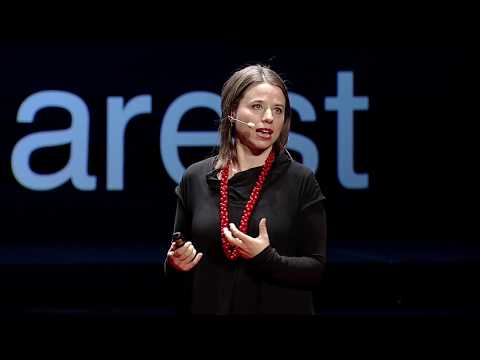
A couple of summers ago, I was walking through central London
and I saw a family of tourists posing in front of a statue.
I looked at the statue,
and it was of some bloke in bronze who’d been dead for about 200 years,
and I wondered, “Why did they want a photo with him?
He probably just killed a lot of people.”
And then I thought,
“What does he mean to me?
I mean, I’m a Londoner, I’m from this place,
what were any of these statues of men to me?”
I looked around and I realized, “Where are the statues of women?”
This isn’t just a London thing;
it’s all around the world.
I mean, just have a moment:
Can you think of any statues of women?
Okay, so there’s statues of the idea of women,
there’s plenty of those:
you’ve got the Statue of Liberty, stacks of angels and mothers,
but very few named women from history.
And we make up half the world’s population,
but rarely appear in history.
But we were there.
(Laughter)
I’m a storyteller, I tell stories using technology,
and I want to see all these missing stories
of great women doing amazing things
reinstated back into history.
I’m a woman in tech, originally a theatre director.
I also got into technology,
and I’ve spent the last 15 years
combining my passion for technology, theatre, and also for education,
to make education software.
I’ve also worked in big events,
with big brands in advertising and marketing,
telling their stories,
using amazing technology to wow people.
But making robots dance for large car manufacturers
can get a bit soulless, even though it’s great fun.
I worked out that by 2014 I wanted to do something
a bit more meaningful with my life.
I’d also noticed something else, working in the tech world,
that I was in the minority,
there was a lack of other women in tech.
And this is the UK’s story:
each year it is slated that 100,000 new jobs will be created in technology,
and in the UK we don’t have enough skilled workers to fill them.
Yet, of all the people working in technology currently,
only 14% are women.
That is less women in tech than 20 years ago.
And this is going to get worse,
because, according to a report two years ago,
it is fewer and fewer women going into technology degrees,
dropping to less than 9%,
which in turn will lead to fewer women in tech.
I thought,
I want to create these stories about women,
because how better to encourage women
than with stories of other great women creating amazing things?
As a society around the world,
in each country, slowly it’s getting better at being gender equal.
Men and women are treated more and more the same.
However, we have all inherited a patriarchal history.
I mean, take the word in English “history”,
it is “his story”.
(Laughter)
So I have decided to update “history” with “her story”,
and I’m going to start with the original woman in tech,
Ada Lovelace.
Ada Lovelace was the world’s first computer programmer.
She wrote the world’s first complex computer program in 1843,
and then she was written out of history.
Ada Lovelace’s father was the infamous and scandalous poet Lord Byron.
Her mother was of polite society, Anne Isabella Milbanke.
She had a noble birth, a strict religious upbringing
and, unusual for a woman of her era, she also had an education in mathematics.
As you might imagine, their marriage failed.
And when Ada was just five weeks old, Annabella, her mother, took Ada away.
She also then proceeded to try and rid Ada
of any of her father’s scandalous behaviour,
his creativity, his imagination,
with a strict course in advanced mathematics.
Luckily for us,
Ada retained her incredible imagination and creativity.
She also was an extraordinary mathematician.
And, as a young woman, she was introduced to the inventor Charles Babbage.
And Charles Babbage recognized in her
a kindred spirit and an intellectual equal.
He was working on
what would have become the world’s first computer,
the Analytical Engine.
Now, the Analytical Engine wasn’t built.
They didn’t get enough funding.
But had it been built, it would have worked, in 1843.
And while Babbage was trying to automate mathematics,
Ada Lovelace had the foresight to realize
that these computers would be able
to be the tool of human imagination.
She realized it was what we told the computer to do,
the instructions we gave it, the programming,
that would unlock this magic.
So, here it is.
The world’s first complex computer program.
It has line-by-line instructions.
It also has looping and conditional branching.
Back then, in 1843, she published it
with the encouragement of Charles Babbage.
She wasn’t going to sign this,
but she was encouraged by her husband to sign it,
so she agreed to sign it “AAL”.
But what perhaps is the most incredible thing
about Ada’s work with Charles Babbage in 1843,
is the extent to which it was ignored.
Instead, it took a whole 100 years
before we get to Alan Turing
and his work in the 1940s,
in the Second World War,
where he created that mechanical computer that cracked the Enigma code.
And it is Alan Turing,
who for the first time talks about Ada Lovelace’s work again,
when he was working on artificial intelligence.
And his paper gets published in 18…
Sorry, his paper gets published in 1950.
And her work is in the public domain,
and it’s talked about,
but it’s also debated, because she was a woman –
“Did she write it?”
Which is ironic,
because, at the time, it was women doing the most of the coding.
And then, in the 1960s, we have this seminal woman:
“Amazing” Grace Hopper.
She came up with the ground-breaking idea of using words in programming.
It was no longer
that someone had to be a mathematician in order to be a programmer.
It opened it up to the world.
She also found the world’s first bug and coined the phrase “debugging”.
It was a moth that she found in the computer.
(Laughter)
In the 1970s, it is the US Military
that recognizes the work of Ada Lovelace.
They name a computer language after her.
However …
now …
Ada Lovelace, the person, is relatively unknown,
and Ada, the programming language,
is prolific.
It’s used in mobile phone networks,
among other things, it’s also used for air traffic control and satellites.
Back in 1843,
Ada wasn’t interested in being known for it.
Us women have always been told to just stand to the side,
let the men take the accolade.
Of course, things are changing,
but this was her attitude.
She needed to do something good,
she didn’t need people to know about it.
And like so many women, myself included –
I mean, I haven’t asked to be looked at.
It’s actually only recently that I realized
if I’m going to actually update “history” with “her story”,
I needed to set an example, as well,
I needed to stand up and say: “Look at me.”
So, I’ve decided to update “history” with “her story”,
and I’ve decided to use Ada Lovelace as where I start.
And I’ve created, using my skills, a one-woman show.
During the performance – it’s interactive with the audience –
we recreate Babbage’s Analytical Engine,
and we learn how to do basic coding.
I also tell it with technology that women have helped create:
an LED dress with 4,400 LEDs that I control with my glove.
Here’s a clip.
(Music)
(Video)
AL: It will become the tool of our imagination.
It is what we ask it to divine, therein lies the magic.
MH: I’m just amazed by all of the tiny details that came together.
JS: The dress and the effects with technology, I loved it.
AL: You are now the analytical engine.
ZP: There are fewer people in technology than society needs.
Ada Lovelace can be this inspirational role model.
VM: Inspirational, it was extraordinary.
EP: She’s a great role model for all.
VM: Such a great story, performance, lighting, music,
coming from deep to your heart.
(Video end)
ZP: Ada’s story is not the only one,
and there are too many for me to tell.
So I’m going to need your help.
I am creating card games and mobile apps to include all the other stories,
but there are seriously just too many.
So, what I’d like you to do is share more stories.
Look them up.
When you start looking, there’s hundreds.
There’s Lise Meitner, who was a physicist and discovered fission,
but then was overlooked, for instance.
Also there’s something else: you can mentor.
Ada Lovelace would not have done anything that she did
without the help and encouragement from Charles Babbage,
from her husband, Lord Lovelace,
and from her mother, teaching her maths.
This way, if we do it together,
we can create the other half of the story,
so that, as we get more gender equal,
every person, not just the boys, have role models to look to,
people that have done it before them.
This way, we can update “history”, include “her story”,
and make sure the future is “our story”.
Thank you.
(Applause)
”
Be First to Comment