
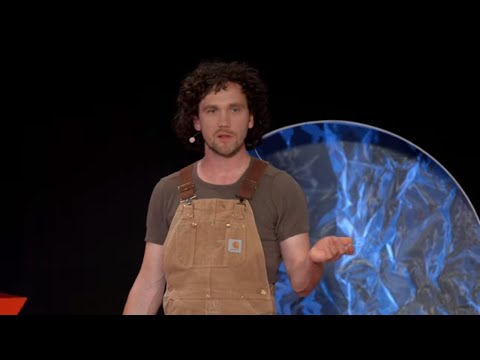
I was trained as a sculptor
and loved becoming a part of raw, hard-working men who get their adrenaline
by moving ten-ton heavy boulders from place to place.
It is a proud tribe of men and women
who bear scars left from droplets of molten iron
or from carving their pieces,
but whose hands are sensitive enough to make a butterfly.
Well, a 200-kilo iron butterfly, of course.
I know how it is to reach ecstasy by looking at the world
reflected in the mirrorlike surface of a metal I just polished.
At some point, in creating flowy shapes,
I was just about to surpass the Mother Nature itself.
But as often happens in such pivotal moments,
I started to wonder, “Where am I? What’s next?
What story does my beautiful shape tell?”
And this is a question that is not easy to answer,
and I couldn’t, so at the age of 30, I put my tools in the box and I quit.
It took several winters before I was ready to take the next step.
But at first,
I had to admit to myself that from now on,
little, joyful, colorful, tiny figurines would be my messengers.
So I filled my studio with spray cans of solid green, pink, and yellow,
and started to cast plastic toys.
This is “The Barbeque.”
An ocean-battle-hardened octopus with five remaining legs,
an angry crab,
an unexploded charge from the Second World War,
and a bankrupt businessman that are having a barbecue.
But the businessman is so bankrupt
that he even doesn’t have a sausage to put on the stick,
so he is just pretending to cook a meal.
At the entrance of Valmiera State Gymnasium,
two friends are permanently seated: the moon and the mole.
The mole, as we know, lives under the ground
and has never seen the stars.
But he has a good friend, the moon,
so once in a while, the moon comes down from the sky,
they sit on a bench, they chat, and the moon tells the little mole
everything he knows about stars and galaxies,
while the little blind mole is staring up into the sky,
trying to imagine what our universe consists of.
Although I had so much fun creating these compositions,
something crucial remained untold.
I felt that some frequencies of sadness and loneliness
are weaved in just about every of my creations.
So I felt that I was at the doorstep of some unknown, unexplored territory,
and by spraying all shades of pinks and purples,
I was trying hard not to open these doors.
As often happens
in such gut-wrenching process of creating new ideas,
I jumped on a bike and went for a ride;
it’s a common way of just freeing your mind from daily noises.
But at one such [occasion], my ritual suffered major difficulties.
Still having this macho attitude, that I can bike on just about any surface,
I found myself pushing the bike deep in the forest
after a few days of heavy snowfall, and it was January.
Somewhat surprised and tired, I stood on a hilltop
and was observing the winter joys others were having.
This is Biķernieki forest on the outskirts of Riga City.
My home and my school were located nearby,
and I had been coming there throughout my childhood
to go down the hill on skis and sledges.
And this spot is one of the best because it is shaped like a bowl,
and you could go down the hill from many directions.
Nothing has changed there since my childhood, except for one thing:
On the left side of the image, you see a concrete sign erected.
It marks the spot where in 1941 mass killings took place.
By that time, the Nazi forces had occupied Latvia,
and the Jewish population was being completely exterminated.
It is estimated that in this place around 35,000 people were killed.
But there are no bodies or bones in the ground.
Upon retreat, the bodies were dug up,
and with the help of many tons of gasoline,
their remains were burned.
Somehow, the thin ice I was standing on shattered,
and I fell into the immense dark waters of our human behavior.
I started to wonder,
“How is it possible that after 2,000 years of Christianity,
after all the beautiful churches had been built,
after all the greatest symphonies had been played,
how is it possible that we, the European civilization,
sent a few millions to die in Siberia, killed a few millions,
and then dissolved their remains through chimneys?
Who are we?
What forces slumber inside of us?
How radically may we change if thrown into new conditions?
What would happen if we were confronted with all our fears?”
Thinking about how to translate these thoughts into an artwork,
I came across the story of Herberts Cukurs.
Born and raised in Latvia,
he became one of the most celebrated sons of our nation before the war.
He wrote his name in the history of aviation
by flying a solo plane of his own design to Gambia in Central Africa
and to Japan in the 1930s.
I guess he could not have predicted
what decisions he would have to make during the war,
but from being an explorer and an inventor,
he became a member of Arājs’ team,
which was sort of a local Gestapo during the Nazi occupation.
There are claims that he personally participated
in the annihilation of people.
On the other hand, there are claims that he was merely fixing the planes.
I’m not here to judge his actions,
and he has already been tried, but it was not an ordinary trial.
After the war, Cukurs fled from Europe and settled down in South America.
Twenty years later, in 1965, the Israeli secret service, Mossad,
mounted a special operation targeting Herberts Cukurs.
What happened is known from the memoirs of one of the agents.
By acquiring Cukurs’ trust,
they were able to get him into an isolated house,
and there he was confronted by the agents,
who actually looked like office workers, not to be suspicious.
“Let me speak! Let me speak!” were his last words
before he was struck by a hammer.
The commandos were dressed only in underwear
so they would not get stains of blood on their clothes.
After exhibiting this work and other works related to our recent past,
I started to receive direct and indirect threats.
I was warned
that I might get some flying stones in the windows of my home.
I was asked to remove my works from an exhibition.
But mostly these comments were just anonymous comments on the Internet.
So I thought,
“Maybe there, when a person is anonymous and is posting these comments,
I may find traces of real human identities I’m looking for.”
So I started to look at these comments and collect them,
and somehow, this path led me to the dating advertisements
that some commentators were also posting.
There were plenty of different ones, crazy ones,
but I was struck by this one:
“In search of a Russian girl, not chubby,
who honors May 9 and knows who was beaten and why.
My age: 33. Height: 170 cm. Weight: 68 kg.”
Just like me.
It is important to note that May 9 is a divisive date in Latvia.
While for many Russians, it is a day of celebration,
for many Latvians, or most of Latvians,
it is a starting point of a harsh, 50-year-long Soviet occupation.
I was wondering: who is this person who [placed] this advertisement?
So, on May 9,
I went to the Victory Square in search of this boy.
I felt, well, maybe this is the one,
or maybe this man,
or maybe this pal is in search of a girl who thinks about heroes.
Back in the studio, I made my own version of what could have happened.
So here he is, standing in the red shirt,
holding a tulip flower in his hands.
Maybe he is so overwhelmed by his ideals
that he doesn’t even see
that the real girl is right there putting flowers.
Or maybe they already know each other,
but for the girl, the number one priority is to pay tribute to heroes
and only then come personal affairs, just as he wishes.
War, political changes, personal tragedies,
or maybe a jackpot in a lottery
may turn us into beings beyond imagination.
While looking at the stories of people who went through such dramatic changes,
I happened to read a story of a boy who studied at a Christian gymnasium
and was considering becoming a Catholic priest.
But interest in literature was stronger, so after the studies at the university,
he received a diploma of a Doctor of Philosophy.
Meet Joseph Goebbels, the Nazi Minister of Propaganda
and the propagator of the idea of the total war.
They were a perfect family:
six children, often dressed in white clothes,
all of their names started with the letter H
as a tribute to the Führer.
It is May 1st, 1945,
in an underground bunker in Berlin.
The Allied forces are advancing rapidly, and it is clear it is their last night.
The next day, they will be captured,
and possibly all of them, including children,
will be torn apart by an angry mob.
When late at night the children were already asleep,
an ampul of poison was put in between their teeth and crushed.
Only the oldest daughter had woken up during this process;
she must have been fighting.
At least, this is what the Allies concluded the next day
when they examined the bodies
and found bruises and damaged jaw on the oldest daughter Helga.
Rochus Misch, the radio operator who was in the bunker and who survived,
later reported that Helga, the oldest daughter,
was crying softly and wore a glum expression on her face
while her mother brushed her hair and kissed her and other siblings.
He remembered
that the youngest daughter, Heide, had turned back to Misch
and teasingly said, “Misch, Misch, du bist ein Fisch,”
which translates as “Misch, Misch, you are a fish.”
And then the mother led them to the bedroom.
While working on this piece, I happened to read a book
by the Austrian zoologist and animal psychologist Konrad Lorenz.
It is titled “On Agression.”
And, by the way, [by observing] fish swimming in a fish tank,
he received the Nobel Prize in Medicine or Physiology.
So in about a dozen chapters of this book,
he describes what geese, fish, and rats do in certain conditions.
However, at the end of the book,
he takes laws [observed] in other species
and relates them to our own behavior.
Concluding all of the above-mentioned,
he wrote, “If I thought of man as the final image of God,
I should not know what to think of God.
But if I know that our ancestors
at a time fairly recent in relation to the Earth’s history
were perfectly ordinary apes closely related to chimpanzees,
I see a glimmer of hope.
I believe, in greater awe of Creation,” he wrote,
“and its infinite possibilities –
that the long-sought missing link
between animals and the really humane being
is ourselves!”
I didn’t want to think that we’re just half-monkeys
surrounded by dark waters of unpredictable patterns of behavior.
Although we have a tendency to flatten cities occassionally,
we also have a passion to meticulously and slowly restore books,
page by page.
This is why this summer, I am planting flowers
in the delapidated remains of a building.
This is my type of prayer or, more precisely, my input
into the Creation of the humane being, maybe a hundred generations from now,
who will possess tools [to] contain our tendency
to burn things, and beings, and places that can actually make us happy after all.
Thank you.
(Applause)
”
Be First to Comment