
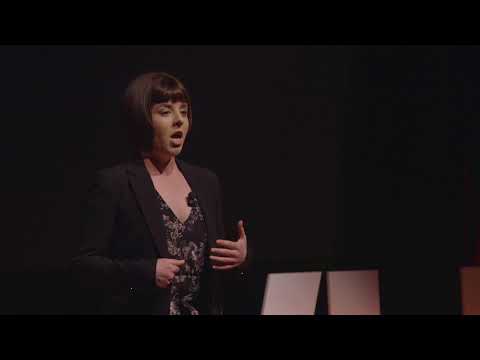
Hi, my name is Lauren Stevens and I was born profoundly deaf.
You’re probably questioning my ability to talk to you today, but all my life,
I’ve had to practice hearing and talking in order to converse within society.
Here’s a question for you –
when you encounter a Deaf person, how do you initially perceive them?
As a person less able than yourself, a member of a culture,
or simply a normal member of society?
I am the only one in my family who is Deaf,
and I have encountered all of these perceptions.
When I was diagnosed with profound hearing loss
at 10 weeks old,
my parents faced a dilemma.
They could choose to raise me with New Zealand Sign Language,
or they could choose to enrol me into early intervention programmes
which would teach me to hear and to speak.
As a result, they faced two strongly opposing views.
The Deaf community told them
that they were denying my rights as a Deaf child
if I did not learn New Zealand Sign Language,
and that my Deaf identity would be stripped away from me.
Rather than perceiving Deafness as a disability,
it is perceived as something you are born with
and as a difference that should be embraced.
In contrast, the hearing world argued
that if I did not acquire verbal and auditory skills,
I would have to be held back in school and in many areas of development.
Because I grew up in a small town that did not have a large Deaf community,
my mother was determined that I would learn spoken language
so that I would be able to successfully interact within society.
And my dad, who is a musician,
wanted me to grow up sharing his passion for the Beatles and Led Zeppelin.
Thus, I was enrolled into an extensive auditory-verbal programme in Australia
at St Gabriel’s School for the Deaf.
At St Gabriel’s, I was taught to come into spoken language
through using what little residual hearing I had with the help of my hearing aids.
Hearing exercises involved the complete removal of visual cues,
such as lip-reading,
so that I had to listen for certain vowels and consonants to identify a word.
For example, if I was spoken to,
the speaker would place their hand over their mouth,
like this,
so I wouldn’t be able to read their lips.
I began this program when I was five months old
and successfully completed the curriculum
at five years old.
This process set me on the path to integrate into a world for the hearing.
I was then enrolled in a mainstream school,
and the way I experienced situations in the hearing world as a Deaf child
was vastly different than that of my peers.
Deafness can be isolating
because it’s considered to be an invisible physical disability,
and not many people understand what it means to be Deaf.
Now, with my hearing aids, I could only hear up to a certain point,
and it wasn’t until I received a cochlear implant
that I realised just how bad my hearing was.
Previously, I could only hear very low-frequency sounds,
but the cochlear implant opened me up to an entire new world.
I can now hear the clock ticking, bees buzzing, and my personal favourite,
the sound of a morepork on a summer’s night.
Yet, there is always something I miss out on.
For example, if I’m conversing within a large group of people,
it’s like walking into a bar at 2 a.m.
full of drunk first-year university students
just yelling over the top of one another.
I have no idea what they’re saying
or which direction the voices are coming from.
This is just one example that serves as a reminder
that I am still too deaf
to be completely part of the hearing world.
Now, the Deaf world I have very little association with.
I grew up with one or two Deaf children
but they signed.
I wasn’t able to communicate directly with them
and relied on my teacher aide to interpret what they were saying.
As a result, I felt alienated from the Deaf community
as there was a huge language barrier that I did not know or understand.
I was reluctant to become involved
as I felt more comfortable being in the hearing world,
where I was able to socialise and communicate with others.
Admittedly, I viewed members of the Deaf community
as people who are even more disabled than I was,
because they do not have the hearing or oral skills that I have,
so I could not understand how they were able to succeed
and interact within society.
So what changed my perspective?
When I began learning sign language at university,
it suddenly became so much more than just a university paper.
In the first class of the course, I had no idea what to expect.
The teachers, themselves, are Deaf, and do not use spoken language.
But because of this,
I did not feel the pressure to work harder than others,
and felt like I was on an equal playing field with everyone.
It was then I realised that Deafness is not a disability;
it is an identity,
and learning New Zealand Sign Language helped me find this identity
as a Deaf individual.
I then wanted to experience firsthand
what it was like being in the Deaf community,
so I began going to regular events set up by the Wellington Deaf Society.
The Deaf community does not just involve Deaf people
but hearing people who have Deaf parents or Deaf children.
Although I was surrounded by technically, strangers,
there was a feeling of belonging and familiarity
that I do not quite experience in the hearing world.
Members of the Deaf community
may not share the same political views or religious beliefs,
but what brings them together as a culture
is the art of sign language and shared experiences.
Deaf people have all experienced complications and frustrations
in trying to navigate in a predominantly aural society,
especially when that society is limited,
when the social requirements of Deaf people are not well catered for.
One misperception is that Deaf people are limited
as to what they can and can’t do.
They do not see themselves as incapable, and focus on their abilities
rather than what we would consider to be a disability.
They have this perception because, in the past,
Deafness was viewed as a condition that had to be treated.
Suppose you were a Deaf person in the early to mid-20th century;
a time when communicating in any other language but spoken English
was strongly discouraged.
Sign language, especially, was too different, too outstanding,
and was perceived to be an embarrassment or incapacity that had to be corrected.
As a result, language barriers were set up between the two worlds.
One point I want to emphasise here
is that sign language is not a universal language.
It differs based on the collective society of a particular country.
New Zealand Sign Language was only formally recognised
as New Zealand’s third official language in 2006.
But there is still a lack of exposure around the importance of this language
as a basic right for Deaf people.
New Zealand Sign Language, in many ways, is not just a form of communication.
It is an art.
Signers use dimensions of time and space
to perform visualisations of stories and poetry.
Greatly contrasting from spoken English, it is a vibrant, expressive language,
and although sentences are structured in simple forms,
it is the way the signs are conveyed that expresses a lot of meaning.
For example, facial expression is a key concept used
to identify between a question or a statement,
and often signs depend entirely on context to understand the conversation.
When learning New Zealand Sign Language, for some people,
it can be a step out of their comfort zone because it’s a very emotive language,
and they may not be used to communicating in such a bold, visible way.
I was at a party a few months ago,
and a friend of mine, who is also learning New Zealand Sign Language,
began a conversation with me from opposite sides of the room
by signing.
It wasn’t long until I realised that room had gone dead quiet.
About 15, 20 people had stopped their conversations
and were just watching us.
With spoken language, it’s easy to ignore the conversation of another person,
but when signing, it’s hard not to draw attention
to something that is rarely seen in the general public.
Sorry, I’m just getting a little bit of feedback from the microphone here.
Now, when people first meet me, most do not realise I am Deaf.
Usually, the first thing I am asked is,
‘You have an accent, don’t you? Are you from Europe?’
(Laughter)
And I’d dearly love to say ‘yes’, here,
because it makes me sound so much more sophisticated,
but, growing up, I wanted to perfect my speech
so that people would be able to understand me better
and that I’d gain the confidence to speak in front of audiences.
An additional 12 years of speech therapy and competitions helped me achieve this.
However, I soon came to realise that not everyone responded the same way
when I said, ‘Actually, I have an accent because I’m Deaf’,
and I would become concerned
that they would not see me as a person equal to them.
One instance was when I was at a careers expo at university
and was having a discussion with a recruiter about social work.
At one point, I mentioned that I was, in fact, Deaf,
and their attitude instantly changed.
They then said, ‘Well, in that case, perhaps a role in communications
wouldn’t be suitable for you, but, of course,
there are other roles in administration you could consider’,
and I was thinking, ‘Okay. Well, if communication is such an issue for me,
how, exactly, are we carrying out this conversation right now?’
This was a huge blow to my confidence,
and often the doubt of others
strongly impacts my own sense of self-worth.
Am I really not as capable as I think I am?
But becoming part of the Deaf community
taught me that Deafness is not a limitation,
and that there is no reason as to why
there are language barriers between worlds.
When I was diagnosed as a profoundly deaf child,
this placed me inside a box.
While I received the therapy and education
that set me up for life inside the hearing world,
I was still perceived as disabled.
That, because I am Deaf, there are certain things I cannot do.
But, for me, I do not see myself
as someone who is severely lacking in the ‘hearing department’
because Deafness is normal for me.
I always get the best night’s sleep, without fail,
(Laughter)
and that includes sleeping through my flatmate’s raging house parties.
By embracing the differences between the Deaf world and the hearing world,
it will create opportunities to open up doors for communication
rather than set up and maintain the barriers
that are currently in place.
There is evidence that New Zealand Sign Language
as a visual mode of learning for both Deaf and hearing children
has been effective in brain development and cognitive processing,
regardless of whether they use spoken language or not.
It is a basic right for all Deaf people
to be able to develop their linguistic and cultural identity by signing.
Research has shown that by both signing and reading or speaking,
Deaf people are more likely to achieve academic success
and fully participate as an active member within the wider community.
As an aural society, we have the tools and responsibility
to make this world a more inclusive place for those who do not communicate orally.
I had once thought that being part of the hearing world
was the ‘be-all, end-all’ of effective communication
as a person with hearing loss.
But becoming part of the Deaf community
opened a door to a culture I did not know existed
in the language of my own right.
Thank you.
”
Be First to Comment