
In the summer of 1991,
I was flying back home from America
where I had got my undergraduate degree.
I was looking forward to going home and to continuing my studies there,
but things did not go to plan.
Instead of becoming a postgrad,
I spent much of the 1990s working as a journalist
and writing about senselessness of war and ethnic nationalism.
What I didn’t know on that long flight home,
when I was daydreaming about my future,
was that the country that I was returning to,
then known as Yugoslavia,
was soon not to be any longer.
The bloody break up of Yugoslavia started that summer,
and it continued with a series of wars throughout a decade.
With their brutality and wanton violence against all,
young and old, man and woman,
use of rape as a weapon of war,
expulsion of people,
wanton destruction of cities, of villages,
of cultural heritage, of schools, of libraries, of museums,
of the houses of worship, of mosques and churches,
the Yugoslav wars really heralded
a gory grammar of contemporary conflicts
that we have come to see and recognize in the conflict zones of our day,
in Syria, in Iraq and in Southern Sudan,
to name just a few.
So you may wonder: How come I didn’t know?
And it is certainly not because I wasn’t political:
I devoured politics then as I do now.
I believe it is our mistakes that make us,
much more than our successes.
They haunt you for the rest of your life
like a footballer who will never forget that penalty he missed,
or a tennis player that remembers for the rest of her life
the break point that she did not convert.
But mistakes can help you grow,
you can stop and think.
And what I have learned is to approach knowledge,
both what we know and how we know it,
with humility rather than with unquestioned certainty.
So here at the London School of Economics,
where we strive to know the causes of things,
I’d like to address the question
of what we, as political scientists, would have and should have known.
So, let’s start with this country.
No matter how you may have found out the results of the Brexit vote,
whether the first exit polls kept you in suspense
and you stayed up all night,
or you woke up the next morning
to the delight or shock of the breaking news,
of course depending on your position,
on the UK’s position in the EU,
or, like me, you fumbled in the middle of the night
in the midst of sleep with the phone
to see what’s going on.
For all of us,
it was a moment where we felt the ground shifting underneath us.
For these big moments in the lives of nations
are followed by uncertainty.
And the uncertainty is unsettling,
and it is even more unsettling, the feeling is even more intense,
because these moments come as a surprise.
I’m sure you’re guessing where I’m going now.
Because, of course, on the heels of Brexit,
came the surprising election of Donald Trump as US president.
But let’s not just be focused on these two latest instances.
Political scientists have built quite a long track record
in these moments of not knowing.
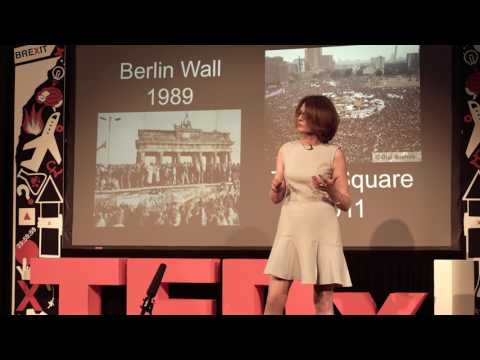
Incidentally, the 9th of November,
the day when Donald Trump was celebrating his electoral victory,
is the day that we have been marking as the day of the fall of the Berlin Wall,
the symbol of the Cold War,
and the day that heralded
the end of the global confrontation and ideological division.
It was a momentous day that changed our world,
and yet it came as a surprise.
Similarly, the Arab Spring came like a flash flood,
and, indeed, was a huge surprise.
So, we did not know over and over and over again,
because we have written people out of the study of politics.
We have focused on political elites and political institutions,
and we have privileged the wave of study that looked at outcomes
rather than explaining processes.
So how then do we study people?
How do we study politics from the bottom up?
Methods are all important.
Methods are magic
that bring you from what you want to know to actually knowing it.
But I will not be the first one to tell you
that methodological tribalism is a dead end road.
Methodological tribalism divides the scholars
who go out there, meet people, do interviews,
and those who do numbers and who do statistics.
There is not one and only one good way of doing political science.
All our tools need to be sharpened.
But, above all, the study of politics
requires an attitude, an interest, and even compassion.
In my work, I have sought to understand
how society overcomes the legacy of mass atrocity.
Is there any glimmer of hope
amidst human misery that we see in the conflicts around us?
And I have talked to people coming from all sides of the Yugoslav conflict:
I have spoken to former inmates
who have endured unspeakable brutality in the detention camps,
I have spoken to mothers
who are still desperately looking for remains of their children,
and have spoken to adults
for whom the lasting memory of their parent
will be a fragment of a bone.
And what I found studying their words, what they say,
is unwavering commitment to justice, to peace and to dialogue.
In fact, when I measure their words,
I find that in conversations across the ethnic divide,
they’re even more respectful to each other than other segments of the population.
So what happens when we insert people
into the analysis, into our study?
We find the opening of peace.
And yet, we maybe forgiven that – to expect –
we will find bitterness and, maybe, revenge.
And in fact, what we find
is that these people are motivated by a very strong drive,
and a very selfless drive,
that no one else should suffer
the loss and pain as they have done.
I told you that I saw war,
and this is the reason why I get very scared
when I open the newspapers
and I read about war drums being louder and louder in the Western Balkans.
But on this occasion,
we cannot say that we didn’t know;
but no one listened.
I think that as political scientists,
we have a duty to seek the truth
from the powerless, from the voiceless, and from the marginalized.
We also have a duty to speak that truth to power,
and never to stop in our efforts to convey it to policy makers.
So, I’ll leave you with a thought:
that the biggest challenge of our times,
for us as political scientists,
is to understand better how people make their political preferences,
how people make political choices.
To know that,
we really need to understand how people breathe and live politics.
We need to know that in order to be able to inform policy,
and to contribute
to a better, fairer, more progressive and more peaceful world
for all of us.
And we risk not doing so at our own peril.
The politics is the art of the possible,
but it is also a dark art of seduction.
(Applause)
”
Be First to Comment