
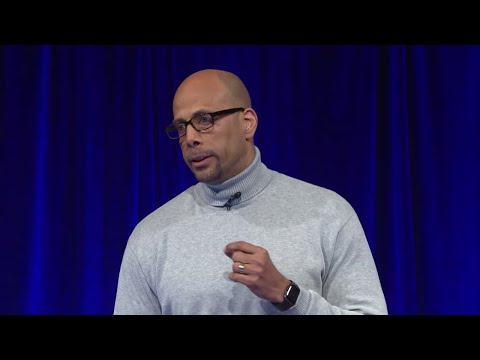
It’s always amazing for me to be on the stage in Washington, D.C.
This is my home.
For those of you who don’t remember,
D.C., 30 years ago, isn’t the city that you see today.
It was the murder capital of the world at one point.
It had very little commerce.
It had a school system that was seen
as the worst performing in the country and not going anywhere fast.
Hardly recognizable is now the city that people refer to
as having one of the most robust economies in the country
and one of the fastest improving school systems as well.
In some ways, the story of D.C. is my story.
I can imagine that people that saw me and my friends
standing on the corner of Southeast D.C.,
using their heuristics and statistics,
would have found it very difficult
to believe that I’d be standing here on this stage today.
Yet, here I am.
And I love D.C. because it launched me on my quest,
and it is the foundation for my optimism about the future.
But I want us to think for a second
about the fact that that story about me and about D.C. is not just local.
It’s a story that is uniquely American:
of individuals, of communities,
of even our country, exceeding expectations.
In fact, not only exceeding them
but then shifting them and redefining them.
Right now, we’re at a place
where people are concerned that those norms,
the new normal that we’ve set for ourselves as American,
may be at risk.
And it’s tearing us apart at the seams.
We’re worried that things may not get any better
the way we’ve always come to expect them to be.
And there’s a reason for that concern; I don’t want to set it aside.
Two Stanford economists, Raj Chetty and David Grusky,
did an analysis using recent IRS data,
trying to answer the question about how we think about
what has happened to the American Dream as defined by most of us:
that we do better than our parents so our children can do better than us.
They found something pretty disturbing.
Since the 1940s,
the percentage of Americans doing better than their parents by income
has been in steady decline;
that doesn’t matter if you were a part
of the Greatest Generation, or the Baby Boomers;
it doesn’t matter whether it was a recession or a period of growth,
whether it was a Republican president or a Democratic president;
it didn’t matter: the line was going down the entire time.
In the 80s, when they stopped being able to really figure it out,
it was to the point where, as you can see,
about 50% of the folks were feeling
like the American Dream was no longer in their reach.
And there’s no reason, frankly looking at most of the data,
to think that that line stopped going down there
and in fact, if you think about the trends we’re hearing about
– artificial intelligence, and robotics, and automatic driving cars –
there’s every reason to believe that it might actually accelerate.
A pretty scary future.
Here’s where the choice comes in.
When confronted with a scary future,
there are those people who focus on how bad it is.
They often worry that you can’t actually get there.
And their response to that is known as that fight-or-flight instinct.
They sometimes retrench; they sometimes lash out.
Then there are people who are optimistic.
I consider myself an optimist in some ways.
We see that there is a possibility.
We believe our brighter days are ahead of us.
There’s a difference between me and most optimists, I think.
Usually, I can see that Sun out there on the horizon,
but I imagine there are these mountains;
mountains in between me and getting to that beach, or that valley,
or wherever it is that we’re trying to go.
That’s where I think we are today.
But there are reasons to be optimistic.
The first one is going to seem kind of strange –
but we’re still here.
(Laughter)
Through the Great Depression, through the threat of nuclear war,
through great social unrest,
whether it was the Vietnam War or the Civil Rights Movement,
we have found a way not only to survive but to thrive;
to create a new opportunity
for many Americans and people around the world having a quality of life
that has continued to go up, though not as fast as we would like.
The next might also seem strange:
we’ve been wrong.
We’ve been taught to think of the world in terms of a bell curve.
That in the end, there’s some of us
– when you look at the line down the middle –
that have it, and some of us that don’t.
Some of us that will get it; some of us that won’t.
In fact, we built our entire school system around it.
The work of Todd Rose who wrote the book “The End of Average”
says that not only is that wrong
but in fact, to the extent that a curve exists,
it probably looks more like the one in red.
This is not just some theory.
There was a researcher who, almost three decades ago,
– named Benjamin Bloom – who asked a simple question:
what could children actually do if you put them in the right context?
If you gave them the right supports?
If you put them in highly favorable conditions?
His proxy for this was a one-to-one tutor.
If I give a child a one-to-one tutor who can meet them every day,
know what they know, know what they don’t know,
know what they’re interested in, what makes them tick,
and I compare them to how they’d have done in a normal classroom
with a controlled study, how will they do?
Let’s be clear what we usually think of when we think of ‘average’: mediocre.
That average kid, that 50 percentile kid,
given that kind of support,
will outperform 98% of children in a regular classroom.
If you repeat that experiment over and over and over again
and get the same result,
then you have to face the fact that it is never ever ever about the kid.
It is always about
whether we’re willing to create those highly favorable conditions.
At that time, and still some today,
you’re then faced with the very difficult question
of what you’re willing to do and what you know how to do.
Where are you going to get all those people and all that money?
How is this going to work?
But this gives me optimism,
because now you have a problem to solve.
Some of you have heard me tell a story before
about how the military needed to find people
who could fix their very complex computer systems.
People who’d been in the service for five to seven years
and had received extensive training, had built expertise, were leaving
because they could make three times as much in the private market.
Their new recruits were being trained
and weren’t able to solve any of the problems they had.
They went to get new computer systems, and instead, DARPA told them,
“What we can do is take your new recruits
– think about the average new recruits as you know them –
and in 16 weeks, we’re going to get them to be
as good as the people who are leaving at five to seven years;
just as good if not better.”
They did it.
First, they did it by giving them one-to-one tutors live,
then, they translated into a digital tutor.
They not only outperformed them on knowledge tests
but on performance tasks, and then, got great responsibilities
when they actually were put on ships, in this case.
The story I want to tell you about is, in the middle of that process,
when they were developing this,
when they first started with the digital tutor,
they also realized they had to give these lab assignments.
Students would work in the morning on their own,
they’d come together in the afternoon, and they worked to solve problems,
sometimes together, sometimes independently.
They were trying to design these exercises from real-life problems
that were hard but not so hard that you just became frustrated.
That zone of proximal development, as they call it.
The instructor told the story one time of a young lady he saw crying
in the middle of his session, one of his students.
And he immediately thought, “Oh, I blew it, I made it too hard.”
He walked over to her, and he asked her, “What’s wrong?”
She said, “I just solved this.”
And he said, “OK, what’s wrong?”
She said, “I was looking at this trouble ticket,
and I see it took almost three months to solve this on the ship.”
He said, “Yeah, I wanted it to be hard. You guys are ready for these.”
She said, “Well, I just did this in 30 minutes; I never knew I was smart.”
Imagine if what we are able to do is not just teach people academic skills
and professional skills – as important as that is –
but to change their identities.
To let them prove to themselves and everyone else that they are smart,
and to turn them loose on the world.
Imagine what they could do.
It doesn’t have to be just the people in the military.
We’ve also done it with kids who were failing out of school
and had encounters with the criminal justice system.
University Crime Labs was just up here.
They did an experiment with intensive tutoring
where they actually had kids who were way behind,
gain two to three years of math in less than a year.
And because many of them had already had encounters with the law,
to see an almost 50% reduction in encounters with the law afterwards.
Change in performance, change in identity, change in behavior.
So, we’ve done it in this other context.
Now the question is: can we do it for ‘normal’ kids,
whatever that means?
“Yes” is the answer.
“But how?” is a reasonable question.
So, let me tell you.
I don’t have all the answers, neither does anyone else.
But we have some strong hypotheses.
The closest thing that we’ve come up with
in terms of thinking about how you actually create the environments
that actually produce the supports and opportunities for young people
that a one-to-one tutor can, we call “personalized learning environments.”
Some people call it “student-centered.” It doesn’t really matter what it’s called.
The things they have in common are clear;
it is focused on the student: what they know, what they don’t know,
what they need, what they’re interested in,
what their passions are, how you get them motivated.
It’s focused relentlessly on meeting them where they are
and taking them as far as they can go.
It’s also focused on letting them drive it.
They get to lead.
They have agency; they get to choose.
It turns out when you let people choose,
the level of engagement and motivation goes up.
Has anyone ever noticed that in their own lives?
By the way, that means you have to let them demonstrate
that they’re ready when they’re ready.
For many of them, that means they’re going to demonstrate it faster,
but it doesn’t always mean that.
So letting people move at their own pace
when they demonstrate that they have made the progress
and mastered the things they need to do to be successful –
– critical.
And then connected:
connected to their teachers, connected to other adults,
connected to their peers, connected to the real world
so it actually has meaning.
It also turns out these people recognize it’s not just about academic skills.
There are certain building blocks
that when you look at them and think about them,
they’re not only important for success academically
but important for success in life,
whether it’s self-regulation, or self-discipline, or resilience,
or self-direction, goal setting.
These things allow you to be successful.
They are interdependent, co-dependent with the academic performance.
It is not a different thing than the work of school; it is the work of school,
as much as teaching math, reading, and science.
The good news is it doesn’t just have to happen in school.
It can happen outside school just as well.
School should not suck.
(Laughter)
The fact that the first word that comes to mind
for most of our high school students when they think of high school
is ‘boring’, is our fault, not theirs.
The world is inherently interesting.
We can create content, projects, and opportunities for them
to engage in real-world problem solving that lets them care,
that makes it matter, that makes it relevant to them.
And we can’t just do this here.
We have to do it for children around the world.
The challenge we always have
is we create these really great opportunities in education,
these one-off examples that no one seems to be able to replicate.
So, we have to solve two problems at once.
We have to figure out how to get much better than the status quo:
how to have much greater impact and how to go to scale.
Just getting better is an invention:
it changed the possibilities, really important.
Going to scale changes lives; that’s innovation.
But there are those mountains,
those mountains in between;
whether it’s poor R&D, or regulations that are overly constraining,
or lack of infrastructure for deployment – they do get in the way.
So, let’s talk about how we get them out of the way.
We, at Chan Zuckerberg, can do some things.
People think of us as having a lot of resources,
but compared to the trillions, literally, of dollars spent on education
and training around the globe every year, it’s minor.
So, we collectively are going to have to do some things,
and, in particular, our governments.
“Em-powered” and “em-powering” teaching:
in the U.S. context, that means giving teachers the tools and resources
that they need to be highly effective
and to create the kinds of learning environments I just described.
We often ask teachers to go into rooms of dozens of students,
and then somehow, to magically know what each one of them is able to do
and to meet them with the perfect instructional approach and content;
with no tools or resources.
Can we give them those tools?
We know so much more about neuroscience,
and cognitive science, and behavioral science,
but we invest less than 2%
of what we invest in defense and medicine at the federal level
in research and development focused on learning and development.
Imagine if we poured the resources into building our people
that we poured into learning how to destroy other countries.
Imagine what that would look like.
Equitable access – I haven’t talked a lot about technology
because it’s not the answer, but it does change everything.
Whether providing dramatic access around the world, or in this country,
or providing a transparency that lets us learn about the power of learning
and how learning happens faster than we’ve ever been before.
But that won’t happen
if we don’t make sure everyone actually has access
to the technology that allows them to take advantage of these opportunities.
This is a wonky one: competency-based systems.
That thing I talked about
where you get to move at the pace you demonstrate you can move.
Most of our systems don’t work that way.
You have to sit in the seat a certain amount of time
to get credit, and definitely, to get funding for it.
Why should it work that way?
If we change it, and especially I’ll talk to my employers right now,
if you, as employers, say that if you can do the job, you should get the job,
if you can demonstrate mastery,
then the rest of the systems will start to follow suit.
And then finally, we need a market where what works wins;
where, if you have a little bit of data,
you can get access to a little bit of money,
but if you have a lot of data and evidence,
you can get access to a lot of money.
That’s whether I’m looking for investors;
that’s whether I’m the person in charge of the procurement office in a district,
I need to know that what I’m putting in the hands of my learners
deserves to be there.
I say all of those things,
but the first ultimate question is always: what’s the choice you’re going to make?
What do you believe,
and what are you willing to do?
Thank you.
(Applause)
”
Be First to Comment