
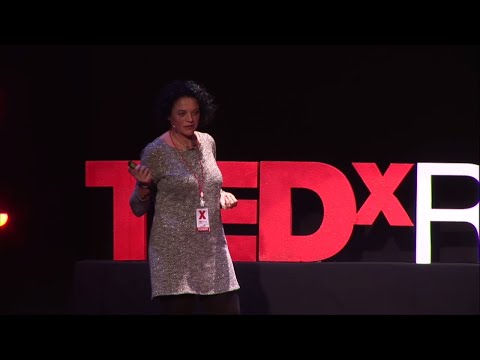
Mot bon dia, good morning.
We are biased, have already seen.
We are biased because they are not tendencies.
I come to Reus today with the illusion of telling them
What is a trend for us?
And a trend is not, neither more nor less,
that a study that is done
of all human, social behavior,
of a group, of a collective
that has some attitudes towards different things
and all that is transformed into knowledge
that designers turn in turn
in products and services that we use.
Why do I say that these are not tendencies?
Because that is the result of trends.
Each of the pieces that you have seen,
which are pieces of catwalk,
of quite important designers,
they are the fruit of the social trends of the moment.
And besides, we have to say also,
that what you just saw
it’s show, it’s fashion, it’s design,
it’s a lot of work and analysis hours
taken from the sociology of design
until the creation pure and hard,
going through the different production processes
that we can find in this very complex sector
and they end up coming to our windows.
It is true.
There they do become the revulsive of what we are going to consume.
And those are the indicators of what we are going to lead in the following years
because Prontomodas companies are inspired by these catwalks
to make the clothes that you and I are wearing today in this room.
Complex, right? But at the same time exciting, I assure you,
because creating a trend is something absolutely overflowing, exciting
where we find many momentums.
Maybe the most interesting momentum
be when we approach
from purely sociological data to the most creative aspect.
What I mean by this?
That to make a trend, first of all,
what we are going to do is always
study how we are behaving as a group
and from there come a series of reference themes
that we transform them into concepts.
I explain:
my team, which takes 6 months to investigate
in concepts that can be transformed into products and services
and in our case, in color too,
What it does is determine where we are going as a community,
and we do it from observation
of what is happening in Spanish society,
because until now, until told otherwise, we are Intercolor Spain,
with what our reference will be throughout the Spanish state.
What does that mean? That we have an agenda “setting”
where we are going looking at what is being published in 5 newspapers,
5 headers of all the Spanish State
in topics such as: society, politics, economy or culture.
These issues are already telling us what the indicators are
of the things that are interesting, from the point of media life.
And they are observed from the data that you provide us
the Center for Sociological Research,
observatories such as sustainability
observatories such as telecommunications
that today is very important for us, etc.
All this tells us that there are certain issues that are more valid than others
during that 6-month period, and from here
What we do is evaluate what it is like, what it is like, what is happening.
These data have to be transformed into concepts
and in content that through semiotics and other science there
which is the perspective, which is Lola science.
In sociology we have a science called perspective,
which is the Lola witch of sociology.
It’s that science that is responsible for telling us
what will happen in the short and medium term
from what is happening now.
From here, we turn it into possibilities.
I give you a very simple example:
Maybe now some accuse me of doing apology for alcohol
but I’m sorry if it’s going to be like that.
But do you think that the bottle was invented by current generations?
No. The bottle was already practiced by us in the faculty
Many years ago.
When I was in the U. of Granada, on Fridays we collected pesetas,
because then we had pesetas, it’s been a long time,
and what we did was puncture a beer barrel
on the campus of the University of Granada, and that was our bottle.
It was the economic way to have fun of the young people.
That became a practice and I thought it was limited
only to Granada.
When I arrived at the Autonomous University I realized that this was also done
Fridays on the lawn of the Autónoma,
in the famous grass of the Autonomous one, and we continued doing it.
Then, people outside the university world, continue to do so because
It is a cheap way to consume beer and share a time with friends.
The thing was generating such lack of control in many cities,
that the authorities were forced to regulate,
through municipal norms,
the behavior of these groups that made botellón. Is not it?
And in the end, some cities like my native
they have created a vialódromo with strict explicit rules,
where there is also an ambulance in case something happens, the police controlling ..
That is a trend.
And the good thing about that tendency, about that behavior,
that I’m not praising him at all,
but what is happening among a sector of the population,
is that there is an imminent quick response of what politicians are
and also the organization of the city’s security protocol.
Another example that I put to you, maybe not as interesting as this one,
but it is true that we are one of the oldest populations in the world.
The CIS tells us that in 2050 we will be the oldest country in the world.
Right now it is Japan,
but we will be the oldest country in the world.
What about this?
Measures are already being taken from the different social spheres
about this circumstance.
For example, Rajoy decided at a certain time
that we had to retire at 67,
and wait, because this promises, surely we will reach 70
and I will see myself doing classes with 70 years
and you each in your tasks too.
What happens? Well, every time this is happening
means that there are social services that have to be remodeled, rebuilt,
because if the law says that I’m going to work until I’m 67,
I will not take care of my parents or my grandchildren,
as many of the people who are here today will do.
But also, how is this put into practice
from the point of view of the design concept,
What do I want to teach you today?
Well, there are companies like Mango, which have already decided
create a specific brand of garments designed for ladies
that have a certain size, but a certain age too,
where they want to be well, which is Violeta.
Violeta is not a brand of large sizes, it is a brand
of sizes designed for women of a certain age
who want to be updated, who want to be modern,
who want to feel well dressed,
and that, in addition, they want to do it in an economic way.
Because of course, as you will understand, one size 40 mine, 42 mine,
It is not the size 40-42 of a girl of 18 years.
Time passes and that the company knows
and he is managing it from that point of view.
And what also happens with the product design sector?
You will have to think about creating products designed also for people
that have less autonomy
and that they will have to be living alone longer.
For example, sofas, beds,
or the kitchen utensils themselves, or the cars themselves.
How will it be for an aging population?
That is a trend.
And the design takes this, the same as Rajoy, to turn it, Rajoy into a law,
us, in products and services that are available to users.
My team, specifically, is dedicated to also make color trend.
What are color trends?
Color trends are color trends
that the industry applies directly to the products it generates
because color is the first purchase option we have
when we approach a store.
Why is this so?
Well, because color is one of the elements
of the most important nonverbal communication that we also have
when it comes to approaching things.
We are struck by a color because with that color we identify ourselves.
The color is one of the most cultural elements that there is also.
What does that mean?
That somehow, we,
when we have a certain mood,
we look for concrete colors, without realizing it,
and we do it like that.
So, what does my team have to do?
Calibrate what the mood of the community is
to propose colors that will be brought to the market
at a certain time also,
and that the industry needs all these references,
because, in the background, color trends, among other elements,
are the programmed obsolescence that my partner commented on before
from the world of fashion and accessories.
What does that mean?
That each season we renew the colors, the chromatic ranges,
and we do it based on the previous study
of what is happening in our community.
I’ll give you an example today.
I’m going to give you the example of the color trend
which will represent Spain for the year 2018.
Sorry, the fall-winter season 2018-2019.
Two years before, because the textile market requires this lack of two years,
and that we will present in London the next day 23,
that is, next Wednesday.
Exclusive for Reus what Spain proposes that is going to take
in the year 2018-2019, that’s for sure.
And it is based on the concept of filtered lives.
Filtered lives, what is it?
Filtered Lives is the sociological study that we have done
from the trends that may arise
of the use of social networks.
Why social networks?
Well, because social networks are one of the elements that are telling us
different observatories, especially that of telecommunications,
that are starting to worry us as citizens,
but also at the same time because the use of them
it has increased a lot in recent years.
Social networks have a very positive part
and it is that they foster relationships with others,
they shorten distances, promote new forms of relationship,
but at the same time they have a negative and dangerous point,
especially because there is a certain de-virtualization
of human relationships through them,
because what it does is generate multiple personalities
in many occasions also,
and also generate or create some compulsive obsessive behaviors.
Let’s see why.
Why are they trend?
Look, the world population, they have it represented in that circle.
Of that world population of 7395 million inhabitants,
46% are connected to social networks, to the Internet, sorry.
And of that, 45% to social networks.
Europe is the territory with the most connectivity in the world,
with a whopping 82.1% of households connected.
And within Europe, Spain, is one of the most connected countries too.
We have 77% of households connected.
Of 77% of Spaniards connected,
82% are connected or linked to social networks,
what has been a whopping 23 million Spaniards.
In addition, the Spaniards, notice that more interesting data,
we spend an average of 7h16 glued to our computer,
to our mobile phone or TV,
that is, we do nothing but eat, sleep, work and be connected.
Bad, bad we go. If so, we’re wrong.
That means that there is a piece of information that designers are interested in,
because if we are connected so long, that is not true,
or are we connected for so long, or rather,
or we do everything at once.
And that means that, from here to nothing, sofas will sell us
where we can recline the head better
to have the mobile phone like this,
while we have the iPod on the other hand and we watch TV.
And that, at the level of audiovisual products, is also a reef
for the design of new audiovisual products and services.
In addition, the Spanish, another interesting fact, is that we have
3 average social networks each of us.
In this order, we prefer: WhatsApp, Facebook and Twitter.
Although the younger ones prefer Instagram.
And also, what we do also quite interesting for the trade,
is that we continue, the average of the Spaniards,
of every ten Spaniards, nine of us follow a brand,
throught social media,
preferably fashion or accessories.
And what does that mean in the face of real numbers?
That means that we are a continuum of data
that companies are starting to take advantage
to know more about how we are and what products they can sell us.
In fact the other day, talking to a student of mine,
She told me she’s doing internships, she’s a fashion designer,
and is doing practices in Xavier Sardá, swimsuits,
within the marketing department,
finding out what users of social networks want
which are connected to the profile of the company, Sardá.
Look also at what more interesting data!
Of the connected Spaniards, 35% have an age, only,
and this is worrying for who we have in the teenage family,
and I am one of them, between 14 and 17 years old.
Our teenagers, almost all are connected to social networks,
It’s a pretty high figure.
In addition, women upload more personal information to networks than men
and we do it, women, 65% compared to 35% of them.
In fact, Spanish women are the ones who publish the most photos
on Facebook and Instagram across Europe.
And we Spaniards are the second most connected to social networks in the world,
after the Argentines.
It’s not by chance.
It is our Hispanic character the continuous need for interaction.
To all that we have to give it shape, because as you will understand,
of sociology alone does not live the design.
It has to be shaped.
And how we do it?
Through the concept that is generated
for those who study this data also in other ways,
as is the case of sociologists as important as Bauman,
which, precisely, was last week in Barcelona, and Del Moral.
Bauman tells us that social networks allow us to transmit
all our experiences, that’s very good.
And that he is delighted that this is so
because they are experiences in terms of relationship.
And men need to relate.
But, eye, because that also means decommitment, fragility,
fragility of feelings, insecurity,
continuous need to be present in the networks.
And on the other hand Del Moral tells us that networks,
what happens with the new generations
is that you create stable personal links, entertainment,
but it’s also a good way to manage at the marketing level,
and we keep in touch with people we do not see.
We with this, with these attitudes that they tell us,
and the data that we have said before,
let’s talk about 4 types of behavior in the networks.
And we have talked about individuals:
of the impatient, the exhibitionist, the voyeur and the imposter.
Here I have nothing to do anymore.
Because designers already leave me out of style,
I tell you this in a different way, much cooler and much more serious.
What is this to be the impatient?
It is the one that is continuously connected,
the one who seeks immediacy in connections.
If it is not connected, it gives something,
and it also has to be connected to a thousand things at once,
because if not, you have a problem.
And he also wants it already, if there is no wifi he gets dizzy,
If you do not have data, worry.
And all this also leads to tremendous emotional stability.
So much is their emotional weakness that psychologists begin to detect
a very important syndrome called FOMO.
The FOMO is the syndrome to be disconnected.
And also we, as a team, have detected another symptom,
another syndrome, or better said, called DIDI.
The DIDI is the fear of not spending everything with the camera.
That is, we are digital diogenes.
And we are digital diogenes because
when we had a reel of 36 photos, we chose very well:
the moment, the person and the place, because it cost us the money.
Now, since it looks like it’s free, we keep everything and then we do not empty it,
And that creates certain problems for us.
The exhibitionist is the narcissist, the egocentrist.
He who seeks the “me, me and me”, “me, me and me”.
He who talks about his public life, because it is a published life, in addition.
And it is the one that, in addition, has a point of important actor
because what he does is personalize his way of behaving.
Look for intentionality and seek above all social endorsement.
The voyeur is the “voyeur”, the one who looks without being seen.
The one that you know can look at you because it’s your friend in social networks
but you do not know if he is seeing you or he is not seeing you.
That implies that we prepare ourselves to be seen always,
and that also creates a lot of vulnerability because we are very transparent.
And what about the imposter?
The imposter is the one that doses relationships,
who wants but does not want,
I am now, but I am not.
I give your “like” because I’m interested
but then I disappear.
And it is what I would call Bauman, the “exerciser” of liquid love.
If you allow me, I will finish my speech
Teaching them a very interesting thing:
How this transforms into a video
and all this video is transformed into color.
Of these colors that you will see, the trends come out.
[Filtered lives]
You have seen it, the oranges, lilacs and blues are very soft.
We return to have a much more positive mood in the coming years.
That’s why, those colors.
That is our momentum,
the momentum in which we are capable
to transform data like the ones exposed before,
sociological to kill,
in content that can serve the designers.
And my momentum, here, now,
is when you become my tendency.
Thank you very much.
(Applause)
”
Be First to Comment