
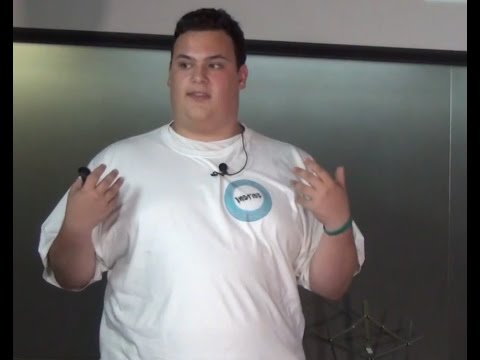
(Tuba music playing)
(Applause)
What does that have to do with anything?
You know, this is all about Tourette’s, right?
Well, it has to do quite a bit with Tourette’s.
Basically, I’m talking about the uninvited guest at my house.
When I was born, three weeks after I was born,
in Queens, not here,
I started exhibiting a head bang.
I would hit my mom’s chest, with my head.
I was not a metal head, at three weeks old.
It was very concerning and my parents thought
it was a soothing method for me.
Eventually we saw paediatricians
and they said:
“Ah, it’s behavioral, he’ll grow out of it.”
I didn’t.
Moving on, we saw more and more doctors.
During that time we actually moved a lot from Queens to here.
When we moved here, we saw a few more paediatricians
and a lot of them still said the same things like:
“Behavioral, he’ll grow out of it.”
One doctor even said so far
that by sixth grade I would bottom out and do drugs.
That’s not true.
I have that, I can’t afford drugs.
(Laughter)
Moving into the first grade,
that’s when I was officially diagnosed, at seven,
by Dr. Jonathan W. Mink, my neuro.
But before we had all this information,
I was just getting in trouble at school.
I kept saying the word, “pizza.”
It was one of the things that teachers were so annoyed,
I’d just say, “Pizza.”
My friends would join in.
So I’d go down to the principal’s office and they’d be like,
“Dan, what did you do?”
“I said ‘pizza’ in class.”
And it was just so confusing.
We got the diagnosis.
Now what?
Well, I’m going to have to tell my friends.
Note that I got the diagnosis when I was seven.
I personally did not find out until 6th grade.
I was probably told that I was too focused on pizza.
(Laughter)
I was able to tell my friends and to open up to them.
But one of the things was:
How many years have people been making fun of me?
You know, I felt so alone, more than ever,
even though I had my friends.
What was I supposed to do?
I got T-shirts.
The one on the right is written sideways.
I saw a few heads turn.
It says: “You look funny doing that thing with your head.”
It was a, “Hey, right back at you” moment.
And it felt better, it helped me cope.
During 7th grade I found the tuba.
Again, in 7th grade
I was offered the chance to go to Washington DC
to speak with representatives for Chuck Schumer.
I was able to talk to them about:
“Hey, we need more awareness for Tourette’s.”
Because the media?
What do you think Tourette’s is in the media?
Do you think I’m going to swear up here?
I could ruin the footage, but I can’t swear.
That’s only ten percent of all TS patients.
It’s called coprolalia, so it’s even funnier to say it.
Then I found my support group,
I found more friends to share the experience with.
Because they found out
that they had this later on and they were confused as well.
I learned a whole lot about expressing myself.
That’s sort of what I’m doing here
I’m expressing my story to every one of you.
It helps just spread more awareness.
By me telling you my experience,
you learn not to do what people have done in the past
and make fun of it.
That other part of me is music.
I’ve done a lot with music
and the shirt “I am Dan Dan the tuba man”
is a real shirt.
And it’s my real name.
But I have all this fun with the tuba and it’s sort of like a house.
The outside of the house says “Tourette’s.”
It’s a dark, scary, haunted house.
It’s black, big black, black windows, curtains all closed.
When you go inside the house
there’s a nice, warm, white wall
and there’s a fireplace with a lot of accolades
and there’s a tuba in the corner.
You can’t really judge the book by its cover with Tourette’s.
You don’t know the kid that’s underneath the disorder.
I do a lot with my music.
I’m hoping to go into music education, as a major.
I’m looking at Eastman and other schools in the area,
and I hope to really advance this, as my career.
What I want people to learn?
If you didn’t know what Tourette’s is, until today,
look up more on it.
Spread more awareness of it
and don’t re-teach the stigma to everyone.
For TS parents: don’t neglect the child.
The child can still grow and do everything.
I have my music.
I sing.
I take advanced courses, college level courses.
I’m in like six clubs, this year.
I’m everywhere in my school district
and I still do it with the stigma of Tourette’s.
I’m still a Tourette’s kid.
For the kids watching with Tourette’s syndrome,
you’re not an end all.
You can go higher, you can achieve your dreams,
even though you have a label to you.
There’s no end, to what you can do.
Thank you.
(Applause) (Cheers)
”
Be First to Comment