
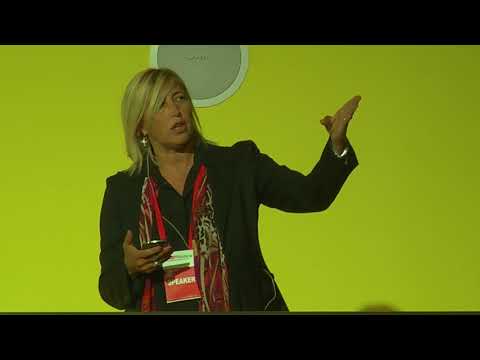
good evening a great pleasure to be here and
to be able to talk among other things after sebastian
I have not heard his what he has
told but I had the chance
to meet him this summer stanford is
one of our doctoral students, however, is
working remotely together with him then
I am very pleased with this introduction
today I will continue this speech and there
I would like to talk about collaborative visual
intelligence I would like to talk to you
obviously of the artificial part
of intelligence that for us that
we are computer engineers is one
normal subject of study but now
it is becoming pervasive and use
really everywhere on the media in the
society and in industry and between the whole
intelligence and I would like to talk about the
visual intelligence that is the part
division that often as a type of
intelligence and quite mistreated
none of us says that a person
intelligent because he sees well but in
reality you have to think we all know
that in our bark at 30 per
one hundred of the neurons and used for the
only eight percent vision for the
feel 2 percent for the audio for which
for us, vision is an aspect
extremely important of ours
intelligence that allows us to
reasoning but natural evolution has
led to different forms of intelligence
my cat is actually much more
clever of us for what
it concerns the visual part to many more
synapses connected and that 15 because i
allow you to work more
reactive in the vision of how much
we do well because I told you
this because now the intelligence
artificial is in fact another form
of intelligence that is evolving into
an extremely faster way of
how much did not make intelligence
natural since sebastian and in 2011
he presented this and now things
they have changed a great deal and only
last year of mind has achieved one
network
network that at the same number of synapses
that to our brain and therefore it is
clear that what you are doing and
that you can do in the near future e
artificial intelligence is
clearly very high think of that
all the intelligence part
artificial there is a discipline that yes
call computer vision vision
artificial that I have the pleasure of
study that sign for twenty years a
modena who owns the school
the purpose of reproducing intelligence
visual on the computer what
we can do now it really is
incredible also incredible for me that
I work so many years I do not know if it is
managed to see that image
that which is above on the slides this
work that a graduate student
of the university of Modena in this
moment is doing in facebook together
to us to not only recognize the
content of the image but also to be able to
describe the language in words
natural therefore not only to recognize
that there is a person of things but also
that there is a person who is watching
inside a fridge
here is this kind of application this
kind of activity we are doing in
artificial vision has a lot of history
ancient for about 40 years there are
very interesting results
here I show you something that for us now
it is prehistory
in 2003 we worked with san diego
for car recognition on
highways
again in 2003 we worked with
ferrari for indeed with people who are
here and today I salute to recognize
compare the car trajectories
using geometry using the
statistics
what you see here that you see a lot
bad are the expresses experiments in the
2003 for recognition of persons e
this is a job done by announcing
which then became the yes or moby
you sold it for 15 billion and passes by
dollars to dental
in March this year then these
let’s say let’s study this activity of ten
years ago they have now become products and
the computer vision industry in
this moment is one of the industries
in the field of information technology
probably more active
the data that we are now tell us that
it is from 2015 to 2022
we expect an increase of 33 for
one hundred every year of turnover
in the IT industry it concerns
the computer vision going to about 5
billions to 2015 and 50 billion
dollars precisely in 2022
and this means that it is not alone
search what we are doing but in
reality I want to tell you though of
artificial vision not just like
general speech but to its extent
collaborative and the first type of
collaboration that I want to tell you
a collaboration between human beings
because the fact that right now
through the planning through the
pattern recognition we got some
results so interesting comes from
a great collaboration between
researchers and scientists from all over the world
world and among large companies too
illuminated that give us the
availability to work on data on
machines and everything in open source for
to work together
and the results obtained are
fantastic 2016 nvidia provides open
source software for recognition of the
trough the networks of crops there
will allow results to be obtained
like this what you see below
it is a result for time analysis
real of the movement that is around
a car we are doing with panasonic
and among other things by an announcement here and that
it’s in real time because it is
information that has arrived to me
this morning panasonic will donate
the university of modena and reggio emilia
another server like the one that has it
donated facebook last year so it is
really a new thing of which
honestly we are very happy well
all this collaboration between
researchers
among even large companies comes from
work done in many parts of the world but
certainly above all he did from
people with mei some how are you there that
I like to mention some of the director
of facebook and iaia new york and it was
the first who created the network
deep neural type for
recognition of the zip of pos
transcode in the united states and together with
I want to remember fei fei between i
faithful and professor at stanford ea
google and was the first in 2009
he thought of this great one
collaboration between people and machines in
what a way to invent the idea of creating
the largest open source dataset
available of images annotated by
human beings right now are
about 14 million images that are
been handwritten by people
obviously you pay for this by indicating
more than 22,000 concepts what they need
these these data these images in
which is written this is a
this car is a refrigerator this is one
person were given available
of the international community to be able to
work and create more and more of the
networks capable of working
together here and what we can do
with this I know if he managed to
see it because the image is very dark
but one of the examples that can
being made this is something that
we are doing together with euro and combos
which is a French laboratory that is a
speech let’s say a lot more research
to be able to recognize some emotions
psychologists have noted love more than
18,000 videos taken from we say from the
very different situation like these is
what the networks are learning
slowly we will present it in a month
in England is the possibility of
to recognize people’s emotions
that are inside a video
obviously if we can do this with
some videos with hugh grant then
we could probably do it with it too
a person who is in the car or with everyone
with we win in many others
good situations I go on to say that
this kind of results as I told you
they are obtained only with one
great collaboration people and
machines in this case this is a
another example of something we are
doing as a company
Milanese who gave us 150 great
prizes written down by hand to be able to
to recognize networks capable of
to recognize overtaking or to recognize
of the other important events in one
video of this kind of new if not there
they were the human beings they love
through files as you see above
they can tell the network where they are
overtaking and where these networks are not
they would certainly have been able to
learn this that i ‘ll show you one
example that I always show because I am
like it a lot and something even more
because we are teaching them
machines to computers that is to do the
same things that humans do
through other other computers
what you see here are networks and
artificial ones we are developing
at the university of Modena and Reggio
emilia that simulate human attention
so we’ll leave the car behind
autonomous guide suppose that the
cars can drive in a way
automatic and they are already
actually doing what
we would like to add in a while it is one
driving style similar to that of a
human being
to do this clearly I do it
we have used others shortly
computers that have learned from beings
therefore human beings who do not
they wrote I’m looking right
he is treating left but using
cameras in the camera trackers
on the car we have united this together
in programs that have helped others
programs to be able to work
what we are doing here
of course it is not only done here but it is done
it’s not just for cars, but yes
they also do for people
these, for example, of something we are
doing with the duke university for
recognition of people in environments
open in urban environments but in
next future you can do in
many other fields and with this me
I conclude I conclude to tell you that I am
certain that in the next five years the
artificial vision will be more powerful
of our vision on this I can
definitely not only sure
because computers are more powerful
of our brain a point of view
computational but also because the points
view that a computer can have
I’m very
flower of our a computer a network
of computers will be able to integrate views from
a drone seen and a machine seen
surveillance cameras or robots
or seen from the immensely small of
one of a laparoscopy inside the
our body or many others
sensors and therefore the union of these data
surely it will give a computing power
the greater vision of what we
we can do but I am very much on this
optimistic because this can be
made on one side in collaboration with
human beings and on the other for the
human beings to increase ours
ability to get a new one
revolution that is not is definitely
within the industry
in the automotive industry
within the industry of
robotics
but it is also in science and also
in the field of culture and am that
went b where the medicine and then me
I believe the near future for us
It will certainly be rosy because we will have
more skills as we have
had thanks to computer science in the
last ten years
Thank you
[Applause]
[Music]
”
Be First to Comment