
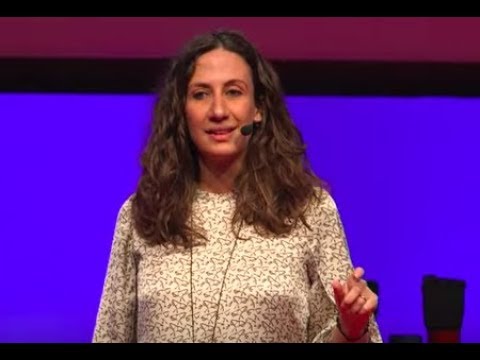
Diving into life feet up, head down
is hands down the easiest and safest birth.
As a mum-to-be
I hope that Maddalena’s first gaze on this world
will be upside down:
feet in the air, head on the ground.
Too bad that later in life we can no longer keep
this flipped worldview,
as everything and everyone ask us to walk straight up,
our feet rooted on the ground.
But ‘what if’ –
what would happen
if we allowed ourselves to keep our flipped gaze in adulthood?
Four years ago, I finally understood that looking at the world upside down
can offer unexpected second chances that ripple to the systems around us.
That’s what happened to me when I reconsidered the word fragility.
I want to tell you my story.
My name is Anna, I am 29 years old
and four years ago I’ve become a fragility entrepreneur,
convinced as I am that fragility is an unexplored and unassessed factor,
both in our personal lives
and in the way we do business.
It was 2013.
I was a well-grounded girl with my feet stuck on the ground.
Feet on the ground, one can run fast,
keep an eye on the horizon,
stand up and duck down, react to threats and fight.
Keeping our feet on the ground makes us feel strong,
and in many ways I did feel strong.
I had just graduated with top scores,
and my strong resume filled with international internships,
was supposed to be my stepping stone towards an international career.
In fact, I had never felt so weak.
An abusive, controlling relationship with a much older man
had turned me into a prisoner.
My life, while externally so successful,
was also so paralised, on the other hand,
I couldn’t even pick a pair of shoes without asking for his advice.
I was tormented: how can my strength and weakness coexist?
How could I be buzzing with energy and broken at the same time?
So powerful and prisoner? So free and chained?
Have you ever felt so fragile, so divided?
Can you go back to those moments
when you felt defensless, scared, cornered?
Think about it, it will come handy later on.
I had been offended in that very space – love –
where one should feel free to be fragile with no fear to be broken.
Then, one spring morning
life came and called me.
A sentence touched my soul
and I felt loved in my fragility, in my bruises.
So I decided to take on a path of deep dialogue –
you name it, an encounter, faith, God, the meaning of life on this planet.
It’s exactly from this upside-down gaze on life
that I started loving my fragility and getting back to my feet.
I started replacing the word ‘weak’ with ‘fragile’.
‘Weak’ means ‘intrinsically strengthless’.
A fragile person, or thing, can break if mishandled or mistreated.
Reconsidering my fragility
not as a limit, but rather as a starting point,
made me come to life again,
and made me more sympathetic
towards that world I wanted to study and defeat.
Where others saw weak chainrings, I saw fragilities to enhance.
So, I erased the word ‘against’ and turned them into ‘for’.
Eventually I could fight for something,
to flip the fragility paradigm.
Where others saw weak economies,
I saw potential for recovery.
I left the world of international organisations
and I returned home, to Italy.
This was an unlucky Monopoly round, a ‘back-to-the-start’,
in many people’s eyes.
Businesses had just started recuperating and the economy was, indeed, fragile.
But it also marked the beginning of my best – and luckiest – game so far.
In 2013, with a team of very young friends,
I founded Progetto QUID.
The peg, our logo,
is a symbol of the chance to combine strength and fragility.
Progetto QUID puts back into the workforce
people with a past of fragility,
producing eco-fashion collections
out of recovered textile surplus
from the best ‘Made in Italy’ brands.
Since 2013 we have employed 75 people,
each with their own specific fragility.
75 lives escaped a future of uncertainty, poverty and social exclusion
75 flipped worldviews, thanks to a job.
In more traditional business terms,
we went from 5 to 75 employees,
from 90.000 Euros
to an over 2 millions turnover,
from 2 to 10 collaborations
with some of the most prominent Made in Italy brands.
In 2017 we shipped over 70.000 clothing items
and 150.000 accessories.
After 10 collections, and 800 km of recovered textiles,
we are proud to say that we’ve built a model
where fragility is a starting point, rather than a limit.
Both the human fragility and the one of our ecosystem,
represent the two axes of this new model.
But only when we add empathy, axis z,
this model can create impact and volume.
But let’s look at the model in detail:
X axis: our capital is the fragility of human lives
and the measure of our profit.
I’ll tell you another story.
This is Rosa,
Rosa joined QUID
after enduring domestic abuse, as a child,
domestic violence as a young woman, jail and addiction in her thirties.
Her interest in sewing machines
sparked in a workshop she attended in a jail in Northern Italy.
The regular pace of hems
gave her a sense of safety
which she, and many others like her, had never experienced before.
Once out of prison, Rosa moved to QUID,
in a six-month internship.
After a few months, though, she stopped coming to work.
A few weeks later she called us, asking for help.
She had started drinking again.
Next Monday, instead of firing her,
we asked her to come back and stick with QUID.
Now Rosa leads a team.
Our mission is not maximising profit
but maximising impact instead,
namely the ability to generate new jobs.
This is our upside-down gaze on the world.
Our statute requires us
to hire ‘disadvantaged’ people,
as the law calls them.
People with disabilities, addictions, inmates –
For us, they are fragile in many profiles and strong in others,
Just like anyone else, sometimes in life.
Axis y – the planet’s fragility is our opportunity.
This is our warehouse.
These fabrics are a side effect of the fashion system.
Designing clothes is no easy business, and it’s a creative process.
Usually, what fashion brands do
is designing a collection, starting one year before release
and trial after trial
they select or discard tons of sample fabrics.
This inevitably creates an overstock of gorgeous textiles,
designed, developed and printed with care and love,
with a tradition, a personality, often locally manufactured.
Our project transformed a weak link in the textile supply chain
into an opportunity,
And thanks to the “Capsule collection” format,
which are limited edition collections.
in every season we can create a unique variant,
according to the current leftover stock.
Here too we flipped our worldview
on clothes manufacturing, textiles and resources,
thus redeeming people, histories and fabrics.
Axis z – Fragility generates empathy.
We have many partners,
many are famous Italian fashion brands.
To those who ask how we got in touch with them,
we explain that often
speaking about fragility openly, and honestly, made all the difference.
The reason is simple:
addictions, family issues, disability, criminal behaviours
are all symptoms of fragility.
But they’re all also facets of our colourful, priceless humanity.
Who, among us, has never come across any of these?
And how many of us have maybe faced them
within their family circle.
Fragility is what we all share – and is transversal,
women and men, Italians and foreigners, entrepreneurs and workers.
Along the way we often met
top managers, lawyers, designers
who told us
they experienced, either first hand or through their loved ones,
what fragility means
when it’s only seen as a limit.
One of the key factors of our success
is that we were able to speak out about fragility,
especially the one we carry on.
Either before an audience, like today,
or while grabbing a coffee in a break with a CEO,
or engaging with our customers in one of our shops.
Inevitably, our story raised empathy,
empathy triggered action, action made impact.
And just like my turning point
was where my own history of fragility and the world’s fragility met
and I involved, through empathy, my team and our partners,
that’s the three-axis model we suggest.
But what happens
if we focus our strengths on just fixing our weak spots,
centered on our belly?
We become depressed.
What happens
if we just focus on the system’s faults,
often insurmountable,
which we cannot solve on our own?
We become cynical.
And if we focus on both our limits and the world’s ones,
we get both depressed and cynical.
Where my own fragility and system’s fragility meet,
there’s neither volume nor impact. It’s just a barren land.
But.. ‘what if’?
What would happen if we added empathy,
namely the ability to involve others
and build a team, or a partnership network, that believes in our project?
Then yes, you get action, action generates volume
and volume has an impact.
I was a hurt woman – axis x –
I decided to do something for other hurt women, like Rosa and myself,
by recovering leftover textiles (Y axis)
involving my team and our partners (Z axis).
That’s how QUID’s peg was born.
Today Rosa stopped drinking
and got a permanent position, which is our impact.
This is the QUID model.
And this is the model we suggest
to those who want to change things and ask us where they can start from.
And going back to my story,
I could have shut down
keeping myself from new projects
and new relationships, in order not to be hurt again.
But I did not:
in 2013 QUID was born
and on May 28th 2016 I married Daniele.
And so, ‘what if’,
what could happen if each of you
saw fragility not just a limit, but a starting point?
(Applause)
”
Be First to Comment