
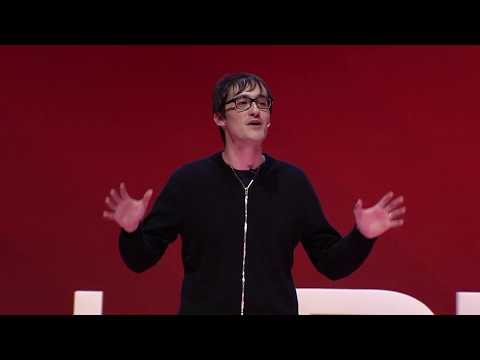
We’re going to do an activity that’s also a scientific experiment
just as we’ve been doing in past editions of this space
we call TEDxperiments, where the idea is we make the most
of the fact we’re 10,000 of us here,
so we can all do science with pencil and paper.
Now the moment’s come for you all to open your envelopes.
There you’ll find a paper sheet that, for now,
I’ll ask you not to open,
stay in the cover where it says TEDxperiments
and your participant number.
One important clarification:
your participation in this experiment is completely voluntary,
you can quit the experiment at any moment
without further explanation.
If you’d like to take part in it, mark a cross
where it says “yes” and write down your age and gender.
So we’re going to start with the experiment
consisting of three parts.
Let’s start with the page where it says Part 1.
There you’ll find five phrases and what you’ll have to do
is read them carefully and answer them
by marking the corresponding checkbox
depending on your selection.
You also have a third option saying “Don’t Know/No Answer”.
This part is individual, do it by yourselves, no cheating.
Go ahead.
Very well then, with this we’re done with Part 1 of the experiment
and we can go on to the next page
where it says Part 2.
In this part you won’t play by yourselves, you’ll play with someone else,
but not just anybody else:
by assigning you a participant number, we already set up
all the couples in the stadium.
Look for the person with the same number as yours.
and remember the participant number in your cover.
Find each other but for now don’t do anything more than meeting,
we’ll see the instructions further ahead.
(Whispering)
And now I’ll ask you for a favor
to the pairs that have already found each other, raise your papers.
Whoa! The experiment’s already worth it for this, huh!
Well, thank you, please put down the papers.
Now we’ll see the instructions of what you’ll do.
You’ll play a game called “The debating game,”
that has two simple instructions.
In each case, hear what I say in the instructions
and wait for me to tell you “go” to start following it.
The first instruction is that each of you will write in your own paper
the five answers the other one gave in the first part of the experiment.
Go ahead.
(Whispering)
We’ll go on to instruction number two,
you have five minutes, starting when I say “go”
to debate freely about each of the five topics in Part 1.
You can use time as you wish, but here’s a clarification.
You don’t necessarily have to convince each other,
you can exchange opinions, arguments, chat,
but it’s not necessary, to convince each other.
From now on, players of the audience,
you have 5 minutes to debate.
Go.
(Whispering)
Very well players in the audience,
time is up, stop, debates are over.
That’s it, time’s over.
Now we’ll go on to the nicest part of this experiment,
where each player will say goodbye to their partner with a special gesture,
Look up that in the paper, below everything,
it says how each pair of you has to say goodbye.
Players, say goodbye through that gesture.
(Whispering)
This scene is really moving.
But we have to go on to the final part of the experiment
so I have to ask you one last bit of effort.
In the last page you’ll see a series of questions
where each of you, individually,
is going to tell us the impression your assigned partner caused on you.
I insist, this part is individual, do it by yourselves,
and actually your answers will be confidential and anonymous,
so as soon as you’re done answering,
put your papers in the envelope again.
I’ll give you a minute to answer those questions.
Go.
Very well then, time’s up,
put your papers again in the envelope
as with this, players, the experiment’s over.
(Applause)
First of all, I’d like to thank you and also to congratulate you.
I have to applaud you,
because you’ve just taken part in the biggest
in-person social psychology experiment in history.
(Applause)
Very well then, before finishing,
I’d like to tell you some of the hypotheses,
we had for this experiment.
We based our study on one
made in the 60s in the US,
which shows that every time we meet someone,
we’ll like that person better if we agree on many topics with them.
The more topics I agree with someone, the better I’ll like them.
What we wanted to see was if that effect was stronger
when we talked about public policy
or when we talked about personal taste.
That’s why we designed two types of phrases we put in two different forms.
Raise your hands those of you who were assigned talking
about high school student strikes
or the airing of soccer matches.
Very well, put them down.
Now raise your hands those who had to talk
about more personal topics, like whether you like blood sausage,
or if you use a bidet when you use the bathroom.
(Laughter)
Very well, thanks, put them down.
Our hypothesis is that agreeing or not
on public policy topics has a bigger impact
on our appreciation of other people
than if we talk about personal tastes.
But facts will be the ones to tell us if this is so.
Lastly, what about the goodbye gesture?
You saw we asked more or less half of you, from here to there,
to shake your hands,
and to the other half, from here to there,
we asked you to give each other a big hug.
We thought, our hypothesis was,
that those people who gave each other a hug,
at least for a moment, and despite their differences,
felt close to each other.
And if you did, there’s the chance
you might’ve liked each other a bit better
than those who simply shook each other’s hands.
To all of these matters,
we don’t have the answer today,
but thanks to you and your participation,
we may have them soon,
in fact, the goal of this section,
the goal of TEDxperiments,
is not only that we learn of a new idea,
but that we all build scientific knowledge together.
Thank you.
(Applause)
”
Be First to Comment