
The world is in such a hurry today
that we lose the ability to see the other.
In the universe of visual impairment,
noticing the other becomes essential to your safety.
No, I’m not visually impaired.
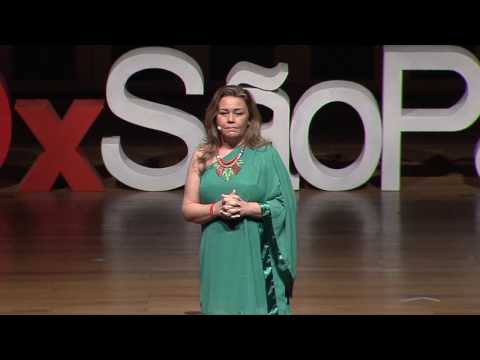
I’m Alice, and I work together with people with visual impairments.
Together with my partners, more than ten years ago,
train and train hundreds of people with visual impairment,
blind and low vision,
to become massage therapists.
Our goal is not just to teach a massage technique.
What we want is to awaken the caregiver that exists within each of us.
In these teachings, they learn to use the power of hand touch
and the ancient healing through this touch.
They learn to relate to others and to feel.
They attend, in a single day,
dozens of people attending a massage,
people who arrive stressed, tired, in pain,
and are able to relieve these pains by making a care with respect and compassion.
In this way, they are contributing to society
and thus true inclusion begins.
They always ask me, “Why do you do this job?
Do you have someone blind in the family? “
And I keep asking myself:
“Do people find
that teaching blind to massage is a novelty? “
The first institution for the blind of São Paulo, in the 1930s,
He taught massage.
In the 1950s,
the first blind man with a formal contract was a masseur.
Pros soccer fans,
was the São Paulo Football Club that hired Ramon,
and there he retired.
In fact, so, what we do and do
was to reactivate a labor market that was dormant,
and create possibilities for income generation
for hundreds of visually impaired people
which, for the most part, lose vision in adulthood
and come to be seen as useless by society.
I believe that we develop on a larger scale
when we live and share with people in diversity.
That’s why when I’m asked why I do this job,
today I know:
because these people have enormous potential,
have a fantastic exchange of experiences.
And, if visual impairment is acquired in adulthood,
It could be you,
could be his father,
It could be me,
that we are people with enormous contribution potential,
but that we would remain on the fringes of society.
And, still today,
many visually impaired people are locked in their homes
because society is not ready to receive them.
Only in Brazil,
there are more than 6.5 million people with some visual impairment.
In statistics, this number will double by 2020.
In these years all living with people with visual impairment,
I’ve heard hundreds of stories,
stories with teachings that I try to bring a little bit to my life,
stories like that of Luzia, who was born with a congenital disease
and by two years of age had already lost more than 70% of vision
and became blind at age 20.
Luzia was barely out of the house and had never worked.
She came to us, did our massage course.
Soon after, she was hired by a multinational as a massage therapist.
She’s been working there for three years, and she’s not just around.
She decided to go back to school.
She took a massage course at night because she worked during the day.
And still not satisfied:
is preparing for the course of psychology,
and this encourages us.
With Luzia, I learned determination and strength,
How I learned from Cris
overcoming and courage,
who was blind and, soon after being blind, was abandoned by her husband,
having three small children to raise.
Cris did not even have mobility, did not know nor use cane.
So she could not take the kids to the bus stop
So they can take the bus to school.
But this woman won.
She empowered herself with a courage that I do not think she even knew she had,
and faced all the barriers:
the one of the blindness,
the social barrier,
including maternity.
Cris came to us at age 44, wanting to do the massage course,
and today, with the money she earns from the consultations she does with the massage,
she helped the eldest son to complete college
and helps pay for the youngster’s technical training.
With these stories, what surprises me most
is that, even today, in Brazil,
less than 6% of visually impaired people are employed.
In the area that I develop, of the hundreds of people already formed,
more than 80% are in the labor market.
Every five seconds, a person becomes blind in the world,
and the first difficulty,
when a person is in the condition of visually impaired,
is impermanence,
as is the case with Stanley,
who at 11 years of age had a cerebral aneurysm
and in the post-surgery, everything was OK,
but he had two cardiac arrests and came back blind.
With the correct procedures, with medical assistance,
he gradually recovered part of that vision,
and it has become a “low vision,” or a “low vision.”
For a teenager,
adolescence itself is already confusing, right?
The famous “aborrescentes”.
But with visual impairment, it’s a bit trickier.
Today, Stanley is 20 years old.
and recently he had a blackout in vision
and he was blind, out of nowhere.
So she woke up.
From then on, he lives with impermanence,
because now he can see, a little,
now he is blind.
It’s difficult, of course, to imagine yourself in such a situation.
We can not.
That’s why this work we do
we would like to share with you
and we also share with all those who seek us.
To every event we make, every trip to work we go,
at each meeting in which we participate,
we know and we believe
that what we are planting today will be harvested tomorrow
for the children who are born blind today, but, that in 15, 20 years,
they will find a fairer society with more accessibility,
with more working conditions
and, above all, respect.
There is no way to speak of respect without remembering a story,
that of his Dalmir.
His Dalmir is a 70-year-old blind man.
On a certain rainy Saturday,
We had an event to do and it was very early.
I confess: I sinned, I woke up with a hideous laziness,
but I also went to the event and, before, I took the subway to get your Dalmir.
When he got into the car, the first question I asked:
“Your Dalmir, you do not feel lazy
to leave home on a rainy and cold day so soon? “
He smiled,
and said, “I feel,
but when I hear the birds singing, I’m glad,
because I know that there is a day out there that deserves to be lived. “
You can learn a lot.
The condition of the visually impaired
is 99% irreversible,
but the vision of society, that yes can and should change.
Thanks.
(Applause)
”
Be First to Comment