
A new look
only happens if we look again
at what’s essential.
Taking a fresh look at the world
doesn’t happen if, in our actions, we maintain old habits.
It may seem kind of obvious,
but humanity lives a moment
in which people express opinions about everything at every moment,
saying that they are different, or that they look at things differently,
but, in essence, they don’t change.
In the book “Illusions”, by Richard Bach,
an old book, there’s a very interesting phrase, which reads as follows,
“The best way to get away from responsibilities is saying,
‘I have responsibilities.'”
It is a trap that the mind sets up on us.
So we have to be very careful when we say,
“Oh, I’ve changed my way of looking at the world,”
or “I’ll change myself.”
We don’t change when we say we’re going to change.
To have a new look at the world, one has to relearn to see things.
In fact, I think that seeing and speaking completely lose their strength,
if they are not succeeded by action.
And the action of relearning to see
depends on the awareness that we have about the edges that define life.
And one of these edges is to live with our fellow man,
to live with the cultural differences,
and, most importantly, it’s to perceive our fellow man,
stay close to our fellow man.
It’s a paradox, we’re always saying, “We have to think about our fellow man,”
or “We think about our fellow man,”
but we don’t understand the meaning of the term “fellow man.”
And, in the end, we’re far from our fellow man.
That’s why I want to share
some experiences I’ve had in the last five years,
living with indigenous communities,
and the meaning of perceiving your fellow man.
By a show of hands, who here has heard of the Guarani?
A lot of people, isn’t it?
And the Paumari?
Has anyone ever heard of them?
The Jamamadi?
The Apurinã?
The Nambikwara?
The Deni?
The Xavante?
And the Katukina, has anyone ever heard of them?
Well, most of these people are Indians of the Amazon,
and they live their day to day
of planting, hunting, fishing, taking care of the family, the village.
It’s a very simple life
and whoever is outside thinks that it’s paradise.
But, living with these peoples, I perceived the same backbone,
which is to think about the collective, to look at your fellow man.
The first and more intensive experience I had with an indigenous people
was with the Xavante of Maraiwatsédé.
This is a people who were expelled from their own land in the ’70s,
and it was invaded, mainly by farmers.
During “Rio 92”, there was a movement of society, of indigenists,
for the land to be returned to the Xavante.
But they could only go back to their own land
and occupy a small area about 20 years later.
And this picture I’m showing you now
became the symbol of the pursuit and the struggle of these people,
when Chief Damião, who was one of the main responsible
for keeping these people together during all this time,
in a circle of conversation, he gestured and said,
“We will not wait another 20 years
to return to the land of our ancestors.
This is our land.”
It’s interesting, he says “ours” and not “mine.”
When an Indian, in general, talks about his own land,
he goes beyond these land issues,
because there is a soul relationship
among them, the land, their cultures and their traditions.
And it isn’t romanticism to think that their lives are better than ours,
it’s a life like any other.
Because beliefs may be different,
but the being, the human, he’s the same.
And that’s the new look we have to have about these people,
and these traditional societies.
I myself had a distorted view on indigenous culture,
because the news that come to us, here far below, in southern Brazil,
are very distorted, very biased.
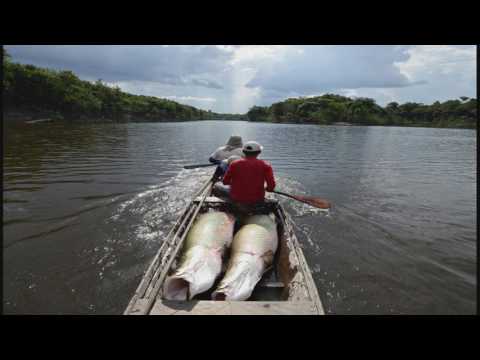
For example, we don’t get to know that the Paumari,
who are known as the water people and are excellent fishermen,
about five years ago, all the villages came together
and prohibited any non-subsistence fishing within their land;
because there are hundreds of lakes there
which are natural breeding grounds for Pirarucu and other fish,
and there was an invasion of fishermen from outside
who were decimating the fish populations.
Well, the Paumari got together, and did surveillance for five years.
What’s all this for?
So that the shoal and the stocks of fish would return
and everybody worked on the sustainable control of the Pirarucu, for all to win.
This is thinking collectively, this is thinking about your fellow man.
This is looking at the fellow man.
And another experience I had was with the Nambikwara,
which are these people that live in the north of Mato Grosso.
In the village where I stayed, I went to photograph the young maiden party.
I noticed a movement of young people trying to uphold their traditions,
because they are realizing that, without tradition, a people,
whoever they may be, will not endure and will have no history.
And I think that, most importantly,
when you look at these traditional societies,
we must look at each people individually.
One can’t simply put everyone in the same package and say that they’re Indians,
because the Indians of the Amazon
are completely different, culturally, from the Indians of the coast,
it’s even a geographic matter.
And if you travel the world,
you’ll see, be it here or in Papua New Guinea,
you’ll see that these traditional peoples,
these societies, they have their own history.
But the most interesting thing I’ve realized
is that the white man society is losing its sense of community.
When I saw a young Jamamadi, aged 13 or 14,
stay a whole night inside the forest,
alone, to hunt,
and came back with just one paca,
and shared it with four or five families of the village,
I understood this sense of community.
They think this way, collectively, they look after their fellow man,
it’s not something that’s enforced.
And I think that’s what we have to notice.
In the film “Dersu Uzala”, a very old film,
there’s also a very interesting passage that says so.
The message is: we have to look at our fellow man genuinely, without interest.
Because the only way for us to be cared for
is by understanding the concept of caring for our neighbor, noticing our neighbor.
The last works I did recently, they were with the Deni and the Katukina.
They’re people living relatively isolated,
they already have some contact with white people,
but they don’t speak Portuguese; only a few leaders speak Portuguese.
But they are in a movement
of building productive chains
to understand the value of the things they have inside the forest.
They’re understanding the value of the chestnut, of the açai,
of the flour,
because they are realizing that, if they don’t keep these traditions
and don’t understand this value,
they won’t be able to integrate into the world to come.
The white people’s world is already coming and, if they don’t make that interaction,
if they don’t understand this, the white people’s world will arrive
and they’ll become marginal to this world.
And this is a big problem
for their culture, for their traditions.
And I think their work is very interesting,
because the only way to preserve the forest,
after so much time that I have traveled through the Amazon,
in order to preserve the forest,
we have to preserve the people who live in the forest.
Because they see that place as a home,
and not just a residence.
There’s a big difference between these two words.
Anyway, to have a new look on the world,
we must relearn and act.
It’s a soul metamorphism process.
And I wanted to end with the words of a farmer from Maranhão, Brazil,
that for me tells everything about this great community
which is the human being,
and this world in which we live in, which is a great community.
Mr. Dázio said the following,
“‘Community’, to me, means ‘with humanity.'”
(Applause)
”
Be First to Comment