
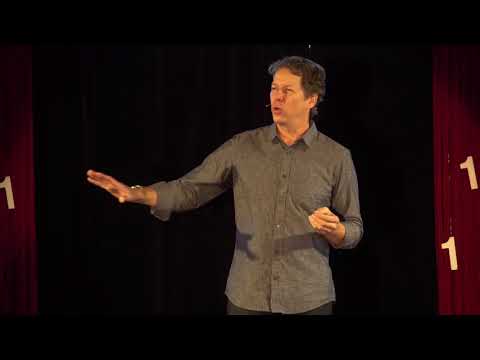
During rehearsal, I totally froze.
I couldn’t remember the script,
and so I’m trying to remember how I am going to deal with this.
And part of my speech has to do with “What’s the worst that can happen?”
And so I started thinking about it,
and I thought, “I’m an artist,” which I’ll explain in a minute,
and memorization is the last thing I ever did.
And so I remembered back how in school,
I remembered how I didn’t like algebra and biology for that reason.
So here I am, and I just went blank before my speeches.
But, having gone through the worst that could happen, I’m ready for you.
So you don’t know me, I don’t know you.
So let’s just start with the Q&A.
You’re wondering: Who I am?
My name’s up there, so you know I’m Timothy Chambers.
And basically, there’s three things about me that make who I am.
I’m nearly deaf, I’m nearly blind, and I’m an artist.
Really interesting combination.
So we’ll start out with the first two first.
I have about 20% of the hearing that you have.
I can’t hear; without my hearing aids,
the world is very quiet.
Peaceful, actually.
(Laughter)
And when I paint, I take them out sometimes.
And there’d be times at home when someone’s talking
and my wife’s like, “You didn’t hear a word I said, did you?”
And I’m like, “I’m sorry, what?”
So the other thing about me is
I’m nearly blind.
I used to have the kind of vision that most of you probably all have here.
That is, you can see about 180 to 200 degrees back here.
And I’m down to about 17 degrees or so, maybe more like 15.
So if I’m looking at you,
as far as I know, there’s nobody else here.
It’s pretty quiet.
All of the sudden I see everybody.
And the other thing about me is I’m an artist.
And I’ve been an artist forever.
I paint – I earn my living painting portraits and landscapes – I still do.
And I love it.
Because when I’m painting, I’m totally in my element.
I grew up watching my dad paint,
and he does amazing things with a brush.
We’re both professional artists,
and growing up, I knew that’s what I want to do.
To me, the creative process is exhilarating,
and there’s nothing like it when I’m drawing.
So that’s what I went to school for, that’s what I trained for,
and —
Now, going back to where all of the sudden the story changed.
About 24 years ago, just when my career was really starting to take off –
I was winning awards,
things were going great,
and I thought, you know,
I’m going to be painting portraits for the White House;
it’s going to be great.
Well, I went in for a routine eye check-up,
and one thing led to another, and they said,
“Something’s not quite right.”
They sent me to a specialist.
I went through a battery of tests,
and the doctor comes in, and he says,
“You have Usher syndrome.”
I’m like, “What?” And he goes, “Yeah, you’re going to go deaf and blind.”
I’m like, “No, no, no, no.
Here’s my portfolio. I brought it with me.”
I showed him my portfolio. It had all my paintings in it.
And he took it, he glanced through a few pages,
snapped it shut, tossed it back in my hand and said,
“Sorry, you better find another profession.”
And even now, I still feel the pain that I felt then.
It’s just – it was like someone had just erased my future
and with it my entire sense of purpose.
I thought, if I can’t see or hear,
how in the world am I going to experience life?
Let alone, respond to it with paint?
So —
I don’t think I slept well for two years after that.
I would wake up in the middle of the night —
2:30, 3:30, 4:30 in the morning
in a cold sweat, just terrified of what lay ahead.
So I was just at a loss.
But there was one night when Kim and I, my wife Kim and I, were talking,
and we were reading, and I was testing what I could see.
So I was looking at the book, I would see a word,
and I would move my finger outward to where I couldn’t see it –
just a couple inches – and I said,
“Look, this is – this is all I can see.”
And she said, “You know” –
and her response began a transformation within.
She said, “You know, Tim, I know this is hard. I know it.”
And Kim is a strong woman. She’s – that’s why I married her –
more like –
I didn’t marry someone who said “yes” to everything I want.
In fact, we’re either fireworks, or we’re dynamite.
(Laughter)
But here, her tenderness came out, and she said,
“Tim, I know this is hard, but you’re not an 80-year old man
who’s fading away with something like Alzheimer’s or something.
“You’re very much alive.”
And she said,
“Remember the promise that we both hold onto,
that God said, ‘I will never leave you or forsake you’?”
Which I interpret to be, “I will always be your friend
and I will always be here.”
And she said, “Let’s build on that promise.”
So shortly after that, I was talking with a mentor friend of mine,
and I told him what had been happening,
and he said,
“Hey, well, what’s the worst that could happen?”
And I remember at that moment, I was thinking,
I can’t believe he asked me that question.
That’s exactly where I don’t want to go.
And he said, “Well, tell me.”
I said, “I’m afraid that I’m going to be relegated to some corner of the house,
deaf and blind,
just waiting for someone to come and touch me and see if I’m still alive,
just wondering, thinking there’s no purpose;
you know, what is the point?
And then he said,
“You know, for one thing, I don’t think that would really happen –
Kim would never let that happen.
And secondly,
you have too much creativity in you for it to just disappear.
It’ll come out somehow.”
So —
the interesting thing about that day – I appreciated the encouragement,
but the thing that really, really impacted me
was his question,
because I didn’t go where I was afraid.
I just let that part go.
And besides, I knew where I was going.
I knew from the time I was a little kid, I’m going to be an artist.
If I don’t play for the Cubs, I’m going to be an artist.
(Laughter)
So the Cubs thing didn’t ever pan out.
I was out of Little League by the time I was, you know, whatever.
They said, “Hey, maybe try another sport.”
So I knew where I was going.
But if I looked at my friend’s question,
and I thought, if I – instead of avoiding my fears, what if I faced them?
And if I did what he said,
if I went to where – what’s the worst that could happen?
And I come to peace there,
then I might get through it.
And I might be able to face anything.
So for a person who always knew where I was going
and I always knew who I was,
and then suddenly not have it because of the doctor –
I mean, that was pretty – talk about bad bedside manner –
he just said, “Sorry, go find another profession.”
Having gone through a place where all of the sudden there’s nothing,
you know, you feel like you’re in the dark,
everything that you built on is gone,
and to find peace there?
I really can’t tell you, but there’s nothing like it.
All of the sudden, if you can be there, then you really can do anything.
So I began to try to look at my life and see what I had built up to that point.
I realized that one thing I couldn’t do is,
I didn’t know how to identify my fears.
So I had to figure that out.
A school once asked me to teach an online art course.
And I was like, that can’t be done.
I mean, give me a break. Art is a studio thing.
It’s like, ‘Hey, you see that? Okay, draw it.’
And you only need, like, six words to teach art.
But I thought, okay, I’m up for a challenge.
Let’s give this some thought.
So I thought, I can articulate and identify the abstract art concepts
in such a way that students could grab onto,
you know, using analogies.
And even for me, I would think something I just took intrinsically –
and all of the sudden, I described it, and I thought, what’s this?
That’s pretty cool.
Not that I’m cool, it’s just an amazing thing.
Well, I took a shot, I did the class, I did the course,
and an amazing thing happened.
The students learned more in the online class
than they ever did in my studio or the workshop.
So I thought, okay.
So I started applying that to my fears.
And I started just, instead of being afraid of them,
I started to try to identify them, put them into words.
And the other funny thing is, I can write.
I didn’t know it then, but words are delightful.
And I think I got that from my parents.
They delighted in words,
and all of the sudden, the concept of wanting to know about words.
So all of the sudden – and it’s really like I had a super power.
Because all of the sudden, this big nemesis,
this invincible fear, which I couldn’t fight,
and it was overwhelming and daunting,
all of the sudden it started taking a shape,
and I could see it for what it really was.
And if I could see something –
I’m an artist – but like anybody, if you can see something,
then all of the sudden you can identify it.
But what you don’t know is it can scare the crud out of you, right?
So I started thinking about things,
and one of the things I realized
was that I had been running fixed toward something
straight in the future,
and I was running 100 miles an hour towards it,
toward that goal.
I was going to be a great artist someday.
And then when I got that diagnosis, suddenly, I wasn’t.
I didn’t know.
And what I realized is the future is nothing more than a mirage.
Now, it could happen. But you really don’t know.
Nobody knows what’s going to happen in a mirage.
We don’t know what’s going to happen next week, next hour, right?
So that was a big change.
And so then I began to slow down.
And you know what I noticed?
I discovered people.
Because when I was running full-speed to the future,
the past and the present were zipping by so fast,
I couldn’t take it in.
But man, I knew what I was aiming for, and that was really what mattered.
I wasn’t a jerk or anything, I was like, yeah, that’s great.
But I was aiming for something.
But when I slowed down, I started to discover something: people.
And when I discovered people, I found stories.
Stories that were rich with past failures.
People are afraid that “because I failed at something …”
But it’s okay – I discovered them,
and then I discovered that people are learning lessons from them.
And then they also discovered joy, like I was discovering –
you know, that peaceful place to be.
So things were changing.
I was starting to notice the present and notice the people.
Before I was diagnosed,
I used to be uncomfortable around someone who was disabled.
If I saw a child with a disease, or somebody in a wheelchair,
without a story,
it just didn’t fit in with my future-is-bright paradigm,
so I would avoid them.
But then, when I was diagnosed, I realized I became one of them,
I had a disability, and I didn’t quite fit in anymore.
There was a guy at a store who was in a wheelchair,
and I used to avoid him;
but now, empathy was starting to rise up.
And I sought him out this time
and went up to him, and I said – I saw his name tag – and I said,
“Hey Luis, if you don’t mind me asking, what happened?
Why are you in a wheelchair?”
It’s a pointed question, one you don’t normally ask.
But he looked up at me with a warm smile and said, “Thank you for asking.
I lost my arm and my legs
when some friends and I stepped out on a land mine in my country.
My friends all died, and I laid there for two hours before someone found me.”
He says, “I thank God every day that I’m alive.”
And I thought, wow.
That’s something to a guy who thought he knew where he was going,
and all of the sudden didn’t have anything;
and here’s was a guy who – a million times worse than what I have,
and he was thankful to be alive.
So I started thinking about it,
and being a painter, you know, you have a palette of colors,
and you paint.
You pick colors and you put them on there, and that’s what you do.
If you put a color on, and then you respond.
That’s how you create beautiful things.
But two of the things on my palette as I just mentioned were fear and future.
I was afraid, but I was aiming for something, so I did good.
So I replaced those two colors with courage and presence.
Huge difference.
And the empathy in me, compassion started coming out.
Instead of people that I would ignore,
all of the sudden, I started having compassion,
eye contact,
a kind word,
an initiated handshake,
transparency.
All of the sudden I was painting light
the present,
with tons of vibrancy.
There’s a painting on my easel now
that’s of a Dr. Kizilhan and a young Yazidi woman named Yasmin.
The story that I read was
Yasmin was one of 1,200 people from Syria and Iraq
that Dr. Kizilhan and his team had rescued and brought back to Germany
to provide physical, mental, and emotional healing.
I don’t know how well you can see it there, but the painting –
Here’s Yasmin’s story.
By the time she was 14,
she had been raped at least a dozen times by ISIS soldiers.
And so I remember reading the whole story and the anguish that she felt.
At one point, she thought she overheard –
she was in a refugee camp at this point – and she thought she overheard
one of the voices of one of the men who had raped her.
And she couldn’t take it anymore, and she doused herself with gasoline,
set herself on fire to make herself undesirable.
And somebody came.
She looked awful.
She really looked like someone from a horror story.
Her ears were burned off,
her nose was half gone, her lips were half burned off,
her eyelids were gone.
She looked awful.
But this time, I saw her as someone so beautifully and wonderfully made.
Someone who was beautiful.
And so I wrote to Dr. Kizilhan –
and I couldn’t believe how quickly I found his email, but I found it,
and I said, “Hey, I’ve been moved by your story.
I’d like to share that with other people.
Can I do a statement portrait?”
He wrote me back within 12 hours and said, “We would be honored.”
I said, “Yasmin, too?”
And he said, “She would totally be honored if you would tell her story.”
The painting is called – and I was given a title of it –
I think it’s amazing how it came – but it said “Please Don’t Look,”
but that was part of what I’d read.
She said, “Oh, I just dream that someday kids won’t scream when they see me.”
And she was like, “Please don’t look.”
The rest of the title is “Please Don’t Look…Away.”
dot, dot, dot, Away.
That’s the other side.
We don’t want people to ignore us,
but at the same time, we want people not to –
not to ignore us – but at the same time, we don’t want them to look away.
We want them to say, “Wow, I see you. You’re a person of dignity and beauty.
I want to talk to you, I will touch you, I won’t be afraid.”
And so, to me, this need to have, actually, a purpose all of the sudden,
and much greater than I ever had before.
I’m hoping that that painting, maybe with other artists or something,
that I can get a traveling exhibit that crosses across the U.S.
and people will begin to see people – the beauty –
you know, pictures of people who we avoid,
people who don’t fit in.
And they can see how beautiful life is and make it for other people.
So if I was to wrap this up
and I had a few things to learn, basically, I would say this:
I have learned
that if you identify your obstacles, you can overcome them.
It’s much easier to fight something you can see than you can’t.
I’ve learned that my heart is much more aroused in the present
than it ever was by the future.
And I’ve learned that weakness is not something to be ashamed of
and the end all,
but it’s actually something that gives you something worth living for.
So if I were to ask you to join with me in something I’ve learned,
if someone would share something with me, I’d say, “Hey, I’ll be there for you.”
And I meant it.
But usually life is too fast,
and you have to go, “Oh, I’m sorry I missed you, but I’ll be there for you.”
Well, maybe if you join with me, you can change it to say,
“I am here for you, today, right now.”
Thank you.
(Applause)
”
Be First to Comment