
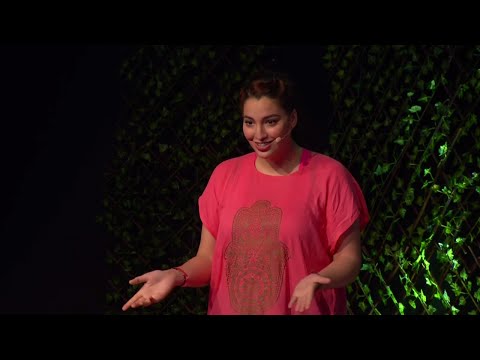
I’m a refugee in Brazil because I was born a woman.
I did not run from a war with guns;
I ran from a war with abuses.
For those who do not know, there are several types of refugees:
war,
politics,
ethnical persecution,
and many others.
I had to leave my country, Morocco,
because I was psychologically abused my whole life for being a woman.
It got to the point where I wanted to die
and be reborn as a man instead of a woman.
I come from a family considered liberal.
My dad is a philosophy teacher in Casablanca.
I have two other sisters.
My dad has always given me a lot of love,
but at the same time, I always noticed that he felt this guilt
for not bringing a boy to the world instead of one of three girls.
Being a woman in Morocco means living with fear.
Fear of being abused by society;
fear of having less autonomy each day;
fear of wanting to set free from men, who control everything in your life;
fear of having your own ideas other than religious rules.
In Morocco, I always had to use a “hijab,”
a burqa,
so that I didn’t suffer on the streets.
I always had to withstand abuse at work because they considered me beautiful.
In Morocco, I knew that if someday I got married, I couldn’t make a mistake,
because society would not accept me as a divorcee,
not even my own family would accept me.
To be a divorcee in Morocco is like being a prostitute.
But do you know what is even worse?
To be pregnant and not married, without a husband,
or having been raped.
You become an object of absolute shame for your family and for society.
This culture is not the culture I want for my kids.
I want a culture based on mutual respect
in which they can be who they want.
I’m not against my country’s politics, religion, or culture,
I’m against people who misuse them and physically attack women.
In my country, I had a friend called Sara, who got pregnant without getting married,
and her dad stabbed her to death.
For all of these reasons,
I left my country a year and a half ago,
and my two sisters also moved elsewhere.
Here in Brazil, I learned I can walk alone on the streets,
that I don’t have to be ashamed of being a woman,
that I can have my own business,
that I can dress the way I want.
When I arrived in Brazil, I had a few integration issues
because some people asked me if I knew how to make bombs,
or if my husband beat me up at home,
but, other than that, I’ve always felt very welcomed.
In fact, I have more Brazilian friends than Arab friends.
Here in Brazil, I worked hard, day and night,
until I managed to fulfill my dream.
And my dream is a restaurant
where I make several types of Eastern food
from Syria, Lebanon, Morocco.
Basma means smile,
and I picked that name
to give good energies and a lot of hope for my life here in Brazil.
And I also met my husband, Naures,
who is a Syrian.
I married an Arab,
but he is totally different.
I can tell you that, without him, I would not have been who I am today.
I love Brazil, but I know the situation of Arab women well,
in Morocco, in other countries,
and I also know that in Brazil girls are going through bad situations.
A few girls I met
were abandoned by husbands when they got pregnant.
There’s the sexism issue;
there’s slow justice.
So I’m asking myself,
how is it that, in the 21st century,
women still do not have the respect that they deserve?
Should we just switch planets?
Or should we just replace our society?
That’s why we need to work together to earn the respect that women deserve.
Shall we?
No? (Applause)
Thank you. Thank you very much!
(Applause)
”
Be First to Comment