
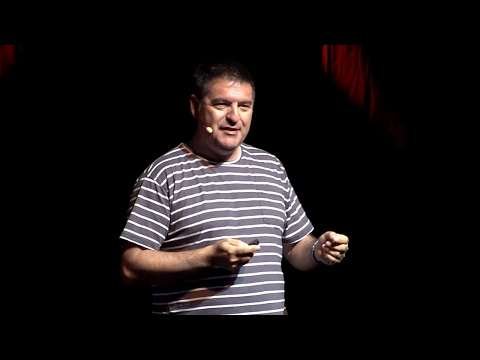
I will tell you why I am a pirate prophet.
Teachers do not read habits of education habitually.
I have to confess.
But most of those involved in the educational system do not read it either.
In some way it can be because our educational system is there
stopped at the time of the EXB.
That General Education Law of the year 1970, which is there
as if it were a transatlantic,
Stuffed in these comfortable and comfortable areas for the whole world
of Basic General Education.
What you see there can give us an idea.
This is a classroom of today’s primary school.
Everyone recognizes her, right?
Well this classroom, which can be of primary or high school, with those ranks
forward and blackboard,
It looks a lot like this one.
This one, in addition, is a recreation of the Pedagogical Museum of Galicia
of the first EXB.
What is not much difference?
And it looks a bit like that
to this you see there.
It is a classroom of a unit from here very close to Santiago,
of the CRA of Boqueixón-Vedra,
where, as you can see, the boys and girls are working
cooperatively among them,
By different zones and not in those straight rows looking towards the blackboard,
what is usual
It happens less in children, more in primary and, when going to high school,
They are all like the previous ones.
Maybe this happens because, at the best, we are preparing
to our boys and girls
To overcome these vertiginous peaks of Selectivity
that you can see on screen.
I’m afraid to see this photo, right? Many of us are there.
The fear that mete …
I heard a few days ago Ángel Carracedo [Uninist geneticist. of Santiago]
What second bachelor’s degree is the most horrible year
of a person’s life.
Who agrees?
Oh! Very good … (Laughter)
It can also be because we are continually doing the exams
to check
They know well the lesson.
The word “lesson”, in the Dictionary of the Royal Galician Academy,
we see that you have a synonym.
Pay attention:
“Escarmento” (Laughter)
It’s more. If you read it, you will see in this example that
“You have to give it a lesson!”
“The suspense served lesson to him again”.
Well, it turns out that 25% of our students
He does not receive the Graduate in Compulsory Secondary Education.
All the compulsory section.
Why will this be?
I’ll give you a clue …
Who does not know this instrument?
Most of us have had this tool
like almost the book of the Bible, to follow daily.
Note that some, nowadays,
(although one is made by Lázaro Carreter
and the other by José Manuel Blecua, the two directors of the RAE)
(this is my subject, Language and Literature)
put a special appeal. Look there in the center: put
“Project Connects two zero points”.
I do not know if you caught the subject …
“Connect two point zero” (Laughter)
I will teach you the inside to see if you are “connected”
or you are not “connected”.
Everyone will be able to identify this.
What do you know about it very well?
Who did not have a book like this?
Pay attention to what we have:
Lots of grammar In the case, again, of my subject.
Impersonal sentences.
And look at the example that is given.
Can not be seen, right?
I want to enlarge it.
[They have been suspended in my language!] (Laughter)
You see that we are still obsessed with suspending.
I promise I did not look for it on purpose.
It was what I found as a digital book.
This is the digital book, right? 2.0.
In most cases (although you will not see it
because it’s pretty small up there)
you will see that it puts the exercises that are put to the boys, the duties;
That is, “Identify what prayers are personal or impersonal,”
with examples that have nothing to do with the students.
This is another reason, perhaps, for which I became
A pirate prophet, of course.
But in a pirate prophet (this is what I will try,
what am I trying and what I will try in the future)
It’s to be a true pirate professor 2.0
Not like the previous one.
For this …
(and look, LOE, what the hell is that?)
Well it is one of the laws currently in force.
We all think it’s LOMCE, but also LOE.
LOMCE only varies to LOE in certain parts.
And if I look at my subject, I am saying that
that in Castilian language and Literature
I have to modify the tasks I usually do
for tasks beyond those that are aimed at the acquisition
of a grammatical knowledge.
That is, not like the ones we saw before.
And the LOE goes a little further and tells us that, in the twenty-first century,
(I do not know, it seems we did not even realize that we were there)
We have to accept a new concept of literacy.
That is, all this information we have, we have to know
manage it in some way:
“Knowing when and why information is needed, where to find it,
and how to evaluate it, use it, and communicate it in an ethical way “.
And you will say: “Well, but it turns out that they see you LOMCE on top.”
So what’s up?
Well, it turns out, surprisingly, for this pirate this is how
a kind of Corsican patent.
Because the law itself says very curious things.
For example, “the language learns not to speak, read or write about the language,
but to speak, read or write about emotions, affections and adventures. “
Can this be done with impersonal prayers? (Laughter)
It seems to me that no.
Doing duties: exercise one, two, three, four, five …?
It seems to me that no.
It’s more. LOMCE still dares tell us how we should do it.
That is, our methodology should be as we have seen
in that child’s classroom.
More active, more participative … in what the students are really
you are learning for yourself.
Learn doing
Favoring, in addition, a very important thing
which is to favor cooperative work.
Cooperation is essential. We will have to work as a team
in our works.
And, in addition, the approach has to be multidisciplinary.
We can not have the subjects divided into watertight niches.
And lastly, we say that, above all,
It would be necessary to take advantage of the possibilities of the methodologies of projects.
And, now, I will explain how. That is, how I work,
with the methodology that favors us.
Therefore, I already have my “Corsican patent”.
I just gave the law the permission to work like that.
Despite being a pirate, of course.
Formulas can be many, but I propose:
“Going from the lesson to action”
And here we will look at what is the etymology of the word “pirate”.
The word “pirate” comes from the Greek “peiratés”, that, as well,
come from the verb “peirán”,
what does it mean or what you see there: “strain”, “risk”,
“try” and “experiment”.
And that’s about it: to experiment. And a lot. And risk Enough
Why
Because it’s out there, from that lesson,
to where?
Well, here.
These are my students, there are two courses.
I went back from the Department to the Rosalía Institute and we were able to work there.
Note that they are in small groups, not in such clear lines.
But I’m going to let you show them in action.
Here they appear in this computer room where you see them as they went
the writing of a newspaper.
They were creating a digital newspaper.
It’s what they’re doing there.
As you can see, working in small groups and sections.
Another possibility, of the formulas, would be
[Integrate the environment in the learning process.]
This is very important, because it is what they do
are more motivated to do,
what would it be to work on what they know,
on the site where they work.
For example, here we see this student of 2º of ESO of this course
working on a project
on the Way of Saint James and interviewing a pilgrim
in the own Plaza del Obradoiro.
Or take advantage of the fact that an author comes to the center with his book, in this case
Javier Cercas with El impostor ,
And create a conversation about that reading.
Or take advantage of the fact that we have at the center ANPA a historian
like Lourenzo Fernández Prieto
who reads the book and shares that reading with the students in the manner of a colloquium
about the historical memory,
What is this particular book about?
Another formula would be [Promoting cooperative work],
as I said before.
Remember the “patent of corso” that we saw before.
Here we have them, to these same students of before.
As the computer room did not work because there was very little bandwidth,
because it turns out that the father of a student, who has a cafeteria in the Ensanche,
We allowed 28 of these students to work there and finish,
In that last effort, that work.
As you can see, at the end of this cooperative effort there is a barbecue pizza.
Very important Very important (Laughter)
(Laughter and applause)
Finally, it’s “getting to the motivation for the excitement to learn”.
Look at the faces of these two girls.
They were talking, two days before closing the digital newspaper
what were we doing,
with the Nobel Peace Prize, which was in New Delhi at that time.
And at the last minute they were able to get that contact
and to talk on the phone with him.
This is in the same bar you saw before.
Or these two girls who, after going to Madrid several months before,
where they had arranged
An appointment with Pedro Sánchez, and it did not appear.
They went to Madrid on purpose and did not appear.
But, the day before just to close the newspaper, it appeared by Santiago.
What’s more, he parked the bus just in front of the institute.
We knew it was going to be there.
And he asked to go to the Rosalía bath.
Still a picture went out in the press about all this.
It turns out he was there, he took a picture with them and,
after fighting the broken arm
With his news chief, (who did not want), they got two questions.
Look at the face of satisfaction and emotion they have.
The last thing would be to forget that unique way [to evaluate]
(I do not say that it can not be done).
We almost have a unique way of evaluating, what would be the written exam;
that of the Selectivity we saw before.
And evaluate the process. Learn in the process.
The process is the most important. And not only the results.
I’m going to let the students you see speak of that process.
Personally, I was surprised at the beginning.
Because we arrived one day at the class and Alberto told us that this course
Let’s forget about the textbook and do something more practical.
And at the beginning we found it weird and unusual because they never proposed us
nothing like that
But later I think we started to excite and see
how things worked
And we got to learn a lot. And yes, it was, the truth, super-emotional.
We learned in practice and learned to work
not simply with a textbook in which, speaking bad and soon,
You can click on twenty pages and take them for a test
Then you forget the next week.
We did what we did was study and take it to practice.
We have done interviews and learned, in addition to knowing what an interview is,
how do you do it
I’m not going to ask who’s cast and then vomited in a test
Because we would raise all the hand, I suppose.
And you will say: “In Rosalía, in Santiago, this is quite easy to do,
being in the capital of Galicia “.
I’m going to leave some students eleven years ago,
I was twelve years old at the CPI of Bembibre, a rural center where there is ESO-
who speak of their experience.
These are guys who at this stage speak of this experience 11 years ago.
The way we worked was totally different
what we were doing in other subjects.
Faced with jobs we could do, more or less boring,
for other subjects,
this was a more creative way.
That is why we did it with such an appetite, because it was something creative, something different.
To me, personally, I served to learn how to structure a text,
Know how to fit the parts, how to write.
And also to model.
Somehow, thanks to “that” [to the project] we remain united,
We continue to remember and remember that.
We still get together and we all get along very well.
And I think that was very important,
who has joined us as friends, people and everything.
For it is a very enriching experience and, for me,
It would be one of the best experiences of my life.
To close, I just want to think about
Why are you a pirate prophet?
Because it is very important to go to that etymology [of the word “pirate”]
and see that the “risk” of what we do every day
in classrooms is important
because we are at a time when there is a lot of risk.
It is very important also to be able to “experience”.
Also, of course, “strive.”
That’s what the students themselves do in their own learning.
Other measures would be “integration in the environment”, the “cooperative work”,
(encourage these cooperative dynamics among them),
“motivate and emotional” students is very important
and, finally, “evaluate the process”.
And now to close, I will ask all people
who are involved in the educational system
(parents, mothers, students, teachers and administration)
that take advantage of the patent of corso
that we have in the own laws, the dictates of the own laws,
and that they dare to be, like me, privateers,
and that we can make this change all together.
I think that this is precisely what the future of education is doing.
In this XXI century, of enormous changes, the important thing is to act, risk,
experience and strive.
Thank you very much.
(Applause)
”
Be First to Comment