
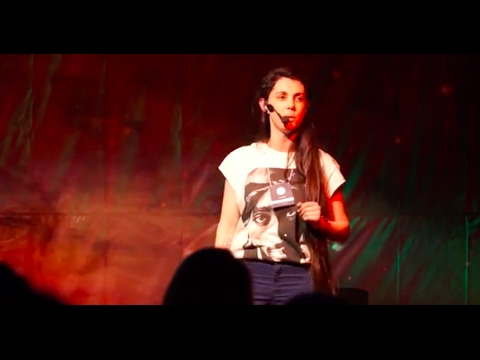
Sorry for the nervousness, the slang. I really like to speak slang.
I’ll be Mahira, as I always speak to my friends.
Pik Nik Collective started with a very simple idea.
I was going to the square to always go picnic and, in a moment with my friends,
I commented with the staff: “One day I’m going to have a collective picnic”.
I went there, I created a Facebook event,
only I could not imagine the proportion of the event.
I expected my friends: 30 people.
In the first Pik Nik he already gave about 300 people.
I started to think, “Gee, I think this gives a big project in the city.”
Then more issues were happening.
I brought some lines from the picnic staff,
which has been in all editions.
From Karoline Krause of Florianópolis:
“Pik Nik is that event that brings happiness in a month.
It is to know that Saturday will always be more beautiful, more cheerful and more cozy.
Because yes, there is no better leisure than being surrounded by friends
in a public space of the city, full of good things.
Synonymous with playing chit-chat, reviewing former colleagues in the area,
to honor the municipal culture and enjoy a good music in the midst of nature.
It is collective love in the form of a picnic. “
So, Nik Pik has no connection with the city.
He’s all independent. I gain support from friends.
One friend gives me a chemical toilet, the other lends me the tent,
the other that lends the sound.
He’s all independent, and I think that’s why
who has this very strong feeling,
because it is a battle every month, now every two months,
to make it happen in the city.
I organize exhibitions,
I get quite independent artists, we go there, spend the afternoon, paint.
They expose the works. People know the staff, the artists.
And they have the DJs that go to discotecar, already had band.
Here was the first issue of Pik Nik.
In the first edition, as I did not expect,
already in the first edition, with more or less 300 people,
I had no way of getting a chemical …
It was a very simple thing, I took the sound box,
the staff began to appear, began to take food.
I’ve already begun to imagine that this would be a great project.
In the next editions I already created the page.
Today, it is all formal.
And Pik Nik had such a large proportion,
that people come from many places.
There come people from Porto Alegre, Torres, from the region here, from Tubarão, Floripa.
I’ve seen people from São Paulo, which was a very impressive thing.
It’s an afternoon when people go to be able to have fun, to change an idea.
I’ve heard of several Nik Pik stories.
People who started dating. People who reviewed friends ten years ago.
There’s a staff that carries their gear.
People who spend the afternoon and exchange some ideals.
Here it is already in the second edition.
“Slackline”: very, very important. It’s a very good vibe.
At the beginning, in the third edition, there were a lot of people, I had a problem with the trash.
In the next one, you already had the staff that helped.
Today I carry many garbage bags in all editions
and I’m going to talk to the people about the trash.
The people are already more dedicated.
At the end of each issue, the folks help me with the trash.
It is very beautiful.
Pik Nik’s idea is this, it’s the collective.
Everyone joining, everyone helping each other.
This is one of the last editions, which “punched” the square.
Like I said, he’s independent, he’s democratic.
I’m always struggling to get a chemical toilet every month,
able to bring exhibitor.
There are a lot of people moving around the city,
LGBT, Feminist Collective,
who go there, expose the works, protest,
they do a thousand things in Pik Nik, which is very interesting, meeting.
This project, as I said, is already part of my life.
I organize. I ride it all. Who creates the event is me.
Whoever posts it, who does all the text, is me.
Who goes there in the morning and sets up the tent for the staff, it’s me.
Whoever shoots Pik Nik, it’s me. Who plays Nik Pik, it’s me.
Whoever dismounts, it’s me and the one who collects the trash, it’s me.
So, I’m entirely on the project.
It is difficult for me to participate.
I really wanted to sit there and spend the afternoon with the people, but I just can not.
So my friends always say, “Mahira, you’re always in the rush,”
but, I think I have to be there.
It’s how I tell my friends:
“Dude, they’re all my kids. I have to take care of them all there.”
And Nik Pik, like I said, he’s already part of my life.
And I think it’s very important to have such a project in our city,
to gather enough people, and the staff feel so good.
It is such a simple thing.
The people go in the square, they take food, they interact, they make new friendships.
And I think that, for people today, culturally, is essential.
Sit there, meet new people,
spend an afternoon, meet artists, all independent, that you may not know.
“There’s an artist in town and I do not know him.”
“I went to Pik Nik and met that interesting boy.”
“I want to know more about his work.”
And I think Pik Nik covers a lot of that part,
both of art, of interaction.
I end with the same question:
“What is the Pik Nik Collective?”
And, who does not know Nik Pik,
I invite you to feel this essence with all the people that go there
in the Praça do Congresso.
Thanks.
(Applause)
”
Be First to Comment