
Do you know those people who shine naturally,
who speak very well in public, with no effort,
who like being the center of attention?
I’m not one of those people.
(Laughter)
A stage like this one is definitely not my comfort zone.
But I’m here because I want to talk to you about a subject that is very important:
fertility.
Perhaps some of you, just by listening to this word, think:
“It looks like this talk isn’t for me, so I’m leaving, bye!”
Keep calm, yes, this talk is for you.
This talk is for everyone.
Because fertility matters for all of us.
Fertility matters for those of us who already have or wish to have children.
Fertility matters for those who don’t want children, now or in the future.
Fertility matters for all of us because, without it, we wouldn’t even be here.
And fertility matters because it is part of our health.
Now, shall we make here an exercise of imagination?
Imagine that people no longer need
to feel fear, doubt, shame
about the so-called “intimate parts.”
Instead, they know their own body,
and understand their own fertility.
Imagine that menstruation doesn’t make women feel desperate,
nor takes them by surprise.
Instead, there is a safe and reliable way
for women to know when the next menstruation is due.
Imagine that people who want to conceive
don’t need to keep trying several times,
shooting in the dark and suffering with frustration.
Instead, they also know how their own body works.
They know when is the fertile phase of the menstrual cycle,
so they know when is the best time to try to conceive.
Imagine that people who don’t want to conceive
don’t need to be always afraid of an unwanted pregnancy.
Instead, they also know when is the fertile phase of the menstrual cycle,
and they use this knowledge to their benefit.
“Hmm, alright, that looks interesting,
but I don’t like this thing of imagining,
I prefer to keep both my feet well stuck to reality.”
Alright, you don’t need to imagine.
All of this is already possible, and it has a name:
fertility awareness.
Fertility awareness is knowledge:
knowledge about your own body,
knowledge about how fertility works in men and women,
knowledge about how fertility is part of our health.
Men, in general, are fertile from adolescence until death.
And, during this time, they produce sperm,
all the time, every day, 24 hours a day, 7 days a week.
Yet women are fertile from adolescence until menopause.
And, during this period, if they don’t use any type of hormonal contraception,
they have menstrual cycles,
and the ovum is only available a few days per cycle.
Alright, but which days, when are these days?
This is where fertility awareness methods come to play.
Fertility awareness methods
are ways to observe, record and interpret
the fertility signs from a woman’s body.
These fertility signs are like symptoms,
showing from the outside what happens inside the body during the cycle.
Alright, so it’s possible to check the fertility signs
using these fertility awareness methods.
But, to do so don’t we need laboratories,
specialized technicians,
expensive, last generation equipment?
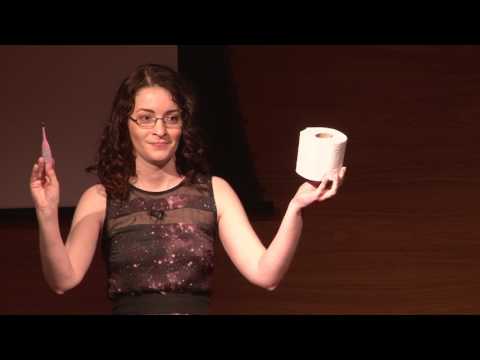
I brought here two pieces of such equipment to show you.
(Laughter)
Toilet paper and thermometer,
expensive, last generation equipment.
The toilet paper is used to check one of the fertility signs,
which is cervical fluid.
Cervical fluid is a natural and healthy fluid
that is produced by the cervix,
and changes in amount, color and texture along the menstrual cycle.
This indicates if ovulation is near,
about to happen, or has already happened in that cycle.
The thermometer serves to check another fertility sign: basal temperature.
Basal temperature is our body’s temperature
measured in a resting state,
soon after we wake up, but before we rise.
It also changes along the cycle.
This indicates if ovulation has not happened yet, or has already happened.
With these two fertility signs,
it’s possible to determine the fertile phase of the menstrual cycle,
and to know when the next menstruation is due.
These fertility awareness methods
are based on decades of scientific research.
And, when taught correctly, they are safe and reliable forms
to conceive, to avoid conception, and to monitor your own health.
“Hmm, alright, Carol, that’s interesting.
But that’s too hard, no one will learn that, come on!”
Well, there’s something else that’s difficult to learn:
how to drive.
The driver has to pay attention, at the same time,
to the car panel, which indicates the car’s condition to the driver
just as the fertility signs,
to the driving wheel, the gear, the pedals,
rear-view mirror, side mirror, car,
bus, motorcycle, cyclist, pedestrian, dog in the middle of the street …
(Sigh)
It’s hard.
But, still, learning how to drive is perfectly possible.
So, the same way it is possible
to study the basics of car functioning and traffic laws,
and to practice to be able to drive in a responsible and safe way,
it is possible to study the basics of our body functioning,
to be able to use the fertility awareness methods
in a responsible and safe way.
OK, perhaps now you are thinking
more or less the same thing that I thought two years ago:
“How come I never heard of this before?”
Well, I had the privilege to have access
to good quality health and education services,
to study biology, here at UFSCar, as an undergraduate,
to study biology in a master’s degree, to work with biology,
but I only learned about fertility awareness at age 27.
I felt dissatisfied, but also curious, and started investigating.
Scientific articles, books, websites,
whatever I found about fertility awareness I devoured.
But obviously I didn’t get obsessed with this, OK?
I want to make it clear.
(Laughter)
I am a very calm person.
And what I found is that there are some barriers,
barriers that prevent this knowledge about fertility awareness
from reaching people.
One of these barriers is confusion.
At first glance, it’s easy to confuse fertility awareness methods
with calendar methods, among them the famous rhythm method.
These two sets of methods have the same objective:
to know when is the fertile phase of the cycle,
and to know when is the next menstruation.
But they do this in different ways.
Calendar methods are based on recording
the duration of previous menstrual cycles
and making a calculation to try to determine when ovulation happened,
and then estimate when the next ovulation will be.
This is looking to the past to try to understand how the future will be,
and it is useful to give a notion of the days,
but the result is not very reliable.
Fertility awareness methods, on the other hand,
they work like this:
you observe, record and interpret
the fertility signs day by day.
You look at the present
to understand what is happening here, now, in the present.
And the result is much more reliable.
Another barrier that prevents fertility awareness
from reaching people is language.
Most of the information about fertility awareness
is available in English, but not in Portuguese.
All of this stimulated me to start a blog,
to share this information about fertility awareness
in Portuguese, and try to make this knowledge reach more people.
And the responses I have received so far are very interesting,
with phrases such as,
“This changed the way I see my own body,”
“I plan to teach this to my children.”
And one that was very interesting because the person wrote in all caps,
(Laughter)
“Why don’t we learn this in school?”
And we can pause and think.
If we could learn fertility awareness from an early age, how would it be?
Some people are afraid of this.
They think that, if we talk
and teach sexual and reproductive health to the young,
that it will be a chaos, that they will start their sexual life earlier,
that they will have sexually transmitted diseases,
that the number of cases of unwanted pregnancy will increase …
But, in fact, what happens is the opposite.
When we don’t teach sexual and reproductive health,
when we don’t talk openly about these subjects,
when information doesn’t reach people,
or when information is distorted,
that is when chaos reigns.
If we could learn fertility awareness from an early age,
it would open doors.
It would open doors to more information
so that people can achieve their objectives, their desires,
to have or to not have children;
more understanding, acceptance and respect towards our own body;
more health.
Fertility awareness is knowledge about our own body.
It’s an idea that’s worth and needs to be spread.
After all, there is a phrase that says,
“Knowledge is power.”
Thank you.
(Applause)
”
Be First to Comment