
Thank you for being here.
My name is Marisela Gomez, and I’m from Baltimore, Maryland;
the city, last year, where Freddie Gray died in police custody.
We rose up challenging this death
and challenging a history of racism
and its legacy of segregation and inequality.
The title of my talk is,
“Overcoming racism for individual and collective well-being.
The innovation of waking up,”
something we’ve been hearing a lot of, today.
First, I’d like to talk about the history of racism
in this creation of segregated and unequal communities,
prone to police brutality.
Courtesy of Doctor Mindy Fullilove,
this slide shows the chronic and systematic upheaval
of black communities in America.
Secondary to policies of the United States,
chronic upheaval has resulted in
what Dr Mindy Fullilove calls a root shock.
Root shock is what happens to people
when we uproot them out of their community.
It’s akin to uprooting a plant; when you pull a plant out.
If you don’t get it into the water immediately, it starts to look funny.
Even when we plant them immediately, sometimes they die.
Or sometimes, they never survive that transition.
That’s what root shock is, but in people.
This chronic upheaval has resulted
in communities going from model communities,
where people know each other, there’s collective energy,
neighbors are looking out for each other,
to communities that are fragmented,
to communities that simply live together not knowing each other,
to communities where people don’t know their history of that community,
they don’t know the heroes of their community,
They don’t know what happened two blocks away
because of this systematic displacement.
Along with serial forced displacement,
which is what we also call this chronic upheaval,
has been a systematic disinvestment from our communities of color.
We disinvested everything: schools, housing, recreation,
employment opportunity, infrastructure;
all the things needed for communities to thrive,
for individuals to grow up and be able to compete in society.
All that was also the result of government policies.
And while we disinvested communities of color and low income,
we overinvested the white communities.
This can most readily be seen
when we look at the life expectancy of these different communities.
That is, communities that are white, moderate income and market rate income
can expect to live anywhere from 10 to 24 years longer
than communities that are low income and of color;
like this in Baltimore
where the red color represents the shorter life span
and the green color represents the longer life span
that’s 10 years apart.
This communities can be sometimes a mile apart, five miles apart.
This is not just an issue of Baltimore.
This is an issue across America;
Dallas, New Orleans, Kansas City.
So while we continue to still have chronic upheavals,
we have gentrification today.
In Baltimore, I’m involved in a struggle where, just in the last few years,
more than 700 black households were forced to leave their homes
to make room for a Johns Hopkins Biotech Park.
So we continue to have these chronic upheavals,
this chronic disinvestment, and these outcomes of inequality.
But while we have disinvested in most of these systems,
there is one system we have overinvested in:
that’s the criminal justice system.
In Baltimore, our budget for the criminal justice system
is more than the budget for housing,
health, education, social services, and transportation, altogether.
Again, this is not a Baltimore issue; this is a United States issue.
This hyperpolicing in the form, enacted through tough-on crime legislation
that supports a mentality that it’s OK
to be violent against the black and the brown body.
It has resulted in police harassment,
police brutality, lack of transparency, lack of accountability,
and, as we all know, death of black bodies and brown bodies.
We are more aware now because of the media,
and because of movements like “Black Lives Matter,”
which have insisted that black lives mater.
But this policing is not new to United States.
Our history of policing is one where in the 17th century,
policing began with the night watches of indigenous peoples,
slave patrols of the black bodies
intended to control and contain the black body.
So, our history of racism has fundamentally built communities
of segregation and inequality,
policed in segregated and unequal ways,
and has resulted in segregated and unequal outcomes.
So, how do we change this?
We can change structures and institutions.
We can change policies.
We can insist that policies reinvest in our communities
that have been chronically disinvested.
We can have programs that change the culture of policing
to one from punishment to one of prevention and rehabilitation.
We can continue to build strong movements that demand justice for all;
but justice, equitable justice.
[Movements] that push the greedy, the rich, the powerful, our government
to reinvest, to repair, and to reconcile damages.
And while we’re doing all this, we have to take care of ourselves.
I suggest to us that taking care of ourselves is waking up.
So we wake up not just to this history of injustice,
we wake up to ourselves, we wake up to everything around us,
we wake up to what we’ve been seeing with eyes constructed by an unjust system.
Eyes that have been seeing things not based on our experiences
but based on the prejudices of the masses.
We must wake up. We must have new eyes.
Being awake, mindful in our actions is a daily practice.
We don’t just wake up one time,
and then, “Hey, I’m awake. How about you?”
(Laughter)
No.
We have to keep practicing.
We have to practice at change. We have to practice at waking up.
When we stop, when we become aware of the breath in that moment,
when we calm the mind, and we find stillness,
we begin to see what is inside ourselves.
We begin to see our perceptions; wrong perceptions and right perceptions.
We begin to understand ourselves a little more.
We begin to notice our tensions, our triggers.
We know our pains. We know our joys. We know this self.
We change this self when we wake up.
Waking up can dissolve anger,
it can transform hatred, transform anxiety and fear.
Waking up opens us up to possibilities,
to opportunities, to truths.
When we wake up we become clear,
and that clarity from inside of us is a clarity that we bring outside.
And so, when we go to boardrooms, and go into city council meetings,
we must be awake when we are trying to talk
to a city council member who thinks that in the 21st century,
it’s still OK to give tax subsidies to a big rich developer like Under Armour,
to continue to build white enclaves in Baltimore city.
We must be awake when we go into community meetings,
and we try to work with a community that have been so fragmented
that we don’t know where to begin,
but we know we can’t continue to do the same thing.
So we must be awake.
And in order to be awake in those interactions,
we, ourselves, must bring that awaken spirit,
that awaken nature into the spaces.
So, let’s wake up together. I invite you to close your eyes.
It’s OK. It’s safe. We are not going to take your pocketbooks.
(Laughter)
I invite you to become aware of your breath,
coming in from the nose, into the belly,
leaving the belly, the lungs, the nose.
And notice the calm that occurs in your mind, in your body
just from being aware for one breath.
Please, open your eyes.
Can we do this everyday? But not just everyday.
Can we do this multiple times a day?
Can we become aware of our steps
each time we place them down on the ground?
Can we become aware of our hands as they close the door,
when we take our shoes off?
Can we become aware in the moment? Can we wake up?
Please, turn to the person next to you.
Offer them a smile.
And tell them, “Thank you for being interested in waking up.”
(Indistinct chatter)
(Laughter)
Because when we wake up–
– I heard that –
Someone said “literally.”
(Laughter)
When we wake up, everything shifts.
We start to see the humanity in the person, the stranger.
We remember our truths, we remember our compassion.
And we get connected again.
I want to close with the story about my practice of waking up,
and how I feel it prevented violence.
I was cat-sitting for a friend
who happened to live in a predominantly white neighborhood in Baltimore.
She had a house alarm. I forgot.
I woke up the next morning, I opened the door, the alarm went off.
The phone rang, I gave them the code.
But it was apparently too late, the police were on their way.
So I was walking toward the door, it was open,
the screen door was still closed and locked,
and there appeared two white police officers at the door.
It all happened so quickly, but in my mind it was in slow motion.
Because when that officer yanked that door open,
and came in with his gun drawn at me,
and the other one behind him, reaching for his gun,
everything stopped.
I became so still. My mind was so calmed.
I was really awake.
Because I knew that in that moment,
if I wasn’t calmed, I could get killed.
If I made the wrong move, I could be killed.
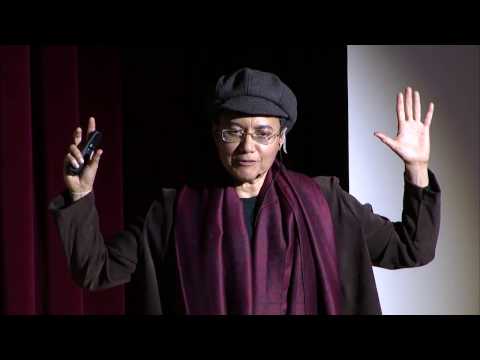
And so I raised my arms,
and with a very powerful and calm voice I said,
“We don’t need any guns here.”
I was wearing pants like these.
There is no room here for guns.
But when people are fearful – and I could see in their eyes: fear –
I could see fear of me, fear of people who looked like me,
fear of the stories about ‘us’ and the ‘them.’
And so in those moments,
when people are asleep, we have to be awake.
Because it’s not just a threatening thing, it’s a matter of life and death.
If we are not awake, we will die. We will continue to die.
The officers stopped. They told me to show them my ID.
Yeah! With my hands up.
But that’s what happens when we are afraid, right?
We do stupid things. We are not present.
So I asked permission to bring my arms down, very slowly.
Some of you know this drill.
Saying, “I’m going to walk over there now.
I’m going to reach in my bag and get my wallet.
I’m taking my wallet out.”
It ended OK. I’m here today.
These officers listened to me.
Too many times they can’t hear me, or people like me.
Because they are hearing the stories.
We have to wake up.
Waking up is radical.
Waking up is powerful. It’s innovative.
Waking up can take us on the path of healing racism
and bringing us to an individual and collective well-being.
Because when we wake up,
we invite in our spirit and our action together.
And that is fundamentally what can move us towards justice.
Thank you for listening.
And thank you for being willing to wake up.
(applause)
”
Be First to Comment