
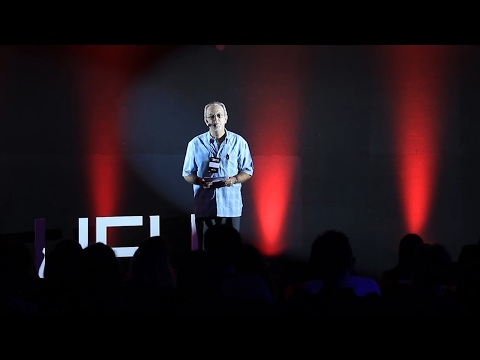
Good afternoon, or good late afternoon for everyone.
I’m glad I’m here.
I hope I can contribute some elements to this diversity of ideas.
In fact, I bring some challenges to think together,
as humanity.
I begin with a question:
to have more and more material goods is to live well?
We are facing a deep crisis of way of living,
a crisis of civilization,
which is based on producing more and more,
consume more and more,
and create many disposables.
This has generated wealth, no doubt,
and much destruction on a global scale.
We live with luxury and trash. That’s the truth.
Our civilization concentrates [wealth] in a few hands
and excludes billions of human beings.
Only 62 billionaires of this system
have more wealth than half the world’s population.
More than 3.5 billion human beings.
We live with great social inequality and injustice.
The displaced of their territories by environmental disasters and wars
are counted in millions.
More than 65 million are now in this situation.
Grows dangerously in society
intolerance, racism, machismo, xenophobia.
A great threat hangs over planet Earth and the future of humanity:
climate change.
As there is interdependence between ecological systems
and threatens its integrity and regenerative capacity,
necessarily reaches a planetary dimension.
As you see, the polar cap, in a few years, what is happening.
With globalization, we have become very interdependent, from the local to the global.
And, as humanity, we must face a fundamental challenge:
prioritize the good live in collectivity,
rather than having more and more disposable material goods.
What are the possible ways?
We need to decolonize, literally, our heads and our looks.
It is a question of dismantling presuppositions of thought and action
who saw common sense,
that invade our lives and shape our dreams and desires.
The culture in which we live, the way we produce and consume,
the type of political management of our society.
We are faced with a question of ethical principles and values
which define the relations of humanity
with its own social and cultural diversity,
and the relations of humanity with nature.
This has a question of science and technique,
since much has been said in science and technology here,
but it is about philosophy and values.
The principles and values are a kind of infrastructure
both of ideals and of the social imaginary,
practices in all walks of life.
What are the principles and values that allow us to make wars,
kill each other, discriminate against different people?
Why, with all the scientific capacity
that we have and that we develop,
instead of using it in a sustainable way,
we have destroyed the resources that nature generously offers,
for us and for future generations?
We are leaving holes, instead of leaving future.
We need to respect the water cycle,
of biodiversity, of nature at last.
We need to rethink our place as beings endowed with consciousness,
on this threatened planet, a great good, but unique.
After all, we are part of the biosphere and we change with it.
See the vegetable garden and our plate. Just compare.
We are living nature.
We are neither above nor beside, we are part of nature.
Being part of nature, we are forced to interact with it.
The condition of life itself is dependence and exchange between ourselves,
and in relation to nature.
The ethics of common goods
the principle of rediscovering them
and organize, as a society, around them,
because with this we can create a new way of being and living,
both in the relationship between ourselves and in relation to nature.
But what are the common ones?
We have natural commons.
We receive them as a gift from nature, and they are fundamental for everyone:
the water, the rain, the aquifers, the springs, the streams, rivers, the seas,
the soil, the winds, the climate, the atmosphere as a whole,
biodiversity with all plants,
the soils and their fertility, the minerals, the natural beauties, finally.
Some are finite, such as minerals, including coal, oil and gas,
which we are simply burning, predominantly burning.
Others are given, inconstant stocks, such as water,
but depend on your cycle
and may become scarce by predatory and polluting use.
We have the renewable and even modifiable commons, such as biodiversity,
but depending on their usage they may end up.
There are unique and undivided natural assets, such as natural beauties
and the great ecosystems that regulate the planet’s climate.
Tropical forests, steppes, poles,
fringed mountain ranges, oceans.
The natural commons are, as we see on this map,
a part of the world map,
are distributed on the planet in an extremely diverse way.
How to manage and share among the whole humanity,
and not only among those who are in a certain place,
these resources?
We have the common goods produced.
This is due to human genius,
which generated, over time, common goods of great diversity,
but of fundamental importance for life and different cultures.
Languages, with different ways of saying thank you, plus religions,
the philosophies, the arts, education,
information and communication,
science and technology, digital culture,
the space of politics and the very social identity of peoples.
We have the goods that combine material basis and human production:
the cities, the territories of citizenship, the streets, the roads, the squares;
the holy places, churches, cemeteries, finally,
the public spaces we all share among us.
The common goods produced are, theoretically, unlimited.
The more you share, the more you grow.
He sees the knowledge, he only grows in the sharing.
The language only grows in the sharing.
In fact, the only way to do the tongues is by talking, is not it?
They are the frontiers of the expansion of good living and human happiness.
This happens with culture, science, technology.
What is the character of a common good?
Goods are not common, they are socially common.
Common is not an intrinsic quality to the good,
but it is a quality that the social relation attributes to it.
In the bottles are seeds.
And the other is a fight by Estelita, in Pernambuco, against real estate
who wanted to transform this place, in the center of Recife, in a private place.
The commons, more than goods,
are what social relations identify and generate as such.
The felt need, aimed and collectively faced
leads to the creation of common goods.
Examples of common goods:
rescue and regenerate common goods, is to create the conditions of another way of life.
The character of common was constituting itself over time
on a par with the collective management.
Being part of a group, a community, a people,
and, for some goods, of mankind,
and have the right to share such common goods,
is that it gives them this character.
The atmosphere, which is a natural common good,
is being privatized by the pollution of some, rather than others,
of some societies and, above all, some ways of using them.
And it is being colonized in this sense, and destroyed as a common good.
Neither private nor state.
Simply ordinary.
Common ones are a kind of common substrate of life in society.
They serve all and all.
The common are the network of natural, social, cultural and digital life.
To speak in common is to refer to the quality of life and the future.
Threats …
For example, a resort privatizes the beach;
beach that is a common good of all.
Cornering, privatization, commodification,
which happens with many goods, is the greatest threat.
It’s becoming scarce, to make it expensive.
It is only for commercial purposes that one does this.
But also, the air pollution, the plastic we play,
pollution that kills marine life,
the destruction of biodiversity,
in our case here, one of the greatest threats is deforestation;
and intellectual property
and the commodification of science and culture.
Principles and ethical values to conserve and broaden the common.
Care, an essential activity for the human being in daily life,
is the fundamental principle of common goods.
Without care, the conditions of life and life itself, do not exist.
Care is the indispensable principle of living in community,
whether the family, the most immediate group,
or the circle of friends and the networks in which we participate,
the territory in which we live, small or large, in short, where we are.
The common good is born and flourishes with care.
Together, protecting, in this case, a beach,
as the right and responsibility of life, of all and all,
our water, our territory, with its resources and beauties,
our collective identity, our sons and daughters,
our elders and elders, our feasts, our celebrations and wakes,
our city, our beach, our water, our mountain.
Live and share with everyone,
are the essential ethical principles and values
to keep the commons at the center of our lives.
The principles of care, coexistence,
and the sharing of all that is made and managed as common,
are the pillars of a new way of living and living well.
This is a fight against Vale, north of the city of Belo Horizonte,
protecting the springs of water and the mountain,
that Vale wants to transform, of course, into a hole, into a mine.
Well live, and I end here, is to prioritize the commons.
It’s having them in the center. It is to be and to participate.
It’s sharing. It is to live. It’s caring.
It is to be entitled to the same rights as others.
It is to be and live as citizenship that shares the planet Earth.
Another world is possible. Thank you.
(Applause)
”
Be First to Comment