
I can remember the night as clear as yesterday,
it was a cold winter night.
You could hear the wind howling outside.
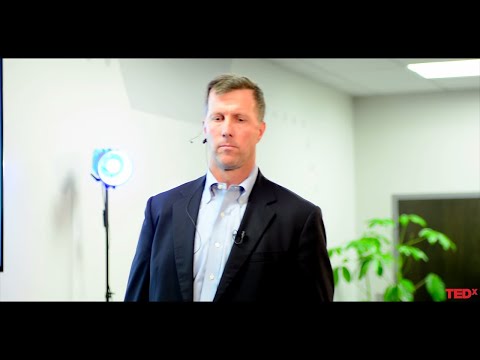
We were in a room very similar to this.
I was with all my teammates, you could feel the tension in the air,
you could cut it with a knife.
We were about to endeavor in an operation
that none of us had ever participated before.
We were in this room planning every detail of the mission.
The walls were lined with nautical charts, maps, photos,
every detail you could imagine to prepare for an operation.
I looked across the room and I locked eyes with one of my teammates.
His name was Dan.
Dan was an All-American football player
and he was everything you’d imagine a Navy Seal should look like:
six foot two, 220 pounds.
I don’t think the word ‘failure’ was ever in his lexicon.
We nodded at each other.
I looked away.
A few minutes later I locked eyes with another teammate.
His name was Don.
Don was a slighter man but equally impressive.
Don ran the mile in high school
and for those familiar with mile times, he was fairly good at his trade.
His high school time was 4:02. One of the best ever, in fact.
We nodded in appreciation for what we were about to endeavor.
A few minutes later, I looked to the back of the room and saw
a teammate of mine, Nick.
Nick, about five foot six, slightly overweight,
I’m pretty sure he couldn’t even make his JV anything team,
but he was in the room nonetheless.
I was worried about Nick but he gave me a sheepish smile,
we nodded and went on our way.
Before we knew it, the night began.
With what seemed like only minutes, the bullets started howling at us.
The rounds could be heard everywhere.
And when you hear that phrase in the news, “the fog of war,”
I’m here to tell you it’s real.
You lose all perspective, you don’t know where you are,
you don’t know where the enemy is, you don’t know where your teammates are.
You sometimes don’t know which direction to go in.
Confusion continued, and continued.
The fire broke.
We consolidated, we moved to a new position.
Fire broke out again a second time.
Hours will have gone by by this point, and I heard the news:
Dan, the football player, was gone, he was no longer with us.
“Chaby, snap our of it!” I heard.
“He was weak, he didn’t have what it took.”
“Don’t worry about him, we need to continue with the mission.”
A thousand thoughts flooded into my mind,
but I knew he was right, I had to continue.
That day would come and go.
The next day came.
Another hell of fire would come on us and before too long
I would learn the next piece of news:
Don was no longer with us, he was gone.
How can it be possible?
How could the two people in our class, the two people on our team
that in my opinion were the most capable, were no longer part,
no longer with us?
A few days later, after five days of this,
four hours total sleep through this whole period,
everything was over.
We were back in that same room and I saw Nick, we locked eyes.
Nick nodded at me and then he winked, and said: “I’m glad you made it, Sir.”
He made me wonder how could I be so shallow and callous,
about this story I was just relaying.
This wasn’t a real world mission; this is what was called ‘Hell Week.’
It’s the keystone event of Seal training.
It’s what our teammates all go through,
and what we value the most is resilience, what we value the most is not quitting.
And when the football player and the miler left our class
they didn’t have what it took,
as per the culture that I would spend the next 23 years being part of.
During those 23 years, I would live by the code:
Failure: unacceptable.
Weakness: unacceptable.
Whatever a man can do, we will do ten times more.
Whatever mission is put in front of us, we will succeed no matter what the cost.
The mission first.
Before ourselves, before our family before our God:
The mission first.
Weakness: unacceptable.
Being a Seal is extremely relevant.
In fact I’ve never felt more relevance in my life than my time as a Navy Seal.
When I think of being motivated to do something, I don’t think it’s money,
I don’t think it’s prestige,
I think relevance is the most potent and powerful force out there.
I felt relevant.
My career was coming to an end now, I was going to retire,
they asked me to do one more assignment.
They asked me to leave Coronado, CA and move to Tampa, FL.
It’s where our HQ, United States Special Operations Command.
They wanted me to lead an effort,
an effort that would build and sustain full spectrum resilience.
You see, at this point, we had been at war for over ten years
and the debilitating effects of war had taken an enormous toll on my teammates.
Divorce rate, up. Alcoholism, up.
Drug rate, up. And sadly, suicide, up.
We had to respond, we had to intervene.
This was our solution:
Let’s implement a program, let’s deliver resources,
let’s advocate, and let’s change our culture
so we can best serve our teammates,
optimize performance and maximize the capabilities of these great warriors.
Regardless of how important that sounds, I felt like I was losing my relevance.
I drove cross-country from San Diego to Tampa feeling as though
the relevance that I’d had for the 23 previous years
was dissipating in my fingers.
I got to Tampa December, before Christmas.
In fact I remember the date like yesterday: December 12th, 2012.
6:30 at night, driving down Highway 19 in Clearwater, Florida.
I hear on the radio: “Navy Seal dies in Afghanistan.”
Who could it be?
I called our headquarters, spoke with a teammate.
I learned quickly it was Joe Price, Commander Joe Price.
Joe was Commanding Officer of Seal Team Four,
he was my peer, my friend, my teammate.
What happened? How did he die?
They didn’t know yet but there was an investigation being conducted.
Hmm, that’s unusual.
Typically investigations aren’t required for battlefield deaths.
I went on with my day, the next day I would find out that Joe
died from suicide.
How could that be possible? How could he commit suicide?
Thoughts flooded my mind.
Was he sick? Did he cheat on his wife?
Did he go bankrupt? What happened? It has to be something else.
He was more resilient than I considered myself to be.
Little did I know that that relevance that I thought I was losing
would come back to me in spades.
I checked into my command the next day.
Began my assignment as the director of an effort called
‘Preservation of the Force and Family.’
Full spectrum resilience: the physical, psychological,
the social – the family piece – and the spiritual.
And we didn’t look at these four domains in stove pipes,
the goal was to integrate them and synchronize them to best effect.
As I was getting my feet under myself, I got a phone call one day.
It was a young woman who identified herself as Susan.
And Susan began to ask me questions about Preservation of the Force and Family.
What are you doing to help prevent suicide?
I gave her our answers.
Have you considered this? Have you considered this?
And she proceeded to ask me about a dozen more questions.
At that point, she said: “I have to be completely candid with you, Tom.”
“My husband, Michael Lube, was a Green Beret
and he committed suicide two months ago.”
We spoke for an hour and a half that first call.
By the end of the call I was shaken, but more importantly than that,
I was challenged,
and that is the thing you do with me and my teammates
when you want actions to take place.
She didn’t know that, but she did the perfect thing.
She challenged me.
I said: “Can I call you back in a couple of days?”, she said: “Absolutely.”
I learned later she thought I would never return the call.
I called our Admiral, spoke to him, said I’d like to complete and form
a suicide prevention working group.
He said: “Absolutely, let’s do it.”
I said: “But Sir, I want to do this one different,
I don’t want it to be made up of psychologists,
licensed clinical social workers, and other behavioral health experts.
I want it to be made up of surviving spouses,
whose husbands committed suicide,
and teammates who had displayed suicidal ideations”.
He gave me approval to move forward with this operation with one exception.
He said: “I want you to have one behavioral health expert on your team,
just to protect you from yourselves.”
That was good thinking.
We moved out, we assembled a team, and began to really take a deep dive
looking at suicides, doing the forensics on them, what happened?
And we learned so many things.
The stigma, huge problem.
Sleep deprivation.
I had a seven month period in my life where I kept a log:
I averaged two hours and 45 minutes per night, for seven months.
Not good, according to the endocrinologists.
But this was typical. Weakness is unacceptable.
“You’ll get enough sleep when you die,” John Wayne screamed in everything he did.
Our culture was about ‘machismo,’ it’s about ‘we can do anything.’
So the Suicide Prevention working group continued.
We made headway, we made differences.
But at the end of the day, when you’re working with a bureaucracy
as large as the DOD Medical System, and the VA Medical System,
it’s hard to move things forward.
Susa, Susa Ullman, who Nick mentioned when he introduced me
got frustrated, and would refer to these frustrations as bureaucratic frustrations.
That’s political correctness for ‘some people can’t get out of their own way.’
She broke off and created and formed a 501-C3 called Warrior 2 Warrior.
I was still on active duty so I couldn’t directly be part of it
but I could be an advisor, which I did.
I retired a year later and Susan asked me to become the Co-Executive Director
with her, which I gladly assisted and took as my new role in life.
We continue to work this now, and the challenge is huge.
Suicide rates are going down, and that’s a great thing.
Suicidal ideations are going up and that’s a good thing
because that means people are identifying, self-identifying they have problems
and are self reporting themselves.
But despite these two dynamics that are strong signs of improvement
many of my teammates still walk around in a state of despair.
I get calls routinely, multiple per week, from teammates, warriors,
people that you could not imagine would have a problem related to [PTSD]
or battlefield trauma, asking for help.
They don’t want to go into the system, they fear the system.
That relevance I talked about before?
If they go into the system they will be marginalized,
they will lose their relevance.
So they come to us, and that’s what we’re doing.
We are de-institutionalized solutions for teammates in need, that’s our tagline,
and we’re doing everything we can,
and right now we’re on the first stage of building a small five-acre town
which will be referred to as the Resilience Ranch,
that will have full spectrum services for these guys,
and when I say guys I say that humbly because it’s 99% men.
Thank goodness women aren’t as afflicted with this challenge.
And in this Resilience Ranch we’re going to have physical rehabilitation,
brain health, psychological therapy, anything they could imagine they need,
and things they can’t even imagine, will be there
in a non-threatening, non-stigmatized manner.
I share this with you today for a couple of reasons:
One:
I look at history, the Vietnam war,
and do we have any Vietnam vets in the room, by any chance?
There’s nobody here.
My heart goes out to that generation, as a country we failed them.
I don’t want to see that happen again,
I don’t want to leave these teammates behind,
so what we’re doing is we’re giving them hope, giving them a solution,
something they can hang on to and move forward with.
Hope, is number one.
Number two: humans are extremely resilient,
extremely resilient, unbelievably so.
But they’re also extremely fragile.
Everybody has a breaking point, everybody, remember that.
And I made a couple of comments throughout my talk today
and I referred to as ‘committing suicide.’
When we did our forensics it became extremely apparent to me
that people don’t commit suicide, at least not the teammates I’m talking about.
The teammates I’m talking about fall victim to suicide,
and it’s a huge distinction;
it’s something that they never would have done deliberately,
but their hormonal balance through endocrinology is in such a despair,
that they can do things they could not do otherwise.
I want to thank you for listening to me today,
I want to thank you for helping any veterans you know,
and if I can ever be of help to anybody you know, in your family
or your circle of friends, please contact me,
and I’ll do whatever I can to help them.
Thank you very much.
(Applause)
”
Be First to Comment