
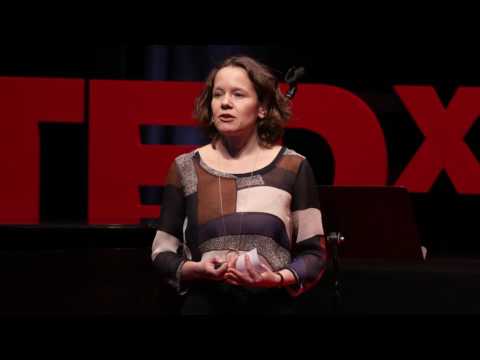
I ran the Weill Music Institute at Carnegie Hall
which is the Hall’s Education and Social Impact Program’s arm.
We work annually with about 600,000 people all over the world.
We do a lot of things that are about introductions
to high-quality musical experiences
in school settings, for families, in general audience settings.
We ran social impact programs
that are active in correctional facilities,
both adult and juvenile justice settings,
healthcare, and in homeless shelters;
we do artist training activity
supporting artistry in young artists
– all the way starting at the age of 13
and as they go up into the professional world –
and also supporting the artistry of educators.
I want to share why we do this work.
We are a big cultural institution, and often, people assume
that the reason we would be interested in this kind of activity
is to grow our audience,
and that’s not why we do
this huge, huge, huge amount of activity in this space.
For us, it’s really about serving people through music;
and among the many questions that we ask, we are always thinking about that:
how do we serve people through music?
We believe that music is a birth right,
and that everyone should have access to extraordinary musical experiences
and meaningful musical experiences
across all music genres,
so, yes, classical music, and world music, and jazz, and hip-hop, and pop, and rock,
and all of those things.
So, in a minute, you’re going to hear a couple of lullabies that were written
as part of the Lullaby Project at Carnegie Hall.
I just want to tell you how Lullaby was born.
We were in a partnership at Jacobi Hospital, in the South Bronx,
and we were talking about how that partnership might evolve.
We were in a room with doctors, and nurses, and staff from Jacobi,
some of our staff, and some artists,
and we were hearing about different medical challenges
the hospital was facing.
A woman started talking about pregnant teenagers.
And she said that these young women were not really ready to have children
and in addition to that, they were facing all of these other problems.
They were often ostracized by friends,
when they became pregnant at the age of 14, 15, 16.
Sometimes, that pregnancy would cause a break in families,
and they would end up homeless.
And they were often living in poverty.
As a result of that, on the medical side, what happened
is these young women did not attach emotionally to their unborn children
and to their infants, occasionally.
We started to wonder about lullabies.
We wondered what might happen
if these young women would have the opportunity
to collaborate with artists,
to write lullabies, specifically for their children,
and to then, have a recording of that lullaby
as a gift and as something they could use to build that connection.
We piloted the project at Jacopi Hospital.
It was hugely successful.
Lullaby has evolved, and now takes place
in numerous healthcare settings.
We do lullabies with homeless shelters,
and at Rikers Island.
We also partner with about a dozen organizations around the country
who are also doing Lullaby in all kinds of different settings.
As Lullaby has evolved,
it’s also broadened out,
and the first lullaby that you’ll hear
is called, “The Emperor of Possibility.”
It was written actually by this gentleman
who you see here.
He is the Director of Special Projects
at the Department of Homeless Services in New York City.
His name is Antonio Rodriguez.
He is an extraordinary man.
He’s been a partner of Carnegie Hall for over 20 years.
He was staffing a Lullaby Project,
working with some young women who were experiencing homelessness.
He wrote these extremely empowering lyrics
to this song, “The Emperor of Possibility.”
Saskia Lane, who’s one of our artists who works in Lullaby encouraged him
to start to put together a song,
and they wrote, “The Emperor of Possibility.”
So, you’ll hear that first.
And then, you will hear a song by Shauna Kanteen, a young woman
who was in the very first project at the Jacobi Hospital.
She was working with Thomas Cabaniss
a composer and an artist we work with quite a lot.
She wrote, “Dream Big.”
“Dream Big” has become this kind of lullaby anthem
as you will hear,
it’s become a bit of a theme song for the Weill Music Institute.
Antonio’s quote is an incredible quote
about the extraordinary power of music
for both to empower people and also to help us feel
like we belong in a community, and we belong in a society.
He talks how important that is for young people in homeless shelters
and people in general in homeless shelters.
I think that’s something that’s incredibly important for all of us,
and it’s something that music can help us to do.
Enjoy these lullabies!
(Applause)
”
Be First to Comment