
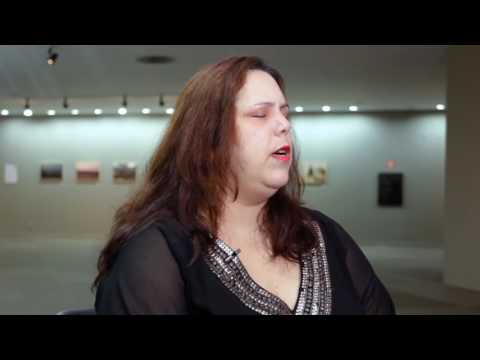
Recently, I finished my PhD research,
entitled “Ideologies and Educational Inclusion in the Context of Globalization”.
The reason for this research is to investigate how antagonistic discourses
are present in the same social practices,
that is, as the discourse of inclusion and the discourse of globalization
are present in the school environment.
This uneasiness of this research
has an intimacy with my personal life
because I am a person with visual impairment, I am blind,
and I am the first blind to complete a doctorate in the UNB,
in the course of Linguistics.
I lost my sight at age 17, and after that moment,
the first achievement I wanted was just the right to go back to school.
I really wanted to go back to school,
although I did not know how, and neither did my family.
And after I insisted, my mother took me to a college
in which the director accepted me with some caveats.
He said that there would be no form of accessibility,
and no one could help me in anything,
and that the time would come when she was going to say that it would not be possible anymore
and if I was not going to be “sad” about it.
He even used a diminutive.
I said no, that I wanted to, that I wanted to try.
And so it was done, just as she said,
without any form of accessibility, only my family read to me at home.
And, after the first evaluations,
she called me to her room and asked, already with that pain:
“How did you do the tests? Did you take the English test?”
Then I replied that it was 9.5 and she was scared: “What, 9.5?”,
and called the other teachers
to know how my evaluations had been,
and everyone answered, “The biggest note in the room.”
And she said, “Look, then, you can stay there.”
I have always earned my right to study and I finished high school.
I wanted the new stage: I wanted to go to higher education in Law and Letters.
And they said: “It’s impossible, it’s a lot of reading. Law and Literature is a lot of reading.”
But I have earned this right to continue studying,
although I still hear a lot that there would be the end,
only going to study, but there would be no right to work,
it would not be possible to develop a job.
And when it came time for the internship,
the university wanted to dismiss me from the internship and put “approved”
but here was the turning point for me:
or I showed that I could work or not,
or say, “Really,” and shut up.
And I insisted; although they deny it, I insisted
and even said that I would file a writ of mandamus if they did not authorize me,
and so I got the right to do my internship.
When doing the internship, one day, in the classroom,
a student stood up and said, “Professor, a woman came into the room.
She’s sitting in the back. “
I imagined that he would be my trainee teacher and I said, “Oh, alright,”
and I continued with my class.
Ten minutes passed and the same student came and said:
“Teacher, the woman got up and left crying.”
And I was scared and I said, “Wow, what did I do?”
I asked the school coordinator who I was
and she confirmed that she was really my internship teacher.
And the next day, at the university, that same teacher asked me for forgiveness
because she really was one of the people who wanted to stop me
and because she thought I had no capacity to be a teacher,
and she said, from that moment on, she would never put a limit on people.
At that moment, it was when I now had practical arguments
that I could work,
and I made the competition for a Portuguese-speaking teacher in the state of Goiás.
There was no vacancy for the disabled, I took the second highest note of the state
and when I went to take possession,
the doctor said, “Look, a blind teacher is impossible.
A blind teacher is impossible.
Disability is incompatible with your profession. “
I tried to argue and he said, “No, no, not at all.”
When I realized he was irreducible, I asked him to take a copy of the document.
He authorized, except that it would be in a copier in front of the medical board,
and his secretary accompanied us to the sidewalk.
I crossed a busy street.
When crossing this street,
I had the impression that the girl was on the other side.
I said, “Mother, was the secretary on the other side?” She said, “It is.”
I said, “Then run, mother, run!” And my mother: “Run for what?”
I said, “I will not deliver the document.
And she obeyed me, though I did not agree,
and I said, “Get the first cab in front.”
Then, we took the first taxi and went to the Secretary of Education
and already wanted to talk to the secretary of education.
I said, “Look, I just want to make a deal.
I have the right to take possession, I passed, I took the second highest note of the state,
and tried to stop me, “
but I was very lucky because the governor’s chief of staff
was leaving the office of the secretary of education.
When he heard what I was saying, he said,
“Put this girl inside the room
because this can be a problem for us. “
And I went in, told the whole story to the secretary of education,
he listened attentively and said:
“Sure, I’ll help you. You’ll be back next week.”
I said, “I do not think you understand.
Next week there is no agreement, and tomorrow there is no agreement.
Or do you help me now, or do I file a writ of mandamus
and I’m going after your political opponents.
and they will really enjoy my story. “
He realized that I was determined on what I wanted, in my aim.
He called the doctor and, during the call, he said,
“He said that you have the document, that you took it and left.”
I said, “I got it, it’s with me.” “You have to give it back.”
I said, “I do not give it back, I do not give it back. I do not give it back.”
Then he said, “Okay.”
So he authorized and I went there in the medical board,
the doctor without being very satisfied, but exchanged the document with me,
and I went to be a teacher in the state of Goiás.
And the inclusion policy began.
The inclusion policy is to place all people with disabilities,
with any type of disability, regardless of grade, in regular education.
When this policy began, I was called and said:
“Look, you have to help us, because you have a lot of experience,
to teach teachers and students how you did to achieve what you got
because now you have up to two higher courses.
You’re a teacher, you’re a lawyer. “
Then, I drew a despair and thought, “What method?”
I had no method, I did not know what to do.
I knew that I conquered by stubbornness, because I went behind,
because I found my way.
But I accepted the challenge and realized that in schools
the situation of the students was not different from mine.
They were in school and there was no accessibility.
But many did not have the determination I had,
they did not have the same stubbornness, and many gave up.
Just as it was with me, no one knew what to do.
That the inclusion discourse was what we wanted, the right to school, was,
but at what point did we say it would be so radical?
Would it be that if I had correct methods, the Braille system,
with accessible computing, with accessibility technology,
would have been easier? Of course yes.
Of course I do because I say: I did not find any open door.
I smashed all the doors.
So, afterwards, I came to study in Brasilia,
I passed the Ministry of Education contest
and I worked directly with the inclusion policy
and still the restlessness continued:
from where this speech comes to propose the end of the special school,
that the discourse of inclusion proposes this radical inclusion,
determining that the special school did a disservice to society?
This idea of discovering
where this discourse lost some of the voice of people with disabilities
was what motivated me to develop my thesis,
and in it I realized that the discourse of globalization, at one point,
contaminates the inclusion discourse
because the discourse of globalization is a very mercantilist discourse
and ends up putting, in a masked way,
that the special school did a disservice to society
and, in a way, it shapes the discourse of inclusion.
Except that, in fact, there does not have to be an end to a special school
and only regular education.
What I developed in my thesis
is that the two schools can be at the same time in the same space,
in the same educational system, as long as the two are inclusive,
that both promote a real inclusion,
because this is what people with disabilities want,
this right to study, the right to be in society,
but with accessibility, with all the mechanisms that promote accessibility,
without throwing away all this achievement that has already been made.
Because it’s this idea that I want too,
that my achievements also serve as doors open to other people,
that what I have conquered is not closed,
but what other opportunities,
such as teaching methodologies in an accessible manner,
also serve as support for the education of people with disabilities,
because I have conquered what I conquered without methods.
I say it’s worth dreaming,
it’s worth going after what your heart tells you is possible,
but if this dream already exists in reality,
already exist as a practice of other people,
surely this path will be easier,
will be a shorter way.
And it will not be just the stubborn who will win a place.
Even those who have a little more fear will also win.
I leave a message: do not listen to the voice of no, not always.
Go after your dream, but turn the dream into reality.
Let this dream come true.
It is.
”
Be First to Comment