
When I have the privilege of creating a show at Cirque du Soleil,
something inspires me a lot:
it is the fact that the company was born from the street.
It was founded in the 80’s by public entertainers,
and it influences the way we create shows.
I’m going to talk to you today about something I’m passionate about,
the creation process of Cirque du Soleil,
I hope that will inspire you in your various spheres of activity.
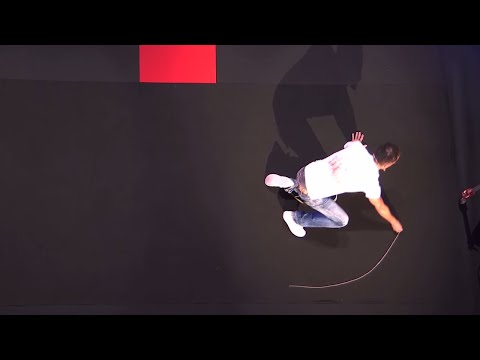
The first thing a public entertainer does
even before starting his show,
it is this:
(Music)
This circle tells the public that there are two realities:
everyday reality,
and the other reality, that of all possibilities.
Inside this circle,
the usual rules no longer apply,
we can do anything!
And we can be different.
In fact, and we must be different
because we must capture the attention of the public walking in the street
with something visceral, something personal,
something unusual,
so that they change their trajectory and come before you,
and that they become your audience.
Street performance is the only form of entertainment
where the public will pay but only after the performance,
and that changes everything.
The creative process at Cirque du Soleil is similar to this circle.
It creates a space of all possibilities,
but it’s a demanding space where everyone has surpass themselves
and everyone will take a risk like an acrobat.
But he is not alone since this circle
is a circle of collaboration.
I never have powerpoints
but this is the ancestor of the powerpoint
and as a public entertainer,
it keeps constant eye contact with the audience
and it listens to the slightest reactions.
The circle is omnipresent in the reality of the circus.
Most of our stages have this circular shape.
“Circus” comes from the word “circle”.
The first thing we do when you arrive in a new city,
we draw a circle on the ground to set up the tent there.
In each of the 19 shows across the planet,
there is always near the backstage
this red and round circle; we call it our red carpet.
This is where at least once a week
the whole company gathers,
and there we give the good and bad news,
or we say our home truths looking in the eye.
In front of the circus headquarters, there is this vegetable spiral
which represents the creation process of our shows at Cirque du Soleil,
and I’ll tell you a little more about it in a minute.
But before that, I’m going to show you something that I really like:
it is how we set up our tent.
(Music)
(Vídeo) Man: Basically, we have three tents
held by 1,200 stakes.
The week before we arrive,
teams come to place all the tents.
On Thursday, we built the artistic tent,
then we set up the poles,
the next morning, we are ready to set up the tent.
(Music)
Man: Let’s go, it goes up!
(Music)
Man: This is the last tent to put the canvas up.
After all these years, we still push all these poles by hand.
It’s very impressive when all these guys are aligned
and you yell, “1,2,3 push!”
Two, three, push!
It’s really amazing!
It takes 5 or 10 minutes and everything is up.
The last section, guys! Two three four !
(Music)
(Shouts)
(Applause)
(Video ends)
Two three push, two three push.
It is a rallying cry that finds its echo
everywhere in the creative process and throughout the company.
And if the challenge is big,
this attitude becomes completely indispensable.
At the head office, for each show, there is a place reserved for it,
a very special creative room.
And it’s reserved for the duration of the creation,
it can be two years, two and a half years…
it is our little cave where we will dream the show.
When I started working on my first tour show,
“Kurios, Cabinet of Curiosities,”
I asked right away to see the room.
I went with my colleague Chantal Tremblay, the creative director,
we opened the door and immediately
I said, “There is a problem.” She told me, “What?”
“The table!” “The table, what?”
“The table is rectangular,
it does not make sense, it’s like a board table,
I’m going to stand at the end and then I’ll talk,
people will listen to me respectfully,
it does not make sense!
We cannot work like that, it would take a table
that allows for a more equal relationship between people
something that really allows us to do art!”
And then I remembered a mythical round table
which was used by the first creative team at Cirque du Soleil.
I said, “You have to find this table, go everywhere,
do everything possible.”
And after two weeks, they came back and said,
“Michel, we went everywhere: to the basements, the warehouses in Anjou,
warehouses in Saint-Michel,”
– and it’s quite a distance between Anjou and Saint-Michel –
“and we did not find the table.”
So I said, “Well, ok, what we should do,
is spend our first dollars on the making of our round table.”
And that changed everything.
In fact I love this table so much that I brought it with me
to Cannes, for you.
So I would ask you to kindly welcome
directly from Cirque du Soleil’s creative studios in Montreal,
the creative table!
(Applause)
Thank you!
With the training studios, with the rehearsal rooms and the stage,
for me, the creative table is truly paradise on Earth.
This is where we have the privilege to gather
and to create worlds, better worlds, new worlds.
Around this table, there is everyone.
It’s not “director meets scenographer”
then “director meets costume designer.”
At the circus, everyone is invited to the table at the same time.
There are the scenographer, the lighting designer, the costume designer,
the makeup designer,
the designer of acrobatic apparatus, acrobatic movement,
the production manager, the creative director,
the composer, so we’re pretty tight!
And all these people gather for weeks and months
to dream up the show.
I could talk to you for hours,
but to be a little more concise, I will call on the music.
(Music)
Because the process of creating the circus
is something inside
which begins as a dance, very slowly,
and takes you by the guts.
It starts at the beginning by the director
who comes up with the idea of a show theme.
It comes from the circus creative, Jean-François Bouchard, or from himself.
So when I do the staging,
I propose this idea, I propose this theme,
and immediately everyone reacts emotionally.
And everyone will say, “Well, it inspires me this, it inspires me that.”
We’ll talk about the creative challenges we want to get started
to get out of our own beaten track.
Then everyone brings sources of inspiration
so that can be the drawing of a flower that grows bravely
in the middle of the desert,
it can be a sepia photo collection because we like the sepia color,
it can be a poem extract,
it can be the excerpt of a film that marked us,
memories of our childhood, an object that comes from home.
And during all those weeks,
this maelstrom begins to accumulate,
it is the spiral of creation in all its width.
Everything is open, it’s an organic process.
It does not have to be logical, we all have to understand it.
There are things that are discarded after a few days,
new ideas coming in, and this spiral keeps moving.
What we follow is not a recipe, it’s not a plan, it’s our intuition.
It’s a lot harder because you have to create without a net.
After a few weeks, the director proposes the beginning of a story.
It will be a dramatic link
which will link all the acrobatic numbers and the theatrical substance of the show.
Everyone will discuss,
portions of the story will be abandoned,
others will be generated by this discussion,
and the creative room is starting to get lined
with the storyboard of acrobatic numbers,
costumes illustrations,
the scenographer arrives with his preliminary model
for the decor; it gives new ideas to lighting designers,
to the make-up designer and all the while,
the composer listens, he takes notes… of music.
Then comes an unforgettable moment,
the artists,
there is nothing more beautiful,
when they come from all over the planet,
that you’ve been writing this character for months
and they come to you and say,
“Hello, my name is Karl, I will be Mr Microcosmos.”
“Priviet, I am Antonina and I will be Mini Lili.”
The show is incarnated, the circle of creation opens
to welcome all these artists’ dreams,
acrobatic coaches, artistic coaches,
the choreographers, we start setting up the acts,
the circle gets bigger, the spiral narrows,
because there are things we cannot do, do not want to do,
the show slowly begins to take shape
and the spirit emerges like a breath.
We start setting up the show, all the staging of the acts,
but also transitions, the opening that will change three times,
the final that will be found a week before the first.
And precisely: three weeks before the opening,
we do something that I think we’re the only circus to do,
we open the doors of the big tent, while the show is not ready at all.
It’s like a little creature that starts to take shape,
it requires a lot of courage and humility.
Because we will give the show to 200 people.
Friends, colleagues who are the most uncompromising judges,
and that’s what we want!
We will see what works and what doesn’t work with the public,
what to change or what to abandon altogether.
Everything is done for the public.
After this intimate performance,
we will sometimes make major changes,
we will change the order of the acts,
bring a new music, a new costume,
sometimes a new artist and we proceed twice in two weeks
to this difficult exercise.
It requires a lot of courage but at the same time
it allows us to check the strength of this team spirit
that we have created for months around this table.
And then of course it’s time,
the heart or the spiral concentrated in a single point
and that’s actually the heart of what we do,
it’s the first of the show.
There is something I’d like to share with you before you leave:
this year, we created a show in Latin America,
based on the music of a band we did not know at all,
called Soda Stereo.
People there listen to them and worship them as much as the Beatles.
They tell us all: “We grew up with this music,
if a film was made about my life,
Soda Stereo’s music would certainly be the soundtrack.”
With great humility, we thought,
“What can we do to feel this music and give to the public there
the show they deserve?”
What we did, for the first time in our history,
we have enlarged the circle of creation to let the spectators in,
to let the audience in.
And as I told you,
it’s something we’ve never done before.
So you see, we opened the door of the room,
the round table was there,
and, over the internet, people were allowed to connect with us.
And at the beginning,
we said, “We have no idea, they will be 100, 200…”
Five seconds in the first live session, they were 8,000.
After 15 minutes, someone writes on a piece of paper for me,
they were 86,000! Wow!
We asked for comments after the session, it came to 4,000.
And from these comments, they were keywords,
public dreams,
I wrote the beginning of a story for this painting.
So we invited them to create an act of the show with us.
And every month for a year, we met them.
They did all the stages of the creation process:
characters, costumes, choice of acrobatic number,
choreographies, all that.
The reason I present all this to you today
it’s that – I want to let it roll –
it was really a process that represented a risk for us,
we had never done that, nobody had ever done that,
I had the impression that by taking the risk of opening,
on the electronic highway, we walked in the footsteps
of the founders of the circus and we were like them, in the street,
and we looked at the public, with the modern technological means,
right in the eye to adjust our creative shot
and to be inspired by their attention
to give them the show they deserve.
When we did Kurios,
sorry, Sept7Imedia, the second show,
I asked that we built a second round table.
And right now, I’m creating two more shows
so I asked that we make two more round tables.
People often ask me how many shows I’d like to create,
for sure, as an artist, I have a lot to say,
I would like to do several, but basically
I believe like all of you that what I am trying to do,
it’s to create a maximum of round tables
where people come together to create beauty
for other human beings.
The last thing a public entertainer does before leaving his circle
it is to thank his audience.
Thank you very much.
(Applause)
”
Be First to Comment