
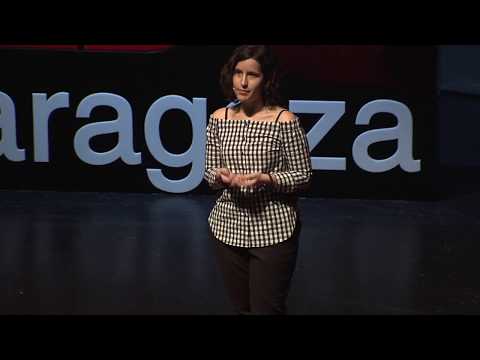
(Applause)
I’m Elena and I’m lucky that I like my job.
There are two things that I especially like:
that you never stop learning and that you can not dedicate yourself to a single subject.
I work in research.
And today I would like to tell you how you have to reinvent yourself day by day in this work.
Increasingly, workers have to be experts in more than
a discipline to be able to exercise its work.
Thing that contrasts with that we live in a highly specialized society.
It is very difficult to find experts in more than one area.
Therefore, many times people from different disciplines come together
in work teams to be able to solve situations and problems
from their different points of view.
This is the interdisciplinarity that currently dominates science.
Before starting, I would like to introduce you to the cause of my being here.
It’s called Plasmodium Falciparum and half of my work consists of
in keeping him warm and feeding him every two days.
(Laughter)
It lives inside the red blood cells and only comes out when
He has grown enough and has to go feed on the next red blood cell.
Actually, he is the bad guy in the movie.
When it infects a person it causes cycles of fever,
vomiting, diarrhea, anemia … And if not treated in time it can be deadly.
It is the parasite that Malaria produces. And it is especially dangerous
for children and pregnant women.
90% of cases occur in Africa and 7% in Southeast Asia.
In most developed countries it was eliminated in the 1950s,
after intense campaigns in which the environment was sprayed with insecticides,
to eliminate the transmitter of the disease,
mosquitoes of the genus Anopheles.
WHO gives such importance to Malaria, which has been marked to reduce
the number of deaths and their incidence by 90% by the year 2030.
There is a very important detail about this disease.
And although it is very contagious, it has treatment.
People would not have to die if treated timely and correctly.
We still have a long way to go to eradicate it.
Especially, considering that some parasites know how to survive
to the treatments that we use. They are resistant.
Therefore, we are continuously looking for new ways to treat them.
If we focus on a linear investigation, in which we do not leave our
field, we would focus on studying how it feeds and how it reproduces
the parasite, to look for new drugs that affect him.
The problem is that they do not apply fast enough
in areas where there is Malaria.
And it gives the parasite the opportunity to adapt and become resistant to them.
Ideally, have a vaccine.
It would make the defenses of our body identify and fight the parasite.
The fact is that this organization is an expert in hiding from
our immune system.
That’s why a vaccine has not been found effective enough.
New vaccines are effective with volunteers who have never been
in contact with the parasite.
When applied in endemic countries their effectiveness is reduced to 30 or 40%.
Faced with these difficulties that have to develop new strategies
to fight the parasite, we have to be more creative
and find new sources of inspiration. How do we try?
There are research groups that are inspired by explored strategies
for other diseases, such as for cancer.
This is important because it forces us to be curious about what
It is being done in other fields. Do not just focus on knowing how it is
our parasite, but we also have to have an open mind
and curious about what other scientists are doing.
For example, they are beginning to investigate targeted therapies,
Ways to transport the drug directly to parasitized cells.
In this way, there the dose will be higher, but not in the rest of the body,
making it more effective with many fewer side effects.
Nor should we forget the efforts that are being made to
Avoid the bite of the mosquito that transmits the disease.
Currently, mosquito nets are distributed around the beds,
and the walls of houses are sprayed with insecticides.
The fact is that mosquitoes are adapting to these conditions.
And now instead of biting into houses at night, they sting at sunset
or at dawn and abroad.
If the mosquitoes evolve due to the pressure we exert on them,
We will have to devise new strategies to put up barriers.
I would not think of myself, since I work in the laboratory
with the parasite in its infection phase in humans.
I need to collaborate with experts who study insects in their environment,
that they understand how they live and when they feed,
in order to invent together more and more effective barriers.
This illustrates something very important in the investigation.
Almost never work on completely new ideas.
Most of it is … Sorry.
From this we can learn many things about agriculture
and their pest control strategies.
Feeders to catch insects, new insecticides and strategies based
in entomology and the study of insects.
For example, it is proposed to infect mosquitoes with fungi or bacteria
that only colonize this type of insects.
And they would prevent the growth of plasmodium inside mosquitoes.
Another idea is to release into the environment sterile male mosquitoes reared in the laboratory.
The females only mate once or twice in their short life.
If they did it with sterile mosquitoes, the number of mosquitoes
in the next generation it would be greatly reduced.
All these ideas illustrate this important research thing,
which is that you never work on completely new ideas.
Most are based on ideas that have arisen for other research
or in long investigations about the elements with which we work.
It’s wonderful because reading about the work that other people have done,
I can think of other applications for my own research.
Above all, it helps us to be a little more modest,
because we always support each other, one way or another,
in the work that others have done before us.
And to be more radical with examples of collaboration between disciplines,
we can think of the great help that would be a person with knowledge of physics,
that will help us to make hypotheses about how it is distributed
the drug and the parasite in the blood, if fluid dynamics are known.
Or, for example, meteorology, since insects reproduce more
in the rainy season.
By collaborating with these people we can foresee those moments
to apply barriers more intensively.
In this line, we could also collaborate with experts in climate change,
which in itself is an interdisciplinary area.
In the Delta del Ebro we have mosquitoes of the genus Anophenes,
that currently do not transmit the disease, but
What if they were in contact with the parasite?
Mosquitoes do not understand borders and their habitats could change
if the conditions change.
Conditions such as temperature, which is changing these years
due to global warming.
Anticipating how these changes will be can help us a lot to prevent
more spread of the disease.
You have to think that a mosquito and an infected person are enough
so you can start spreading. And that 10 thousand travelers
from all over the world they return to their countries of origin infected with Malaria.
The sooner we get ahead of changes, the more we can prevent the spread.
Until now I have only given examples with Malaria because it is my field of study,
but any other discipline, from aerospace engineering to economics,
You need this kind of collaborations.
Dating with carbon-14 is a very useful tool
to investigate ancient cultures.
It is based on the research on radioactivity of physicists,
but now historians are experts in this technique,
since they apply it to the historical remains they study.
In interdisciplinarity, interdisciplinarity is also important.
The future quantum computers will be based on nanotechnology,
discipline that combines physics, chemistry and even biology
to make memory units the size of molecules or atoms,
increasingly thin and structurally refined cables
and supports for these smaller than we can imagine.
In a world with increasing specialization,
in which each time the fields are more concrete,
this kind of collaboration is important to be able to continue advancing.
In the end, we are dependent on each other.
Therefore, I would like to encourage you, whether you are scientists or not,
to look for this kind of collaboration, to compose work teams
with people of different discipline or to be open to new proposals
with groups of different specialty.
Because in the end, these collaborations are important for everyone’s future.
Thank you. (Applause)
”
Be First to Comment